
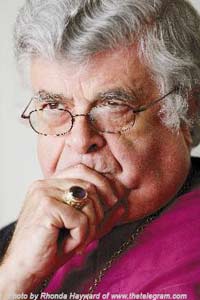
The Anglican Church of Canada is in “full-blown schism,” said Michael Ingham, controversial Bishop of New Westminster, to the Anglican Journal this week.
Ingham was responding to the November 15 resignation of Donald Harvey, retired Bishop of Eastern Newfoundland and Labrador, from the Anglican Church of Canada (ACC). Harvey has been accepted as a bishop with the Southern Cone province of the worldwide Anglican communion, which covers much of South America.
Harvey has been serving as moderator of the Anglican Network in Canada (ANiC), a theologically conservative movement within the ACC, since he retired as bishop three years ago. ANiC has been critical of “liberal” trends in the ACC, including the blessing of same-sex unions.
The ANiC is holding a conference November 22 – 23 at the Crossroads Conference Centre in Burlington, Ontario, where it will consider a proposal to “provide a place for Anglicans who find themselves unable to stay in the Anglican Church of Canada but want to stay connected to the Anglican communion.”
Although Harvey refused to be specific, the proposal would apparently set up some kind of alternative, theologically conservative Canadian Anglican church under the authority of Harvey as a bishop of the Southern Cone Anglican province.
The Council of the General Synod of the Anglican Church of Canada, meeting in Mississauga, Ontario November 16 – 18, issued a statement saying that Bishop Harvey’s resignation was “a source of sadness.” The statement also said that the plans of the Southern Cone province to “intervene” in Canada are illegitimate, “inappropriate and unwelcome,” “not a valid expression of Anglicanism and . . . in contravention of the ancient and continuing traditions of the Church.”
Fred Hiltz, newly elected moderator of the ACC, told the Council that, having transferred to another Anglican province, Harvey no longer has authority to minister in Canada.
While not using the word “schism” as Ingham did, Hiltz conceded, “What we have here is a break. We have pain, and we have sorrow.”
Roots
The roots of the schism go back to 2002, when the Diocese of New Westminster approved the blessing of same-sex unions.
The clergy and many parishioners at some parishes left the diocese in protest, and formed the Anglican Coalition in Canada (ACiC) in 2004 under the authority of the Archbishop of Rwanda. There are now 12 churches in this group, spread across Canada.
Others unhappy with the decision formed the Anglican Network in Canada in 2005 and chose to stay in the ACC and fight for change. It is this group that is now thinking of leaving as well.
Harvey told CC.com that when the ACC’s General Synod passed a resolution last June that the blessing of same-sex unions is not in conflict with the core doctrine of the ACC, “I knew the game was over as far as reforming the ACC is concerned.”
While many Anglicans may hang on for another three years to see what the next General Synod does, “I’ve given up,” said Harvey. He said it was important to act now to minister to those who are already “completely disaffected” with the ACC.
The General Synod that took place in June turned down a resolution that would allow individual dioceses to bless same-sex unions. However, since October, three dioceses — Ottawa, Montreal and Niagara — have passed resolutions approving such blessings, although only the Bishop of Niagara has agreed to implement the decision.
Harvey said the November ANiC conference was planned three months ago, after General Synod, and not as a result of the dioceses’ recent actions. However, he noted that recent registrations from parishes in these dioceses have pushed expected attendance at the conference above 200.
Among other things, the conference will discuss the legal and financial implications of leaving the ACC. Because most church buildings and other financial assets are held in the name of a diocese, the parishes in the ACiC had to leave their buildings behind when they left the ACC. The same may be true of parishes in the ANiC which choose to leave. However, Harvey said it might be possible to negotiate some division of assets with the ACC, or the ACC might be willing to sell a building to a departing parish at a reasonable price.
The ACC has been experiencing financial difficulties in recent years. The 2008 national church budget is predicting a $1.3 million deficit on expenditures of $10.2 million, although the deficit will be covered by an expected $4 million bequest. Some disaffected parishes have stopped contributing to the denomination.
Because of the financial considerations and because of varied local decision-making processes, Harvey said it is likely that churches may leave the Anglican Church of Canada one at a time rather than as a group.
“We are not going to be recruiting,” said Harvey, who added the ANiC is merely fulfilling a promise to offer a solution.
Those parishes which choose to accept the ANiC proposal will not become part of any new structure until next spring, when an international gathering of conservative-minded Anglicans will take place in the Vancouver area.
A question of church unity
Bishop Ingham said the ACC can tolerate a wide variety of theological opinions but it cannot tolerate schism, the setting up an alternative church.
However, Ed Hird, a leader in the ACiC, told CC.com that those leaving the ACC are still very committed to remaining in the worldwide Anglican communion, particularly with those provinces in the “global south who still believe what Anglicans have always believed.”
He noted that the majority of the primates — the archbishops who lead the 34 Anglican provinces around the world — may refuse to attend the next worldwide gathering unless the Anglican Church of Canada and the Episcopal Church in the USA repent of their approval of homosexuality. In that case, the Canadian dissidents would be still in communion with the majority of Anglicans worldwide even if they are out of step with the ACC.
The main issue is not homosexuality but “the authority of Scripture and the lordship of Jesus Christ,” said Hird, who placed the blame for the schism on the church leaders who chose to change Anglican doctrine. “Heresy and immorality always break church unity,” he said.
While he is passionate about Christian unity, Hird said that unity should encompass unity with Christians of other denominations on the basis of orthodox Christian theology. “The world is bigger than the Anglican Church,” he said.
With the ANiC apparently coming under the jurisdiction of the Southern Cone, the ACiC under the jurisdiction of Rwanda, and other dissident Anglican groups in North America under the jurisdiction of Nigeria, Uganda and West Africa, there is considerable confusion.
“We are all quite concerned with the fragmentation,” said Harvey.
The ACiC and the ANiC and eight other groups have joined together in the Common Cause Partnership, which met in Pittsburgh at the end of September and agreed to work toward some sort of joint organization.
Harvey said the current fragmentation is a transitional thing and he is “very, very hopeful” that a unified conservative Anglican organization may be formed in North America.
Hird said he is equally supportive of conservative Anglican unity — he noted that the groups often meet together — although he is “not interested in creating more bureaucracy.”
However, he agreed that the current situation is temporary. “The Titanic has hit the iceberg. It’s sinking. A number of lifeboats have been launched, and they don’t all leave at the same time,” he said, adding that the ACiC affirms the ANiC’s decision to leave the ACC at this time. “We’re praying for them.”
Related stories:
A seismic shift in the way Canadian Anglicans are treating same-sex blessings has made its way to the Diocese of Niagara. In a historic weekend vote, Anglicans in the diocese moved overwhelmingly to adopt the so-called local option, allowing clergy “whose conscience permits” to bless the marriages of gays and lesbians. The Right Rev. Ralph Spence said he will allow same-sex blessings in the Niagara diocese, which includes Hamilton, Burlington and Guelph as well as the Niagara Region, once a protocol has been worked out… The Niagara vote followed news that the head of a conservative Anglican movement has broken all ties with the Canadian church to affiliate with the more orthodox Province of the Southern Cone, the Anglican church for much of South America.
Toronto Star, November 18
Bishop gives Anglicans new option
A retired bishop has defected from the Anglican Church of Canada over the issue of same-sex blessings and said he expects others will soon make the same decision, raising the spectre of a schism forming in the national Church.
National Post, November 19
‘Full-blown schism’ in church, Anglican bishop says
Diocesan turf-poaching is the biggest bureaucratic sin in the decentralized Anglican Communion, the world’s third largest Christian church. Authorizing same-sex blessings may represent a theological difference of opinion, but one bishop taking his episcopal authority into another bishop’s diocese is clearly a schismatic act. Bishop Ingham also warned 10 priests in his diocese who are pastors of conservative parishes that he will discipline them if they take part in the ordinations planned by retired bishop Don Harvey.
Globe and Mail, November 21