|
One recent memorable headline read: ‘Epidemic of
violence.’ It was one response to the wave of killings which swept
across Metro Vancouver last month, leaving fear and confusion in its wake.
BCCN asked James Lee,
director of Vancouver Urban Ministries (VUM), to give perspective on some
of the factors which breed gangster culture.
THE East Vancouver neighbourhood around East Hastings
Street and Commercial Drive is one of the poorest and most troubled
districts across Canada.
In this area, there are a number of social housing
apartments where some 500 First Nations families reside.
Poverty, drug and sexual abuse, teenage pregnancy and
alcoholism are rampant; such activity is normal to many families and youths
in the area.
Above all, youth gang activities and violence are
clearly present in the neighbourhood.
Family violence
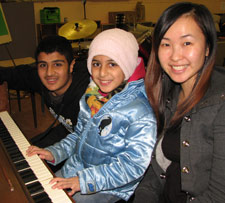 | | Vancouver Urban Ministries employs creativity to inspire kids to choose paths other than lawlessness and violence. VUM youth music school director Esther Kong is pictured here with her students, Noor and Muhammad. |
Serious family violence often results from
alcohol abuse. More than 50 percent of First Nations homes are led by
struggling single mothers with kids, and these homes are very vulnerable to
family violence.
When some of the mothers get drunk, they become
physically aggressive; they neglect parental responsibilities, and
don’t attend to even the basic needs of their children. Kids become
agitated, then angry and aggressive. It is a breeding ground for
violence.
Once, a 14 year boy showed up for one of our youth
events, and he looked really banged up.
He said he just fell down; but it turned out that he
actually got beaten up by his drunken mom, and was too embarrassed to admit
what really happened.
In this neighbourhood, there are a dozen youth gangs
active, with names like IP (Indian Posse) and EVS (East Vancouver
Soldiers).
Actively recruiting
Some of these groups are just street gangs, and some
are serious crime organizations.
These gangs actively recruit new members from the
neighbourhood, and have three requirements for new members:
• Commit a significant crime
• Go through a rite of passage, which involves
getting badly beaten up by existing gang members.
• Sell drugs.
These gangs use violence and fear to gain
‘respect’ and territory from other gangs.
A while ago, there was a gang fight in a local park,
and one youth’s arm was hacked off by a machete swung by a rival gang
member.
Stabbing often happens, and occasionally some youth use
guns to show rival gangs how tough they are.
Recently, a guy got shot in his leg in one of the local
apartment buildings.
Police barricaded the entire block, and searched for
suspects and guns all night. Many families who resided in the
building could not get a good night’s sleep because of this
incident.
Drinking & drugging
Retaliation is a big issue.
Fighting often happens when youth are drinking and
drugging.
They get drunk and get into a fight with someone over
trivial matters. The initial fight might stop soon, but it becomes an
ongoing conflict when retaliation kicks in.
Last year, the plight of a 15 year old named Austin
caused serious problems for his family.
Austin had been chased by local teenagers looking for
revenge; they kept coming to his apartment and attacking him physically.
His older brother was also attacked; his back was
seriously injured by a machete.
The repeated intrusions by these vengeful youths
disturbed some tenants, and Austin’s family got an eviction notice.
Austin stopped going to school, because he knew he
would confronted by rivals in the classrooms – and it would be
too risky to face them again.
The result was that he dropped out of school. While
this was partly due to a lack of good parenting, retaliation also took a
serious toll on him.
Cycle of retaliation
Retaliation by organized youth gangs is much more
vicious and destructive.
To gain respect and turf, they will get into a cycle of
retaliation to eradicate a rival gang if they are in serious conflict.
One of local youths explains: “They will fight
until the whole rival gang is down.” This can precipitate
severe violence, such as loss of limbs or gunshot wounds.
Continue article >>
|
Even if they arrest some suspects, the police often
have difficulties in finding out who did what, because of the ‘code
of silence’ among the gang members or their friends,
This kind of gang violence causes self-destruction, and
hopelessness without the end. Many addicted and drinking parents and youth
are already in a life of hopelessness in this impoverished neighbourhood.
This violence significantly adds to the misery and brokenness to these
lives.
George is a struggling young man whom I have been
working with for the past several years. He was born into a life of gang
and crime. Once, George said to me: “All of the males, of my family
members and relatives, have criminal records.”
He was a very troubled kid; but he met a Christian
teacher when he was in grade 5, and he became a Christian. However, he
backslid into in a life of crime and gang warfare, mainly because that was
all he had in life.
There were not many alternatives for him; he was
constantly around family members and friends who were engaged in criminal
activity.
A couple of years ago, he got in serious trouble with
the law. I was in touch with him regularly by phone, and supported him.
A different path
Somehow, God slowly worked things out for him, and
George realized he had to take a different path in life.
He started to work with the police, and provided them
with valuable inside evidence of gang activities; now, the police really
favour him.
Before, George was bitter about the treatment he got
from the cops, since they treated him like a ‘criminal.’
The cops were the worst enemy to him. Now, George sees the cops
differently; they are friends who do public good.
His faith in Jesus has also been deepened, through all
the difficult times he has gone through.
What can Christians do, to help young people who are
embroiled in gang activities?
George has one key answer. “Prayers are the
foundation, and then we should show these trapped lives genuine support and
love, as described in 1 Corinthians 13.”
George says gang life starts when a child does not have
parental support and love. They often have no one who prays for them.
When a child feels there is no one to trust, and then
is looking for love from somewhere else, they often find it within the
wrong crowd – a gang, who provide what George calls
“blinded support and love.”
Gang members may say: “We support and love each
other.” But this is not genuine love. George concludes:
“We Christians have real love and support.”
Christians can really help these troubled young people,
and make a difference in their lives, because we have a genuine love to
offer.
If we reach out to them with authentic love, there is a
chance they will turn their lives around.
More safe places
Another practical idea, suggested by a community
parent, is to establish more safe places for inner city youths to go.
Kids in East Vancouver often do not have a safe and
caring place to go, especially on weekends and holidays. If they do not
find positive alternatives, they will get into troubles.
Vancouver Urban Ministries has been looking for a youth
drop-in place in the neighbourhood; we are one example of a faith-based
approach to problem of youth gangs.
We seek to enable underprivileged youth reach their
full potential by demonstrating and sharing the love of Christ. We run a
variety of ministries in the Grandview-Woodlands area of East Vancouver.
Presently, VUM is running a youth music school, and is
planning to set up an after-school program in partnership with a local
inner city school.
We also partner with local churches, like West Coast
Christian Fellowship, to reach out to underprivileged families.
Contact: myvum.ca.
March 2009
|