
By Peter T. Chattaway
LIVING ON the margins of society can be a curse, but it can also be a blessing.
The Downtown Eastside, which has the distinction of being the poorest urban area in all of Canada, has been the traditional site of the March For Jesus since it began five years ago, partly due to the lack of traffic in the area and the accompanying convenience with which marching Christians could pass through the neighborhood.
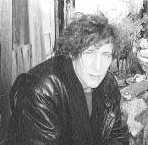 Bud Osborn |
But the route has not always been free of friction. At last year's march, the Christian group Friends of the Downtown Eastside distributed leaflets that described the event as "insensitive to the nature of [the Downtown Eastside's] pain and needs."
"The March for Jesus was bringing a triumphal Christ, when the Downtown Eastside was in its passion, really," said Bud Osborn, a poet and a member of the board of the Downtown Eastside Residents Association.
This year's March For Jesus (May 31), on the other hand, saw some important first steps towards reconciliation, as members of both groups seized the opportunity to publicly pray together for a renewed sensitivity to the plight of the Downtown Eastside's poor.
And, thanks to recent meetings between the March's organizing committee and the Friends of the Downtown Eastside, some pastors are taking a more active role in helping the residents of the Downtown Eastside to solve their community's most immediate problems. It is their hope that the Christian community, once resented as an indifferent intrusion from outside, may prove to be the Downtown Eastside's strongest advocate.

Gordie Lagore |
The "bridge-building" began at a meeting before the March, when David Carson, pastor of Westcoast Christian Fellowship and chair of the committee overseeing the March For Jesus, apologized to the Friends of the Downtown Eastside for any insensitivity the March may have displayed to the Downtown Eastside in the past.
Carson then wrote an open letter on behalf of the March for Jesus to agencies in the community, acknowledging "the presence of Jesus within the struggles of the economically poor and physically afflicted residents of the Downtown Eastside, who are currently attempting to save their community from the displacement and homelessness." He also asked the residents for forgiveness "for any harm, offence or insensitivity experienced from Christians in the past."
That letter was printed in the Carnegie Newsletter (from the Carnegie Centre at the corner of Main and Hastings), but an editor attached a note to it, asking, "Saying you're sorry before you do it -- does this make it okay? Or does one person have the authority to ask for blanket forgiveness for any and all 'harm, offence or insensitivity' ever perpetrated by anyone in the name of Jesus?"
Osborn wrote a follow-up article in response, commending the pastors' committee for their willingness to dialogue: "This letter was not at all meant to make up for all harm caused by all Christians elsewhere or here, nor was it intended to make anything 'okay,' but this letter, in my opinion, is a very significant first step towards a real healing between Christians and the Downtown Eastside. There is certainly a long way to go, but I have always been about building bridges of understanding and support."
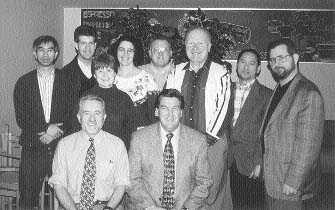
The March For Jesus coordinating committee represents a wide range of churches. Among the organizers are, seated (from left): Dave Carson (West Coast Christian Fellowship, Vancouver), Dan Cook (Westside Pentecostal, Abbotsford), standing: Gideon Chu (Church of Zion, Vancouver), John Jenkinson (Calvary Christian Church, Surrey), Cardee Duttchen (Concordia/Mount Calvary Lutheran, New Westminster), Holly Roddam (St. David’s Anglican, Delta), John Wiens (Willingdon, Burnaby), George Johnson (Fraserview Pentecostal, Vancouver), Allan Lee (Amazing Grace Mandarin, New Westminster) and Rainer Mittelstaedt (International Christian Centre, Vancouver).
The March For Jesus coordinating committee represents a wide range of churches. Among the organizers are, seated (from left): Dave Carson (West Coast Christian Fellowship, Vancouver), Dan Cook (Westside Pentecostal, Abbotsford), standing: Gideon Chu (Church of Zion, Vancouver), John Jenkinson (Calvary Christian Church, Surrey), Cardee Duttchen (Concordia/Mount Calvary Lutheran, New Westminster), Holly Roddam (St. David’s Anglican, Delta), John Wiens (Willingdon, Burnaby), George Johnson (Fraserview Pentecostal, Vancouver), Allan Lee (Amazing Grace Mandarin, New Westminster) and Rainer Mittelstaedt (International Christian Centre, Vancouver).
Osborn, who attends Holy Rosary Cathedral, told Christian Info News that the efforts of the March For Jesus committee to make amends left him "stunned" and "astonished."
"This is so rare, in my experience, for a group of serious and responsible and intelligent people to say publicly, 'We were wrong, we didn't see, we repent.' It's al-most unheard of."
He said he was also impressed by the speech given at the March by Gordie Lagore, a pastor at Vancouver Eastside Vineyard.
"I think the speech was a really prophetic and powerful thing," he said. "I hope to condense it and have it printed in the Carnegie Newsletter as well."
For his part, Lagore said his speech was inspired by a mixture of good scripture and bad weather.
Tears of God
"When we crossed into the Downtown Eastside, it began to rain," Lagore said, "and I kind of had a sense that God was saying, 'I am raining on your parade.' The rain represented the tears of God for the pain of the Downtown Eastside. So I called the March to repent, not so much because there was deliberate wrongdoing in the past, but just because it's so easy to come down, do our March, throw our balloons and sing our songs, and do it in the face of some of the greatest suffering in our nation.
"I basically shared from Amos, where he said, 'Away with your songs, let justice roll.' I don't think God's against our songs, but if it's just songs without accompanying solid action on behalf of the poor, then I think that's when it becomes noise to his ears, rather than a pleasant sound."
Woodward's a symbol
Representatives from both groups have met to brainstorm possible ways to channel their efforts into such action, and much of their attention has focused on the former Woodward's building. Fama Holdings, the company which owns the building, recently scrapped plans to evenly divide the building between co-op housing and market-priced units, announcing instead that all 400 condominiums would be sold at the market price.
If that happens, according to David Ley, a professor of urban geography at UBC, the result would be "a major reshaping of Hastings Street" and the imminent demise of the community that exists there.
"The whole area would essentially be on a life-support system, and its long-term future would be severely challenged."
"The whole area would essentially be on a life-support system, and its long-term future would be severely challenged."
Ley said the Woodward's building represents a "last stand" for the "community of the poor" there. "Warts and all, there is a community there, including churches and public agencies and self-help organizations, so people feel they have a community to defend," he said.
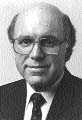 Robert Smith |
"The Downtown Eastside is the last reserve of affordable housing for the poorest people in the region," Ley said. "Historically, there has been a large stock of that housing, but it's been declining as hotels have been closed down or renovating themselves into tourist hotels. The housing continues to erode, but there is no replacement housing. At the same time, there is tremendous investment in property all around that district, and it creates a kind of siege mentality. And that mentality is well-placed, because it creates a kind of pincer movement around the place.
"The Woodward's building crystallizes all these tensions. It's a symbol of the district."
Robert Smith, pastor at the First United Church on Hastings Street and a former moderator of his denomination, agreed that the Woodward's situation is "critical." "If Woodward's goes, the neighborhood goes," he said.
Robert Smith, pastor at the First United Church on Hastings Street and a former moderator of his denomination, agreed that the Woodward's situation is "critical." "If Woodward's goes, the neighborhood goes," he said.
"It's the linchpin of the social housing in the Downtown Eastside."
Tracy Tobin, a member of the Friends of the Downtown Eastside, said the Woodward's building marks the border between the Downtown Eastside and the neighboring communities. "It's holding back the gentrification," she said.
But she also pointed to the closure of the Pender Detox Centre and the subtle changes in retail outlets, which have begun to target wealthier clients, as evidence that the displacement of the community's poor is already under way. "They're just taking things away piece by piece down here, but people don't notice it because it's not all done at once. The only thing that keeps people going is their sense of neighborhood."
Prayer and fasting
The Friends of the Downtown Eastside are thus calling on clergy and lay members alike to participate in a vigil June 30 at the Woodward's building. The vigil will begin at five o'clock in the afternoon and continue, with prayer and fasting, for 24 hours.
Jen Ziemann said the vigil was inspired by "the true fast" spoken of in Isaiah 58.
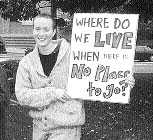 Tracey Tobin |
"I think it's just taking responsibility and being a visible presence," she said. "As a church, we seem to have been afraid of politics, and we've adopted a more personalized faith. We've forgotten the orthodox view, which is that we are part of a community, and that includes the poor. Their suffering should be our suffering, so we want the church to take this time to be a visible presence, and not just stand for them, but with them."
Lagore said he and his wife Kathleen would be taking part in the overnight vigil.
"I don't think it stops there," he said, "but it's certainly a starting point. I think we need to advocate on behalf of the poor, and that means, certainly, an outcry from the body of Christ against any injustice, where people are losing social housing and being forced into the streets.
"They're not only poor, but they're going to be scattered. We need to raise awareness, but we also have to come up with creative alternatives."
No strings attached
Those alternatives, however, will still require some careful negotiation. Christians will need to continue to be sensitive to the concerns -- and, perhaps, the suspicions -- of the local community, Osborn said, otherwise "there could be a real serious concern that Christians are trying to impose something."
Smith echoed Osborn's concern, and said the more affluent churches should follow the "El Escorial principles" established by European churches.
There, he said, the more affluent churches agreed that, when they donated money and resources to more needy congregations, they would relinquish control of those resources and allow the recipients to determine what use to put them to, with no strings attached.
"This community, if it had support, could solve its own problems," said Smith. "But it doesn't have support. Please understand, I'm not a poor person, I'm an affluent person who has spent a small portion of my life working in the Downtown Eastside, but if I were taking on the voice of the poor people, they would say, 'Don't come down here to help us with our problems. We can solve our own problems, if you will use your political power to give us the tools that we need.'"
Marching on
Carson points out that the March for Jesus is looking to spread out in future years, with marches happening not just in Vancouver but in other locations in the Lower Mainland as well, including Surrey and Abbotsford.
This could, conceivably, enable those taking part in the Vancouver March to focus more directly on such local issues, although, Carson notes, "It wouldn't change the objective [of the march]. But it might change the context."
Osborn saw an even more dynamic possibility coming out of the improved relations between March organizers and the Downtown Eastside. "I think this could be a real revitalizing of what it means to bear witness, as Christians. Instead of coming out periodically to hand out soup or sandwiches, they could come out in another dimension, in a prophetic way."
Osborn said he has no regrets with regards to last year's controversy.
"For Christians, I really don't think uniformity or this image of solidarity is an authentic Christian posture. Struggle and conflict are not antagonistic to the message of the gospel, or to the way Christ lived as revealed through the gospels. I think it is through conflict that actions can emerge.
"Understanding where each other is coming from is really important, and it is expressing these things that has contributed to the bridging."