
By Lloyd Mackey
"God has given the people the land. God is a God of justice. He wants to bless the First Nations, not only with the land and resources, but with the knowledge of who he is. God is able to heal the nations."
- Steve Jakesta, Kaska-Dena negotiator
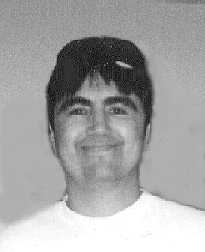
Steve Jakesta
A NUMBER of committed Christians, many of them aboriginal, are currently playing significant roles in First Nations matters in British Columbia.
Those roles emerge in various sectors of the extensive network of negotiations currently underway in the province. But, additionally, there appears to be substantial input from Christians in the economic development area. To many First Nations leaders, economic wellbeing for their people is as important in the short run as is the negotiation process, in the longer term.
The presence of Christian input in these processes is not well known in non-native communities. As a result, some non-native Christians assume that B.C. aboriginals want to turn the tables on the non-native descendants of those who crushed them in the 19th and early 20th centuries.
Christians involved with First Nations groups in treaty negotiations or economic development would like to allay those fears. And they want their non-native brothers and sisters to know that their concern for aboriginal justice grows out of the Christian faith, not from some secular or pagan vision.
Kaska-Dena
Consider the thoughts of Steve Jakesta of Lower Post, a village in northern B.C., just a few miles from the Yukon border.
Jakesta is vice chair of lands and resources negotiations for the Kaska-Dena Council, the ruling body of a First Nations community which claims traditional territory covering 10 per cent of the province. He is quick to point out that, while this is one of the largest land claims in B.C., it does not involve any major third party communities. (Other claims, smaller but closer to major urban centres, have the potential for generating relatively more controversy because of tension over such things as the true meaning of ownership and compensation.)
Asked to synthesize the theology that shapes his negotiating stance, he says: "God has given the people the land. God is a God of justice. He wants to bless the First Nations, not only with the land and resources, but with the knowledge of who he is. God is able to heal the nations."
And how did he come to that place?
Jakesta's life has been shaped by a number of Christians: a family with which he stayed in Watson Lake for 12 years, a sister who took him to a Terry Winter meeting in Whitehorse in 1982 and the entry of the Vineyard movement into his Lower Post community in the early 1990s.
At each juncture, he made a Christian commitment, then was drawn away by the influences of alcohol and other "hounds of hell."
It was the Vineyard movement that resulted in the restoration of his marriage and gave him the confidence to learn the negotiation process which led to his present job.
And he comments intriguingly on the way the Vineyard and other newer evangelical movements have learned from the mistakes of Christians who repressed natives in earlier eras.
A product of a denominational residential school system, which he says repressed him to the point of not knowing how to talk to other people, he says his view of the gospel, today, is much more liberating.
Non-native Christians forced aboriginals to have nothing to do with their native culture, and that was a mistake, he says. The Vineyard, with its free-flowing emphasis on the movement of God's spirit, he suggests, provides a healing framework.
Jakesta's spiritual odyssey is illustrative of some of the tension showing in other aboriginal issues.
Jakesta's spiritual odyssey is illustrative of some of the tension showing in other aboriginal issues.
B.C. Treaty Commission
In B.C., much of that tension is being brokered through the B.C. Treaty Commission. That body was set up in the early 1990s to tackle the fact that this province, unlike others, declined to make treaties with aboriginal groups in the early years of confederation.
Paul Kariya, the commission executive director (and himself a non-native) is one example of a Christian who finds himself in a servant role in the treaty process.
A worship leader at Fort Langley Evangelical Free Church, Kariya points out that the need for a treaty initiative came from Bill Vander Zalm, just before he left the B.C. premiership, and was formalized by Mike Harcourt.
Under the commission, he says, some 50 aboriginal groups are in various stages of developing treaties with the other principals -- the governments of B.C. and Canada. Of that number, 27 are at Stage Four, the level at which Jakesta's nation is working.
Stage Four is where the negotiations actually begin, after a framework "agreement in principle" has been established. (More details on the whole process are available on the BCTC web page: www.bctreaty.net .)
Stop 'cheap shots'
Victoria lawyer Wally Braul, a non-native Mennonite who currently worships in an Anglican church, says there is substantial "diversity" in native communities over economic and justice issues.
The co-chair of the Mennonite Central Committee/Aboriginal Rights Coalition (MCC/ARC) in Victoria, Braul says one key to progress on such issues is to see native people and nations as neighbors, in need of fairness and compassion. (The ARC is a transdenominational group working "in solidarity with First Nations." The Mennonite Central Committee's role -- intended or otherwise -- helps bridge the thinking of Christians in mainstream and evangelical denominations who are interested in native issues.)
From Braul's perspective, people like open line show host Rafe Mair, who refer to the "Indian industry" growing up around the treaty process, are taking "cheap shots."
"There has to be a forum," he insists -- a place where the process can be humanized and debureaucratized.
Economic issues
Mike McDonald agrees. A lawyer and member of the Pegius nation in Manitoba, McDonald has a Cree-Scot background, is a Trinity Western University graduate, serves on the board of World Vision Canada and worships at Sutherland Bible Chapel in North Vancouver.
He sees the treaty process as long term and suggests that many of the younger aboriginals involved in it are on a valuable learning curve.
Meanwhile, it is important to help bands concentrate on economic issues, because it is within that context that short term solutions come. And, in the longer term, aboriginal autonomy, whatever form it takes, will come more easily.
Mark Podlasly, another Trinity Western graduate -- and a member of **** Nation in north central B.C., is information officer for the Federal Treaty Office which, as the name implies, handles negotiations between First Nations groups and federal agencies.
Like many aboriginals who get into the process, Podlasly gained some of his initial experience in the corporate sector, having spent two years with Westcoast Energy as a communications officer.
Nisga a model?
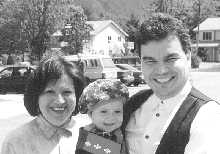
Patrick and Roberta Stewart
Patrick and Roberta Stewart, also members of Sutherland Bible Chapel, know something about that dichotomy. They are Nisga'as and, as grass roots members of the nation, have participated in group meetings about the well-publicized agreement-in-principle reached a year ago.
That agreement is seen as both a landmark and a possible model to other aboriginal nations. But it stirs up controversy, too, because some non-native leaders see it as being too much in favor of the Nisga'as. Conversely, many Nisga'as see it as too little too late.
The Stewarts look forward to the continuing discussion. They expect, in due course, that all 6,000 Nisga'as will have input into the final shape of the agreement. Close to 4,000 of those 6,000, like themselves, live away from the nation's traditional Nass Valley territory, north of Terrace.
But they maintain close association with both their own nation and other aboriginal groups, through their respective vocations. Roberta is a community development work and Patrick, an architect.
His work, in fact, is found in the design of cultural centres, band offices, community buildings and recreational centres in native villages throughout the province.
They do not get into conflicts with respect to native or Christian belief systems because they are not in the villages. But they hope that their particular perspective is helpful, lodged as it is, across urban non-native and rural native cultures.
In the design of buildings for villages, for example, Patrick believes it is important to get the input of the children of the communities, who, in other cultures, might be left out of the process.
Liberal MLA
In the course of her work, she may come across Paul Nettleton, a Liberal MLA who has just taken on the aboriginal economic development critic's role for the official opposition in Victoria.
Nettleton, whose constituency is Prince George/Omineca, attends Nechako Christian Fellowship, a Mennonite Brethren congregation in Vanderhoof. His aboriginal experience comes out of his practice in a Dene-run Prince George law firm.
When he is not in the legislative assembly in Victoria, he spends a fair amount of time in the Atlin area, working with native groups as they track activities relating to the reopening of a mine in the area. He enjoys working out joint venture arrangements which see that bands receive economic benefit from the exploiting of resources in their areas, while protecting those same lands from undue environmental impact.
Gathering for reconciliation
Nettleton sees Linda Prince, a chief in the Vanderhoof area who has been active in The Gathering, as pivotal to a number of aboriginal/Christian initiatives in B.C. The Gathering is an occasional charismatic event which draws together several thousand at a time for worship and teaching, in various B.C. locations. Aboriginal/caucasian reconciliation has been the sub-theme of two such events, with Prince playing a key role in enunciating those issues from an aboriginal viewpoint.