
B.C. Christian News, December 1997
Bishop Ingham: Christianity or the Primordial Tradition?
BC Christian News, · Arts
By Ron Dart
- Michael Ingham: Mansions of the Spirit: The Gospel in a Multi-Faith World, Anglican Book Centre, 1997.
The religions of the world are all faced with the daunting task of making sense of their truth claims in a multifaith environment. The appeal of Michael Ingham's Mansions of the Spirit is that he is keen to face the hard questions of the Christian ethos.
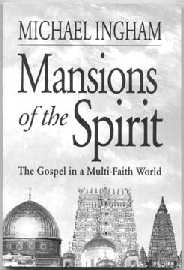
Ingham begins by describing our multifaith context. He then discusses the 'interfaith movement' that began with the Parliament of World's Religions in 1893 and was celebrated by 10,000 people during another such Parliament one century later.
Some sort of paradigm is clearly needed to make sense of the diverse truth claims and perspectives of the various faith communities. Mansions of the Spirit probes four models: inclusive, exclusive, pluralist and primordial.
Ingham prefers the 'Primordial Tradition'; most of the latter half of the book is a popular yet reflective apologia for this Tradition and why thoughtful Christians should doff their caps to it.
The Primordial Tradition has some attractions, but there is much that needs to be called into question; Mansions of the Spirit does not do this. I will point out seven areas of concern:
1. Ingham seems to assume that the 20th century 'is a new phenomenon' for Christians. Pluralism is nothing new. Christianity was birthed, and matured, in the Classical and Late Antique World; this culture was very pluralistic and syncretistic.
New Testament, Post-Apostolic and Patristic writers constantly tried to make sense of their faith in a world most similar to our own. Mansions of the Spirit suffers from chronological snobbery and historic myopia.
2. Ingham is quick to point out the limitations of the inclusivist, pluralist and exclusivist models (the latter he is inclined to caricature, and sometimes identifies with fundamentalist movements), while he tends to be weak on any far-reaching criticisms of the sophisticated syncretism of the Primordial Tradition. Surely one should be willing to turn the light of truth on the shadows of one's own pet theory.
3. Mansions of the Spirit, following the lead of the Primordial Tradition, argues that religions must be seen in two ways.
There is the exoteric world in which various Traditions (with their symbols, theology, art, music, institutions, etc.) are distinct and cannot be merged or unified. It is considered naïve to expect different religious Traditions, within time and history, to be one; this is the folly of the populist syncretism of Baha'i and New Age spirituality.
But, on the esoteric -- or mystical -- level, a universal core or unity can be found. The Primordial Tradition argues that the mystics, more than anyone else, have seen and experienced the unity that is at the core of many of the religions of the world. This mystical or esoteric tradition, then, points the way to a 'transcendent unity' within religious Traditions.
The problem with this approach is that there is little or no proof that mystics do, in fact, agree on what the Ultimate is like.
The stubborn reality of diversity amongst the great mystics and contemplatives of the world, so well tracked in Geoffrey Parrinder's Mysticism in the World's Religions, refutes the conclusions of the Primordial Tradition; pluralism and disagreement -- not unity and convergence -- dominate the transcendent landscape.
4. Ingham is quick to historicize, rationalize or jettison texts that do not fit his worldview, but this method can be applied both ways. If the words of Jesus are not really the words of Jesus when the exclusive tradition uses them, then perhaps the words of Jesus that are chosen to fit the Procrustean bed of the Primordial Tradition might not really be the historic words of Jesus either.
When we play Russian roulette with the text, the use of the text often does more to reflect our prejudices than the authentic sayings of Jesus.
5. The Primordial Tradition itself smacks of dogmatic exclusivism. Self-appointed mystical illuminati possess higher knowledge, whereas those in the lowlands of the exoteric have subordinate knowledge. Such an approach to the study of other religions tends to be patronizing, and does not honor profound differences on both the exoteric and esoteric levels.
6. Genuine interfaith dialogue begins when we recognize that there are real points of convergence between religions, but it is the points of discord and divergence that make them unique. We do not need to be all that tolerant if we agree, at the beginning, that all religions are saying much the same thing on the esoteric level.
7. In the end, Mansions of the Spirit reduces Jesus the Christ to an enlightened avatar or bodhisatva. Christianity, throughout its long and varied history, has dealt with the claims of Christ and the claims of other religions.
It is much more fruitful to allow all religions to speak from their unique Traditions rather than, in the name of tolerance, suggesting that when the sun sets on human history everyone, on the deepest level, will really be found to have been saying the same thing. True dialogue and tolerance begins when we differ with others on the most profound issues, yet remain charitable and willing to listen.
The Primordial Tradition which serves as the intellectual framework for Mansions of the Spirit is ancient, yet it has been renewed this century.
The Tradition, in its revived and more sophisticated form, was articulated by René Guenon, Ananda Coomaraswamy and Frithjof Schuon. Those who followed these luminaries, have kept the Tradition alive in 'Studies in Comparative Religion.'
The Primordial Tradition has been popularized by people like Huston Smith, Joseph Campbell, Jacob Needleman, Aldous Huxley and Kathleen Raine. With its notion of the 'transcendent unity' of most religions, it challenges both the uncritical popular syncretism of Baha'i and New Age, but also the obvious and persistent reality of diverse faith communities.
Ingham is to be lauded for his interest in 'grounded openness,' but the model he has chosen -- The Primordial Tradition -- is not the best way to foster authentic interfaith dialogue.
A middle way between syncretism and fundamentalism offers us the finest openings for those of different faith Traditions to meet and challenge one another with their respective visions of Truth, Goodness and Beauty.
Ron Dart teaches in the Department of Political Science/Comparative Religions at the University College of the Fraser Valley.