
• BC Christian News • APRIL ISSUE 1998 • VOL. 18 #4 • Formerly "Christian Info News" •
Christianity and art in the west - Part IV
Early Renaissance
- - - - - - - - - - - - - - - - - - - - - - - - - - - - - - - - - - - - - - - - - - - -
WHEN PEOPLE think about the fifteenth and sixteenth centuries they tend to think about major historical events such as the fall of Constantinople and the Turkish conquest of southeastern Europe. They may also consider the exploits of great Spanish, Portuguese and English explorers who sought to expand their respective empires. We must also include the deep spiritual crisis of the Reformation and the Counter Reformation.
It is against this dynamic background that two periods flow together, namely the eras of the late Middle Ages and the Early Renaissance.
Artistically, this means an examination of late Gothic painting found in the work of Flemish artists such as the Master of Flemalle and, in contrast, Early Renaissance sculpture and painting as seen in the work of the Florentine masters; Donatello and Botticelli.
Master of Flemalle
BC Christian News, · Arts
The neighbors of the Master of Flemalle, Robert Campin, had a different worldview from the one shared by his Italian contemporaries in Florence. Late Medieval culture did not think it belonged to an age distinct from that of classical culture. Medievals thought of the past as 'under the law' (Old Testament, 'BC') or 'under grace' (New Testament, 'AD').
Thus the Medieval mind did not view history from the perspective of human achievement, but rather from a heavenly point of view -- the intervening acts of God in human history.
Secondly, Robert Campin's patrons came from the developing middle class, from his own painters' guild or others, including the merchants guilds;. This background information helps the viewer understand the meaning of the symbols in Robert Campin's paintings, in particular, the 'MŽrode Altarpiece' 1425-30. In this oil on panel (wood) painting, the viewer observes the familiar scene of the Annunciation in which the archangel Gabriel announces to the Virgin Mary that the Holy Spirit will come upon her and she will conceive the son of God. The whole scene takes place inside a typical Flemish home.
What is critical is Campin's attention to the visual detail of every object in each of the three panels of the painting. His realism has a two-fold purpose. As a painter he is advertising the skilled training he received from his guild. Secondly, he reveals his own unique mind in the use of two symbols. The smouldering candle stick on the Virgin's table and the mousetrap on Joseph's workbench had never been seen before in Western art. Scholars feel that the candle represented God's physical presence; the fact that it has gone out means that God's power has gone elsewhere. If one looks at the clothes covering the Virgin's womb, one can see that they are radiant with light. Thus God has entered the world of human flesh. The mouse-trap on the right panel finds its meaning in the writings of St. Augustine. He believed that the cross of Christ was a trap that snared Satan.
The Master of Flemalle is telling the viewer that spiritual reality interfaces with physical reality. Objects in our human experience are worth painting because of the divine power that lies behind, and indeed supports, the physical world. The technical term for this integrative process is 'disguised symbolism.'
Rebirth in Florence
 |
South of the Alps, in Florence, Italy, there was great respect for the technical ability of the Flemish masters. At the same time the Florentines had a very different view of history. They believed that they were living in a new age that was superior to the previous period of the Middle Ages. This attitude came from the discovery of classical works of literature and art. The intellectuals and artists of Florence felt that they could match or surpass the achievements of the great Greco-Roman authors and designers. They called this new age, the Renaissance which comes from the Latin word renascere, or 'rebirth.'
The idea of rebirth had great importance to the city state of Florence at the beginning of the fifteenth century. Lorenzo Di Medici, the ruler of Florence, needed to motivate his subjects to defend their city against the armies of the Duke of Milan. Lorenzo had gathered a group of artists and scholars around himself to launch a powerful propaganda campaign to convince Florentines to view Florence as a reborn Athens. He spent millions of dollars on decorating the city with the best sculptures, paintings and architecture that money could buy. The result was a new style of art and architecture that imitated the art of the classical age but also surpassed it due to a desire to imitate nature through direct observation.
Donatello
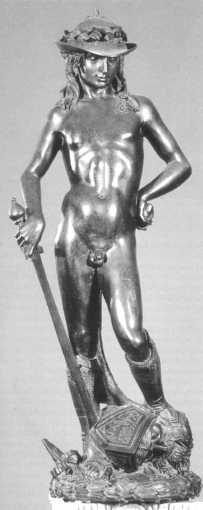
Donatello's bronze sculpture of David, 1425, is the first free-standing nude statue since antiquity. The statue was designed for a public space, most likely on the top of a column. Donatello quotes the sculptors of the past in the counterpoise position of the figure. He leaves classical convention behind, however, in his daring choice of an adolescent male. The Greeks preferred a mature, male torso with its fully developed abdominal muscles. Donatello, by contrast, prefers the sensuality of undeveloped youth. Furthermore, the biblical account described David as a young shepherd boy.
Donatello's concern does not focus on correct biblical exegesis, however. He knows that his patron wants a political symbol. David's hat is of the kind that would have been worn by upper class Florentines. The hat also sports a crown of laurel leaves. Also, Donatello has David standing on the decapitated head of Goliath, whose helmet clearly resembles the armor worn by the Duke of Milan. Thus David is dressed as a victorious Greek hero, (the crown of laurel leaves being a symbol of victory), who has successfully defeated Florence's enemy, the Duke of Milan.
Botticelli
We conclude our brief survey of Early Renaissance art with a painter, the gifted Botticelli. Like Donatello, he was under the patronage of the Medici circle. As a member of the inner circle of Lorenzo Di Medici, Botticelli was not only exposed to the idea of rebirth, but also sat under one of the leading Neo-Platonists of the day, Marsilo Ficino. Ficino had developed his theory of Neo-Platonism to unite the best ideas of Plato with the doctrines of Christianity. One of his central ideas was that the human soul could, through the contemplation of physical beauty, reach a higher state of consciousness in contemplating the beauty of God .
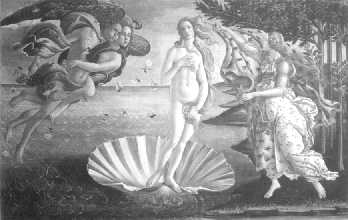
Botticelli's painting, 'The Birth of Venus,' 1480, illustrates this central idea of Ficino. The nude figure of Venus, blown on shore, is a clear reference to the classical myth of the birth of Venus.
Botticelli adds a different layer of meaning to the image, however, if one considers the gestures of Venus. She covers her breasts and her genital area in modesty. Modesty was an attribute of the Virgin Mary, who represented the ideal of spiritual beauty.
Thus, in one image, Botticelli combines two ideas of beauty, one from the classical world, the other from the Christian. We also note that the image could include the idea of baptism. Baptism, as a picture of the Christian's rebirth, could also, in this historical context, serve as a metaphor for the rebirth of Florence as the new Athens.