
BCCN: 'Jesus Encounters'
• BC Christian News • APRIL ISSUE 1998 • VOL. 18 #4 • Formerly "Christian Info News" •
'Jesus encounters' get scholarly attention
- - - - - - - - - - - - - - - - - - - - - - - - - - - - - - - - - - - - - - - - - - - -
- Phillip H. Wiebe: Visions of Jesus: Direct Encounters from the New Testament to Today, Oxford University Press, 1997.
"IF JESUS is not raised from the dead, then our faith is futile." So wrote the apostle Paul in his first letter to the Corinthians. But despite the renewed interest these last few years have seen in scholarly study of the 'historical Jesus,' the resurrection itself has been curiously neglected.
 |
Liberal scholars, pointing to various discrepancies in the New Testament, have generally assumed that the event itself did not happen. And even relatively conservative historians -- such as E. P. Sanders, John P. Meier and N. T. Wright -- have tended to bracket the resurrection off from their recent works on the life of Jesus, relegating it to an epilogue or declaring it too fraught with theology to be the subject of historical study.
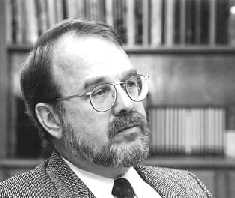
But Phillip Wiebe, a professor of philosophy at Trinity Western University, thinks there is more to this topic than meets the eye. In his book, Visions of Jesus, he collects the accounts of 28 modern-day individuals -- and, in one case, an entire congregation -- who claim to have seen Jesus personally.
But he also goes beyond these accounts to trace the role such visions have played in the history of the church, beginning with the apostles themselves, and he examines in depth the various psychological, physiological and theological explanations that have been offered for these events.
The resulting book is a challenging interdisciplinary work. Wiebe says he ap-proached the subject as a philosopher, first and foremost, but, to do it justice, he needed to "stretch" his efforts across the sciences and humanities.
"Years ago," he explains, "I read something that Karl Popper told his philosophy students: 'Find a problem and work on it. If it takes you outside your field of expertise, don't worry about it, learn as much as you can in those other fields.'
"And I frankly think that, to give more vibrancy to philosophy as a discipline, it's important for philosophers not just to read one another, but to read outside their field and to bring a larger body of information to bear on an issue that's worthy of discussion."
For Wiebe, that issue was the resurrection and subsequent appearances of Jesus, a subject that, he discovered, had never attracted serious academic study in its own right.
Wiebe bought ads in periodicals, looking for people who could give detailed accounts of their visions; he originally hoped to cover 100 such cases in his book, but travel expenses forced him to settle for the 30 cases he had compiled by the time his sabbatical came along. (Two of these did not, in the end, meet the requirements of his book: one participant had had a dream, not a vision, while another claimed to have seen God, not Jesus, per se.)
Wiebe says he was surprised by the variety of experiences he discovered, both in the present day and within the New Testament. The wide range of modern accounts, he says, may help us to understand the puzzling, and potentially controversial, differences between the resurrection stories in the New Testament.
"There are a lot of peculiarities surrounding the resurrection," he says. "The failure to recognize [Jesus] is quite remarkable. And then of course, [there is] the possibility that the form [of Jesus] might have varied. I found that quite fascinating. I think that's what bothers some people, perhaps.
"There's an idea that the resurrected
But he also says the church needs to engage in serious historical criticism without "glossing over" the Bible's apparent discrepancies. "Christianity takes you into historical issues profoundly, and historical issues are empirical ones, and those empirical matters have a certain way of being addressed, and it's bringing in evidence," he says.
"I don't think that you can 'rescue' the Bible now at this point, after all the biblical criticism of the last 200 years, by just repeating it," he adds. "It takes some novel kinds of additional evidence."
Visions of Jesus is, Wiebe hopes, just the beginning. He hopes his book will encourage other scholars to take a serious look at such experiences, and he says he has come across several new cases himself since finishing the book.
Next year, he will step down from his position as Trinity's dean of arts and religious studies to direct a brand new graduate studies program which will offer a master of arts degree in religion, culture and ethics.
Among the courses Wiebe plans to teach is one on "the evidential force of religious experience," which will explore visions of Mary, out-of-body experiences and stigmata, in addition to visions of Jesus.
"Not having had a vision myself, I'm very intrigued by this," he says with a laugh. "It would be an interesting thing to have one, just to see what it's like, because I'm really an outsider looking in."