
BCCN: Abortion Rites
• BC Christian News • MAY ISSUE 1998 • VOL. 18 #5 • Formerly "Christian Info News" •
Abortion: the 'good old days' revisited
- - - - - - - - - - - - - - - - - - - - - - - - - - - - - - - - - - - - - - - - - - - -
• Marvin Olasky: Abortion Rites: A Social History of Abortion in America, Regnery, 1995.
Abortion Rites looks at public policy, private practice, and social mores related to abortion in the United States over the last 400 years.
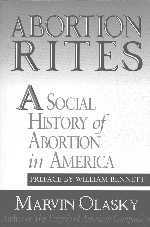
Marvin Olasky, editor of World magazine, is out to correct what he perceives as inaccuracies in pro-choice accounts of abortion history. But he also dispels a number of pro-life myths, including the notion that there was once such a thing as "the good old days" when nobody had sex outside of marriage and abortions were very, very rare.
In the colonial period, a time when infanticide (the low-risk alternative to abortion) was common enough to be the subject of "many ballads," fully one-third of all babies were conceived out of wedlock. Lives were saved, however, by a social safety net that provided support for both mother and child: marriage was one option, and a mother who remained single could name a "reputed father" who would then be compelled to support the newborn child. Men thus shared in the consequences of their actions.
That changed with urbanization and increased mobility, which undermined the social coherence that made such accountability possible. If men now showed any 'responsibility' for their actions, it was often by forcing their mistresses to undergo surgery or consume "French lunar pills."
Male arrogance reached its odious peak during the spiritist movement of the mid-19th century. Harmon Knox Root argued that it was "hypocrisy" for women to insist on marriage before sex, and he praised prostitution and adultery for bringing women closer to "nature." At an 1858 convention, Henry Wright told the women in his audience to "Die rather than give existence to children thou dost not want."
In the absence of a social safety net, turn-of-the-century moralists emphasized raising awareness and statutory rape laws. In addition, doctors were forbidden to perform abortions, though punishments were kept fairly light.
Volunteer organizations such as the 'Erring Woman's Refuge' emphasized personal empathy and family reconciliation over political sloganeering. Private homes for women with crisis pregnancies made for compassionate alternatives to the cold-hearted institutions of previous decades.
These advances began to slip after the First World War, as "professional social workers" moved to replace "evangelically-oriented" volunteers.
Adoption was discouraged because, it was believed, infants could be agents of their mothers' "regeneration." Pro-lifers also lost much of their credibility when they condemned contraceptives even within marriage. This withdrawal of compassion hit the poor the hardest and fed the rhetoric of eugenicists who wished to control birth rates among minorities.
Olasky's book, which concludes with the thalidomide baby scare of the 1960s, is incredibly informative, though his style sometimes lapses into stale pseudo-hip analogies, such as: "Physicians gen-erally were likely to be the Rodney Dangerfields of the era, getting no respect."
He also repudiates sci-entific pro-life arguments and argues that the reduction of abortions "requires a continued expansion of those chur-ches and other organizations that espouse uncompromised Biblical doctrine." Surely this is putting the cart before the horse.
Moreover, he assumes that biblical doctrine must be pro-life, though am-bivalent passages such as Exodus 21:22-25, which makes a sharp distinction between the worth of a fetus and the worth of its mother, leave room for discussion. I, for one, am a card-carrying pro-lifer not because of any clear-cut biblical directives, but because science has demonstrated that embryos are as unique and complex as children, adults and other human beings.
Equating the pro-life movement with Christianity also threatens to cut off potential help from pro-life atheists or members of other faiths. I know a few personally who hesitate to call themselves "pro-life" simply because it conjures up images of Bible-thumpers. In the past that Olasky has researched so intimately, North America may have been predominately Christian, but a broader base of support is needed to fight today's battles.
All told, however, Abortion Rites is intense, complex and riveting, with a wealth of invaluable data.