
• BC Christian News • MAY ISSUE 1998 • VOL. 18 #5 • Formerly "Christian Info News" •
Anglican antagonists blinkered by ideology and bias
- - - - - - - - - - - - - - - - - - - - - - - - - - - - - - - - - - - - - - - - - - - -
• John Simons, editor: The Challenge of Tradition: Discerning the Future of Anglicanism, Anglican Book Centre, 1997.
• George Eves: Two Religions, One Church: Division and Destiny in the Anglican Church of Canada, VOICE, 1998.
By Ron Dart
I HAD anticipated the publication of The Challenge of Tradition, naively hoping for a solid critique of the Essentials movement (which involves more traditional, evangelical, charismatic or orthodox Anglicans) --but I was sorely disappointed.
Most of the authors of The Challenge of Tradition are inclined to caricature the Essentials movement or simplistically react to the Montreal Declaration, which followed the Essentials '94 conference.

Gregory Baum's article tends to misrepresent the complexity of the inclusive-exclusive interfaith dialogue in Christian history.
It is not that the exclusive was the preferred tradition and the inclusive the minority tradition -- both traditions, in their different ways, have been on the front stage. Baum's use of the exclusive-inclusive model as an analogy to justify the gay rights agenda is weak thinking, although it does represent dutifully the social liberal establishment.
Andrew Taylor's article on 'Anglican Social Thought' is insightful, but if he had read my article in Anglican Essentials (Anglican Book Centre, 1995) he would have realized that the Essentials movement cannot be reduced to bourgeois ethics or neoconservative politics. In fact, Taylor might discover, if he had probed a bit further, that the Essentials movement might be much more radical and prophetic than the authors of The Challenge of Tradition.
If Susan Storey had thoroughly read and absorbed the Pell article on 'Baptismal Min-istry: Partnership, Gender and Integration,' she would have discovered that much of the feminist movement is warmly welcomed in the Essentials camp.
Bishop Terry Brown's article, rightly, criticizes the unholy union of evangelism and empire; but most in the Essentials movement would be equally critical of such an idol. Brown, like most of the authors of The Future of Tradition, is going after a straw person; in doing so, their prejudices shine through in a most illuminating manner.
Editor John Simons and study guide author Paul Jennings participate in many of the same failings as their peers. The Essentials movement is caricatured, and a rather trendy form of establishment social liberalism is set on the throne; once this is done, the authors then genuflect to this predictable worldview.
• • •
Two Religions, One Church, by George Eves, has laid bare some of the most pressing issues in the Anglican Church of Canada. He makes it clear that the fault lines within the ACC must be faced up to; he articulates, in the most lucid manner, both what the issues are, and the underlying historical, theological and intellectual reasons for the widening chasm within the denomination.
Eves has put his finger on some troubling and unresolved problems; but there are many who know these issues exist, and most have chosen to be more circumspect about the parting of ways on many issues. Eves, an organizer of Essentials '94 and first president of Barnabas Anglican Ministries, is committed to a very specific tribe within the ACC, and this accounts for both the strengths and limitations of his book.
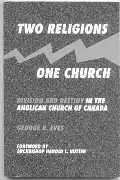
The dominating thesis is that there are two distinct and opposing religions with-in the ACC: the tradition-al/orthodox and the liberals. The former group is seen as bearing the truth and light, and the latter group is seen as the enemy of all that is good, true and beautiful in the historic Anglican tradition.
Eves fails, in his stridency, to subject his own clan to any substantive criticism. Such reasoning is reactionary and silly. The liberal tradition is much more complex and nuanced than Eves makes it appear, and liberals have contributed much good to the life of the church. Eves' lack of healthy self-criticism is a worrisome feature of Two Religions, One Church, and I do not think it represents the more thoughtful tradition that 'Essentials' seeks to reflect.
Both the liberal/progressive tribe and the traditional/orthodox clan have their dark sides. The sooner both families can become more self-critical and less other-critical, the quicker the Anglican Church of Canada will be renewed. There is nothing quite so tragic within religion as ideology; at the present time, this tendency has, unfortunately, made it appear as if a person can only belong to one tribe or the other.
The Anglican Church of Canada has a tradition of uniting and drawing the church together. I would hope that in the future, a third book would be written, in which the polarization that so besets us these days would be overcome; we do await the sort of visionary leadership that can move us beyond the culture wars of our moment.
Ron Dart teaches in the Political Science/ Religious Studies Department at the University College of the Fraser Valley; he attends St. Matthew's Anglican Church.
Related books of interest
BC Christian News, · Top Stories
• George Egerton (ed.): Anglican Essentials: Reclaiming Faith Within the Anglican Church of Canada, Anglican Book Centre, 1995. A collection of essays aimed at reaffirming the traditional, orthodox beliefs of the Anglican church. Most of them were written for presentation at the Essentials conference in 1994.
• Dean N. Henderson: Anglican Anxieties: A Priest Thinks About the Church's Future, 1997. A collection of essays by a Nanoose Bay priest, dealing with the use of inclusive language; concerns about pluralism; family breakdown; philosophical relativism; and Anglican/Catholic dialogue.
• Michael Ingham: Mansions of the Spirit, Anglican Book Centre, 1997. An exploration of pluralism, which presents the thesis that Christianity is only one of many valid roads to salvation. Endorsed by the Dalai Lama and former Archbishop of Canterbury Robert Runcie.
• J. I. Packer and Ron Dart: In a Pluralist World, Regent College, 1998. A response to Ingham's book, which makes the case that non-Christian faiths can be respected and appreciated without denying the uniqueness of Christ as Savior.