
• BC Christian News • MAY ISSUE 1998 • VOL. 18 #5 • Formerly "Christian Info News" •
Christianity and art in the West - Part V
High Renaissance and Mannerist
- - - - - - - - - - - - - - - - - - - - - - - - - - - - - - - - - - - - - - - - - - - -
THE ITALIAN High Renaissance occupies a short period of time, 1495 - 1520, while the Mannerist style in Italy endures from 1525 - 1600. Historians can summarize the High Renaissance in the accomplishments of six great masters: Leonardo da Vinci, Bramante, Michelangelo, Raphael, Giorgione and Titian. By comparison, Mannerist painters have not been taken seriously until recently. We now view their varied styles of painting as having formed the foundation for the expressive, international style of the seventeenth century, known as the Baroque. Our survey of these periods will focus on the art of Leonardo da Vinci, Michelangelo and El Greco.
Leonardo da Vinci
BC Christian News, · Arts
By the time Leonardo da Vinci was working on his tempura wall mural, 'The Last Supper' (Sta. Maria dell Grazie, Milan, 1495 - 1498), the visual arts had become established in the liberal arts curriculum. The artist was accepted as a valued member of the academy and at the courts of the aristocracy. Art could communicate complex ideas about human nature and theories such as mathematical perspective.
During the High Renaissance the focus of art shifted one step further, however, to the idea of artistic genius. Artists reshaped what they observed in nature according to their own taste or standard of grace. They no longer wanted simply to imitate ancient masters or nature, but to re-create nature according to the rules of their own imagination.
In Leonardo's case, genius manifests itself in two ways: in his ability to take risks with materials and in his integration of psychological insight with superb artistic composition. For example, he was not content to mix paint with plaster in the traditional fresco technique to create his famous mural. Instead he mixed oil tempera paint with gesso directly onto the wall's surface. Despite the fact that the mural began to deteriorate as soon as it was finished, Leonardo's attempt exemplified a key characteristic of genius, a stubborn desire to overcome impossible odds.
Leonardo's genius was also demonstrated in his ability to integrate psychological insight with strong visual composition. If we examine the relationship of the architecture and the figures, we see that they depend on each other. For example, Christ's spiritual isolation is emphasized by the open window behind him. In fact there are three open windows, a subtle reference to Christ's place in the trinity. Also, the lines of perspective, formed by the roof beams and side doorways, converge on the head of Christ, establishing his importance visually. The apostles lean away from Christ, further emphasizing his isolation. Through their gestures and shocked glances Leonardo registers their reaction to Christ's words that "one of you shall betray me."
Michelangelo
Michelangelo, like Leonardo, displayed at-tributes of artistic ge-nius in his ability to grapple with large-scale projects that de-manded the integration of many elements. Nowhere do we find a better example of this than in his Sistine Ceiling fresco (1508 - 12). Michelangelo had al-ways considered him-self a sculptor first and a painter second. Pope Julius II had to use his full authority to bully Michelangelo into leaving a sculptural project to complete the Sistine Ceiling. Michelangelo completed the entire project in an astonishing period of four years. Recent cleaning of the Sistine Ceiling has revealed stunning colors and powerful brush-strokes.
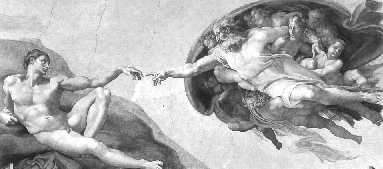 |
Michelangelo divided the ceiling into nine major scenes which illustrate the history of salvation, from creation to the flood. Each scene is framed by four naked male athletes at the corners. These figures, known as ignudi, represent the Greco-Roman world, which had sought to find the truth of salvation in Christianity. Michelangelo includes them respectfully, as he had been exposed to the ideas of neo-Platonism, which sought to integrate pagan and Christian thinking.
In 'The Creation of Adam' we see Adam as a heroic figure reaching towards his Creator, who has one arm stretching towards Adam and the other sheltering Eve. In Catholic iconography the Holy Spirit was represented as the finger of God. Furthermore, the Mass of the Holy Spirit was sung at the coronation of the Pope.
Thus we have a demonstration of Michelangelo's ability to integrate many layers of meaning: the ideal, nude body of Adam refers back to the classical world's idea that the physical state of the body relates to the spiritual condition of the soul; the space between Adam's and God's fingers be-comes the place where the Holy Spirit's power creates Adam's soul; the location of the creation of Adam is directly over the throne where each successive pontiff would be coronated, making the Pope's coronation a significant and holy moment.
El Greco
El Greco had a different focus from Leonardo and Michelangelo, namely the private world of an artist's religious mysticism. Trained in Venice, El Greco moved to Toledo, Spain in 1576. Before leaving Venice he had become familiar with the work of Raphael, Michelangelo and the Central Italian Mannerists. He had his own ideas about form before he reached Spain, which was deeply involved in the Counter-Reformation.
 |
It was not Counter-Reformation theology that influenced El Greco's intense emotional style, however, but the spiritual mysticism that had evolved out of the writings of St. Ignatius of Loyola, who had founded the Jesuits earlier in the century. St. Ignatius encouraged the faithful to envision the different stations of the cross until they become a physical reality to the believer. El Greco's paintings, in their distorted forms, reflected a similar state of meditation.
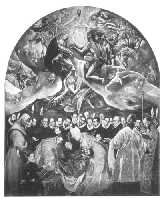
The Burial of Count Orgaz (Sto. Tome, Toledo, Spain, 1586), oil on canvas, provides the viewer with an excellent sample of El Greco's exalted emotionalism. Count Orgaz was a medieval benefactor who was so pious that St. Stephen and St. Augustine were said to have appeared at his funeral to lower the count's body into the grave themselves.
This subject allowed El Greco to use his Mannerist style to portray a vision of a miracle; he was free to interpret the scene. He did this by contrasting the earthly realm with that of a heavenly one. In the bottom half of the painting we see a crowd of mourners all dressed in black, with the exception of St. Stephen and St. Augustine. The top half is full of movement. As one observes the clouds that swirl around the saints and Christ, one sees that they have as much tactile reality as the clothes worn by the heavenly host.
El Greco's genius lies in his ability to depict mystical events such as miracles with a believable yet dynamic form. He incarnates the extremely personal and emotionally intense style of Mannerism.
Stephen Williams, an artist and former art department coordinator at Trinity Western University, lives in Richmond and attends Granville Chapel.