
BCCN: Tramp
BC Christian News, · Arts
• BC Christian News • MAY ISSUE 1998 • VOL. 18 #5 • Formerly "Christian Info News" •
Little 'tramp' embodied spiritual tensions
- - - - - - - - - - - - - - - - - - - - - - - - - - - - - - - - - - - - - - - - - - - -
• The Feature Films of Charlie Chaplin
May 1 to 31 at the Pacific Cinematheque
ONE OF Hollywood's more enduring contradictions is the fact that studios will spend millions of dollars to make films that extol the virtues of poverty, safe in the knowledge that working audiences will attend such films in droves and thereby help these studios to make enormous profits. Just look at Titanic.
 |
Not coincidentally, that film is set in a time when movies themselves were just beginning to take off, and the years immediately following the loss of that ship marked the rise of cinema's first great celebrity, a man who embodied this paradox and made his millions, in film after film, by playing a beggar and a tramp. That man was Charlie Chaplin, the subject of a month-long retrospective at the Pacific Cinematheque.
Chaplin's life was marked by other contradictions, too. His films -- he directed or appeared in over 60 short comedies between 1914 and 1918 alone -- probe the tension between selfish bodily appetites and the nobler impulses of the spirit, and he often used religious imagery to convey his humanistic and somewhat anti-religious beliefs.
As a boy, Chaplin hated the church services that his mother, a devout Protestant, forced him to attend, and the "aching impatience" he said he felt during sermons is reflected in a number of his films, including Easy Street (1917, playing May 13 - 14) and The Pilgrim (1923, playing May 10 - 11), in which he plays an escaped convict dressed in stolen preacher's clothes.
Chaplin disapproved of his mother's religious fervor because it led her to abandon her work in the theatre. When she learned that he was a millionaire several times over, she remarked that he could have used his talent to save "thousands of souls." According to Chaplin, he replied, "I might have saved souls but not money."
Chaplin's distrust of religious authorities -- which was part and parcel of his lack of trust in authorities of any kind -- is reflected in Police (1916), in which a preacher tries to convert Chaplin and pick his pocket at the same time. But the little tramp was capable of conversion if the circumstances were just right -- that is, if, as in Easy Street, a pretty girl such as Edna Purviance could introduce him to the faith.
In general, though, Chaplin placed his faith in humanity, and it was on a very human level that he found the stories of Jesus -- particularly the stories of his compassion and his moment of doubt -- so compelling that he once asked a studio to let him star in a film on the life of Christ.
That project, as interesting as it would have been, never came to pass, but references to the gospels do surface in Chaplin's films nonetheless.
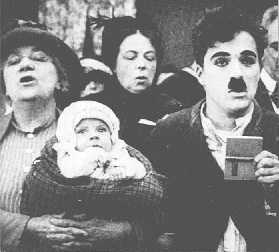
In his first, and rather charming, feature-length film The Kid (1921, playing May 1 - 3), Chaplin dissolved from an image of an unwed mother carrying her illegitimate child to a statue of Christ carrying his cross.
And in The Great Dictator (1940, playing May 22 - 24), Chaplin's first talkie and a so-so spoof of fascism, Chaplin played a Jewish barber who, in the middle of an impassioned speech, gives a democratic spin to Luke 17:21: "The kingdom of God is within man -- not one man nor a group of men, but in all men! In you! You, the people, have the power!"
Chaplin, who made his fortune with one- or two-reel shorts, had mixed success with his feature films. The Gold Rush (1925, playing May 8 - 9), City Lights (1931) and Modern Times (1936, both playing May 15 - 18) have each been recognized as Chaplin's masterpiece. But when Chaplin finally began to produce talking pictures, his talents seemed to evaporate.
It did not help that his voice was rather feeble and patronizing, quite unsuited to the kick-in-the-pants antics of his youth, nor did it help that he peppered his talkies with moralistic speeches.
In Monsieur Verdoux (1947, playing May 22 - 24), he played a serial killer who argues, in court, that he is an "amateur" compared to the armies that employ weapons of mass destruction. When he is sentenced to death, Verdoux refuses the services of his chaplain because, he says, he needs to be reconciled not to God but to mankind.
Chaplin's last films were tainted with smug self-pity. In Limelight (1952) and A King in New York (1957, both playing May 29 - 31), he cast himself as a washed-up comedian and an exiled monarch, respectively.
The latter film was a not-so-subtle commentary on Chaplin's exile to Switzerland, where he hid from American tax collectors and McCarthyites bent on proving him a Communist. It also suggested that, by the end of his life, Chaplin had resolved his career's central paradox and was comfortable with his almost royal status among wealthy celebrities.
But it's the plucky tramp we remember best, a figure both proud and humble, looking for grace in the sometimes harsh ordinariness of life.