
• BC Christian News • JUNE ISSUE 1998 • VOL. 18 #6 • Formerly "Christian Info News" •
Christianity and art in the West - Part VI
Northern Renaissanceand Baroque
- - - - - - - - - - - - - - - - - - - - - - - - - - - - - - - - - - - - - - - - - - - -
THE NORTHERN Renaissance applies to countries north of the Alps which had significant contact with the art of the Italian Renaissance in the latter part of the 15th century. From this point on, there was a war of styles in northern Europe that would last until the international phenomenon of the Baroque in 1600.
The reason for this prolonged struggle lay in the dominance of the Gothic style in the north and in a difference of religious cultures, namely those of the Reformation and the Counter Reformation.
Germany as the birthplace of the Reformation will serve as our base for examining the Northern Renaissance, while Italy will pro-vide us with an example of Baroque art and its place within Counter Reformation culture.
Albrecht Durer
BC Christian News, · Arts
Albrecht Durer occupies a central place in the art of Germany and of the Northern Renaissance. Although a citizen of Nuremberg, he acted as a bridge between the cultures of Protestant Germany and Catholic Italy. His deep respect for the ideas of Martin Luther, founder of the Reformation, did not stop him from going to Venice and absorbing the ideas of Italian humanism, or the art of masters such as Leonardo Da Vinci and Mantegna.
Durer agreed with the Italian viewpoint that the visual arts should have a place in the liberal arts curriculum, and that the artist should pursue the role of a cultivated gentleman and humanistic scholar. At the same time, he believed in Luther's idea that human beings could approach God without the church acting as an intermediary -- that the individual Christian believer depended solely on scripture, and on God's grace.
This theological perspective is seen in Durer's 13 woodcuts that illustrate the book of Revelation, with text translated into German by Luther. Durer engages the text on a literal and personal level. His imagination and skill lift the crude and popular folk art medium of the woodcut to the level of fine art.
Four Horsemen
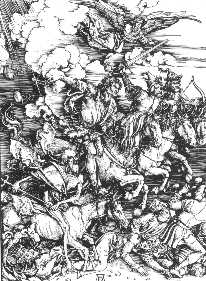 |
Our analysis will focus on 'The Four Horsemen of the Apocalypse' (1497 - 98), one of the most well-known of the series. 'The Four Horsemen of the Apocalypse' depicts God's four agents, who ride out into the earth bringing war, famine, disease and death to humanity.
The subtlety of line which describes the form of the horsemen and their victims had never been achieved in woodcuts until this moment. Durer benefited from his study of Italian masters, who taught him how thick and thin lines create light and shade, weight and volume.
In the same way as Leonardo Da Vinci, Durer grasped the importance of portraying human psych-ology. One can see the terror on the Pope's face as he descends into the mouth of hell in the bottom left corner, a not-so-subtle reminder to the viewer that religious knowledge and tradition do not guarantee personal salvation.
Baroque Art
We now shift our attention to a different religious culture, namely the Counter Reformation. This movement, which extended from the mid-16th century to the early 17th century, was the papacy's response to the Protestant Reformation. Pope Julius II established a pattern of commissioning the finest artists in Italy to decorate Rome on a grand scale, so the city of the true Catholic faith would be the most splendid in Europe, "for the greater glory of God and the Church."
The Pope also enlisted powerful political allies such as the Hapsburgs, who ruled Spain, the Netherlands and Austria, to fight on behalf of the true faith.
Thus, artists had access to patrons who had both the ambition and the wealth to exploit the arts. Patronage, therefore, influenced the focus of Baroque art.
For example, the Catholic church decreed that artists employed by the church needed to focus on the lives of the saints in a dynamic manner. Paintings describing miraculous events in a saint's life were to have emotional impact on the illiterate faithful, so that poor people would have their senses overwhelmed by the truth and tradition of the Catholic church.
Art became an important tool for keeping people within the fold of the church.
Caravaggio
Michelangelo Merisi, called Caravaggio after his birthplace near Milan, carried out the desires of the Catholic church in his large canvases of key biblical figures.
We will focus on his painting for the Contarelli Chapel in S. Luigi dei Francesi, 'The Calling of St. Matthew' (1599 -1602). This masterpiece has such realistic detail that a new term -- naturalism -- was employed to describe it.
Its emotional impact is felt in the dramatic lighting and in the strong gestures of Matthew and Christ.
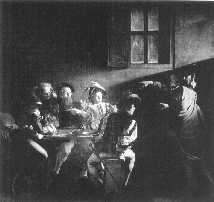 |
A strong beam of light penetrates the dark interior of a typical tavern in Rome, from the top right hand corner. It falls onto the face of Matthew the tax collector, whose shocked expression contrasts with the authority and self-awareness of Christ, who calls him into a new life.
We also see a powerful comparison set up in the gestures of Christ's and Matthew's hands. Christ's hand stretches out so that his finger points with concentrated force at Matthew, who in turn echoes Christ's gesture in his own hand. This gesture is a direct quotation from Michelangelo's 'Creation of Adam' on the Sistine Ceiling.
Caravaggio had been deeply influenced by the teaching of St. Philip Neri, who had sought to communicate Catholic doctrine in a way that poor people would understand. This approach came naturally to Caravaggio since he knew from his own violent lifestyle what it was like to live on the street.
Ironically, the people Caravaggio wanted to reach rejected his work because they did not want to see the saints portrayed like themselves in street scenes. Educated collectors and wealthy church patrons greatly admired his work, however.
Stephen Williams, an artist and former art department coordinator at Trinity Western University, lives in Richmond and attends Granville Chapel.
Albrecht Durer: The Four Horsemen of the Apocalypse (1497-98).