
BCCN: Borg
BC Christian News, · Arts
• BC Christian News • JUNE ISSUE 1998 • VOL. 18 #6 • Formerly "Christian Info News" •
Borg open to dialogue, Spong won't listen
- - - - - - - - - - - - - - - - - - - - - - - - - - - - - - - - - - - - - - - - - - - -
• John Shelby Spong: Why Christianity Must Change or Die, HarperSanFrancisco, 1998.
By Peter T. Chattaway
COME, let us reason together, the prophet once said. But current debates in the Anglican Church and other denominations often generate more heat than light. Two recent books by American authors, both of them liberal Episcopalians, demonstrate the radically different directions in which the dialogue with conservatives can go.
Marcus Borg, a member of the Jesus Seminar and a professor of religion and culture at Oregon State University, grew up in a Lutheran family, but became an atheist in college. However, he eventually found himself drawn to 'panentheistic' theology, and through it he became a Christian again.
Borg has shared his testimony before, most notably in Meeting Jesus Again for the First Time. Now, in The God We Never Knew, he takes an academic step back to explore the broader trends in theology that, he argues, have led conservatives to lose sight of God's transcendence and immanence, thus making it easy for some Christians to lapse into atheism.
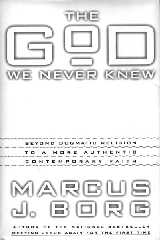
Borg is quick to emphasize that panentheism, i.e. the belief that everything is in God, is not the same thing as pantheism, i.e. the belief that everything is God. In fact, Borg argues, panentheism lies behind such biblical passages as Acts 17:27-28.
There are some problems with Borg's thesis, especially when he reiterates some of the more dubious aspects of historical Jesus scholarship. But Borg is appreciative of those Christians whose beliefs do not entirely match his own. He cites Tony Campolo as one evangelical who, although he holds to a conservative theology, nevertheless shares with Borg a deep and abiding belief that compassion is central to the message of Jesus.
To paraphrase something Margaret Thatcher once said of Mikhail Gorbachev, Borg is the sort of liberal that evangelicals can work with.
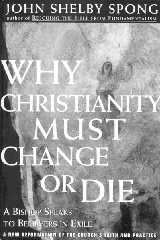
Then there is John Shelby Spong, Bishop of Newark, New Jersey and a notorious firebrand, whose latest missive bears the slightly misleading title Why Christianity Must Change or Die. Spong believes that Christianity is actually already dead -- it's just up to him to help bring it back to life, and presumably not just because his career depends on it.
But where Borg is open to pluralism within the church, Spong -- his cries of 'postmodernism' notwithstanding --comes across as a die-hard modernist who won't be satisfied until all Christians have conformed their theology to his.
Said theology, in a nutshell, rejects theism, the uniqueness of Jesus, and a whole lot of other things besides. In fact, there's so much rejecting going on in Spong's book that it's hard to tell what he actually stands for. And he has the audacity to criticize opponents like Alistair MacGrath, N.T. Wright and Luke Timothy Johnson as "revealingly hostile and without saving academic merit"! That sound you hear is the pot calling the china teacup black.
Spong says the church has always conformed to its surrounding cultures, and since the culture (singular) of the 20th century is so different from the culture (singular) of the earliest Christians, the modern church needs to take its cue from outside forces that are more up-to-date.
But his thesis is overly simplistic. The church has always actively subverted the assumptions of its surrounding cultures, and that is a task which beckons us still. It is folly to assume we must passively accept whatever worldview gets handed to us by the leading skeptics of the day.
It is also unduly smug of Spong to assert that ancient people were a naturally ignorant lot. For example, he says the story of the Virgin Birth was invalidated in 1724 by the discovery of egg cells, but that is sheer nonsense. The ancients knew about menstrual blood and considered it a kind of semen; that is why Hebrews 11:11 says that Sarah had a seminal emission by faith. Miracle births and the mother's role in reproduction went hand-in-hand.
Ultimately, even Spong does not take his own advice. It is fascinating to watch how, in a single page, Spong moves from hard-bitten skepticism to wishful thinking. At the top of page 192, he lists a number of genetic, medical and social factors that shape each individual's identity. Without a theistic God, there is no magical act of creation -- genes just happen to combine, and people just happen to be shaped by their environments.
But then, at the bottom of that same page, Spong asserts that the ritual of baptism calls each child to go "beyond his or her limits," "to be all that that person was created to be." But without a creator, how can Spong say children are created to be anything other than what they are? Having allowed the naturalists to define his limits, Spong offers no justifiable reason for thinking that there can be anything beyond those limits.
Spong does more harm than good to his cause, confirming the stereotypes some evangelicals have of washed-up liberal clergy. Borg, at least, offers the conservative reader a more patient and tolerant invitation to find some common ground.