
• BC Christian News • JULY ISSUE 1998 • VOL. 18 #7 • Formerly "Christian Info News" •
Christianity and art in the West - Part VII
Neoclassicism and Romanticism
- - - - - - - - - - - - - - - - - - - - - - - - - - - - - - - - - - - - - - - - - - - -
By Stephen J. Williams
NEOCLASSICISM and Romanticism cover the period between 1750 and 1850, a time of industrial and political revolution. The influence of these artistic movements has lasted well into the twentieth century.
Neoclassicism is linked to the ideas of the Enlightenment, while Romanticism eludes attachment to one single historical viewpoint.
Romanticism refers not to a specific style of art, but to an attitude which can reveal itself in many styles, including Classicism. Therefore, our analysis of these two schools must focus on the work of artists who best represent the different values of Neoclassicism and Romanticism. Jacques-Louis David is a good example of the Classicist side, while William Blake's work acts as a powerful symbol of Romanticism.
Jacques-Louis David
Enlightenment thinkers called artists of the eighteenth century to return to reason, nature and morality. In art this meant a return to Greek and Roman models as interpreted through the work of the Renaissance masters, particularly Michelangelo and Raphael.
 |
The German art historian and theorist Johann Joachim Winkleman popularized the concept of "the noble simplicity and calm grandeur" of Greek art. The 'Winkleman Program' became an integral part of the French Art Academy in Rome, under the leadership of Joseph-Marie Vien, acting head from 1775 - 1781.
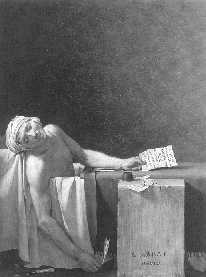
It was Vien who introduced Jacques-Louis David to the values of Neoclassicism. Upon his return to France in 1781, David established himself as the leading Neoclassical painter. His masterpiece, 'The Death of Marat' (1793, oil on canvas), portrays a leader of the French Revolution as a martyr.
David played an active role in the revolution and wanted to immortalize his murdered comrade. He does this by borrowing compositional devices from Renaissance paintings that portray scenes of the deposition and entombment of Christ.
The position of Marat's body, for example, reminds one of the body of Christ in Pontormo's 'Deposition' (1535). In fact, the bathtub that Marat lies in looks more like a sarcophagus. And we can see Marat's chest wound, which ties in with the prominent position of Christ's wounds in Renaissance paintings. Finally, one notices Marat's head covering, which could be associated with the one Christ wore.
Thus, Christian symbols in David's painting uphold a political leader who modelled the ideal of the Enlightenment, the power of reason conquering oppression.
William Blake
If Neoclassicism tended to eulogize political figures, Romantic artists were more inclined to focus on their personal struggles. This inner conflict was effectively portrayed in painting; the greatest achievement of Romanticism in the visual arts was its control over painting.
 |
Romantic painters exalted emotion as an end in itself, whether the public approved of this aim or not. The search for 'authentic feeling' led artists like William Blake on a search that took on religious overtones. Blake ultimately did not define his spirituality in conventional orthodox Christian terminology, however. He defined his personal mysticism as part of his artistic imagination.
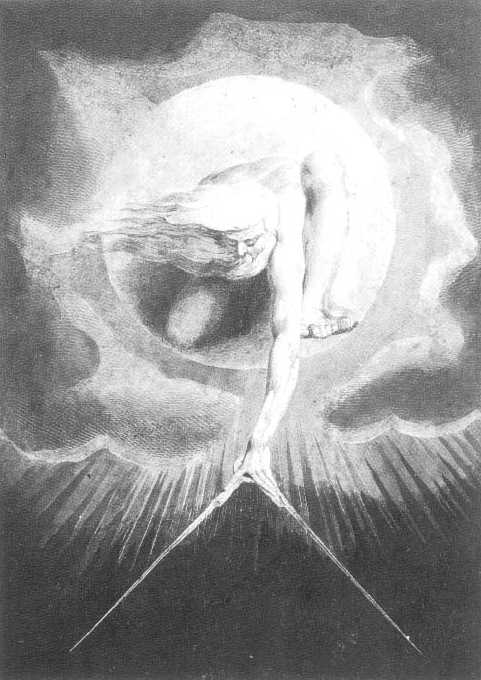
Blake confronts the viewer with his own imposing image of God, in a hand-colored etching, 'The Ancient of Days,' a frontispiece of Europe: a Prophecy, 1794. The figure of God reminds us of the muscular figures from Michelangelo's Sistine Ceiling frescoes, 1508 - 12, or of the figure of God in Zuccaro's painting, 'The Conversion of St. Paul,' 1555.
Blake had acquired a large collection of engravings of Renaissance and Mannerist paintings. He also knew that in medieval representations of God, one saw the Lord as an architect constructing the universe out of the power of his reason.
In Blake's esoteric mythology, however, reason was ultimately destructive, stifling vision and imagination. So the 'Ancient of Days' in Blake's iconography was an image of oppression against which the human spirit had to fight.
Stephen Williams, an artist and former art department coordinator at Trinity Western University, lives in Richmond and attends Granville Chapel.