
• BC Christian News • OCTOBER ISSUE 1998 • VOL. 18 #10 • Formerly "Christian Info News" •
George Grant -- giant of philosophy affected many
- - - - - - - - - - - - - - - - - - - - - - - - - - - - - - - - - - - - - - - - - - - -
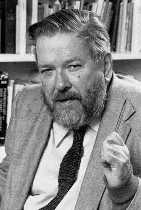
George Grant died 10 years ago this fall. His influence on Canadian academics and religious thinkers has been tremendous. Following are four testaments to that influence.
Harry Robinson
BC Christian News, · Top Stories
AT THE conclusion of a lecture by George Grant, a lady stood and asked: "How can I be happy?" His answer came back: "Whoever told you that you were meant to be happy?" With that response Grant's contagious and characteristic laughter made everyone happy, at least for the moment.
He had a great capacity to be joyful, I think, because the truth, whether congenial or not, always seemed to delight him.
I knew him mainly because he was a great friend of my aunt Judith Robinson, who was for many years a columnist for The Globe and Mail.
Her father, Black Jack Robinson, was for 35 years editor of the Toronto Evening Telegram. Their home was a great redbrick, Victorian home with a second floor library, with a constant fire in the coal-burning fireplace. Above the fireplace was a picture of Lord Nelson commanding a young man to do his duty.
 |
It was around that fireplace that as a student I used to sit in and listen to conversations with George Grant . . . great conversations about where Canada was and where it was going, all with a clear, unabashed loyalty to Britain and the crown.
George Grant was a devout Anglican, not devoid of the ability to critique the episcopacy of his day. It was this dimension of his life which gave him such delight in truth -- a profound delight that made him indifferent to secondary matters and totally preoccupied with the big issues. The most casual conversation with him was never casual in content; the most mundane remark or circumstance he seemed able to relate to ultimate realities.
He was able to weave into whole cloth the failure of the universities, Canada in the grip of losing its birthright, and the role of the church in preaching the gospel. One stu-dent asked him how, when he was so negative about universities, he could continue to work for one. He enjoyed the question immensely and replied, "Only with irony."
He was like a Canadian G.K. Chesterton. He was very articulate about his faith, fascinated by simple folk, and able to give meaning and new dimensions to their lives.
I see Grant as a predecessor to the committed, learned and devout lay people of Canada who are struggling to articulate what it means to be a Christian and Canadian. He walked with determination among the false hopes, the lies and pretensions of his day, confident that those walls would come tumbling down.
Harry Robinson was rector at St. John's Shaughnessy Anglican Church in Vancouver from 1978 to 1992.
Thomas Bateman
HOW MANY of us have been changed by reading an author's work? In these cynical, sophisticated times, when we have 'heard it all before' and nothing surprises us, few would admit to such a quaint experience.
In the early 1980s I was a young undergraduate at the University of Calgary, breathing the easy liberalism wafting through the air of higher education.
I believed without questioning that knowledge was about progress, unlocking the mysteries of the natural order for the advancement of human purposes. I believed technology was the benign servant of our self-defined ends. I believed religious faith should bend appropriately to the vital present. I believed anyone should be able to do anything as long as it did not harm others.
I had unwittingly embraced a happy secularization of a deeper ethical tradition. I would become an eager functionary in the unfolding technological order.
Then I read George Grant.
I was asked to read Lament for a Nation, Technology and Empire and English-Speaking Justice for a second-year course in North American political thought. Difficult, lucid, disturbing works, their brevity hid a depth that shook me to my foundations. Here was a man who had stepped outside of his age, someone for whom the competing left-right ideologies were so many boats traveling down the same river. Grant dared to face secular liberalism and criticize it. Of course, many people criticized liberalism, but always on the basis that it was not progressive enough. Grant argued that the age of progress was a disastrous forgetting of ancient truths. Conceding the basic decency of political liberalism and its disdain for tyranny, he nonetheless attacked the notion that 'man's essence is his freedom.'
What was to be put in place of freedom as the ultimate for humanity? Here Grant became more oblique. He wrote about virtue, the wisdom of the ancients, the meeting of Athens and Jerusalem. Little of this was clear to me. But it captivated me.
I learned from Grant that the most interesting people to know are those whose ideas cannot be packaged in received ideological labels. He taught me that there are deep connections between faith and politics, going quite beyond the relation between church and state. I also struggled, after reading him, with the relationship between faith and intellect, thinking far more critically about fashionable criticisms of biblical literature and history.
I never met Grant. This saddened me when I learned of his death. For me, he is one of those who died with his hands outstretched in love toward the further shore.
Thomas Bateman is assistant professor of political studies at Augustana University College in Camrose, Alberta.
Iain T. Benson
My wife Eleanor and I were invited by George Grant and his wife, Sheila, to visit them in the late summer of 1988. Just prior to doing so, we received a hurried note from Sheila saying George had gone into hospital, and we should reschedule our visit when he recovered. He never did, and died of pancreatic cancer soon thereafter.
In one of the letters he sent me the year before he died, Grant wrote of his high regard for C.S. Lewis. Grant and his wife were both students at Oxford and often attended the Oxford Socratic Club meetings where Lewis would engage some of the leading thinkers of the day in philosophical debate.
Grant exemplified courage and integrity, and many of his ideas continue to impress people. He turned down his first university job shortly after getting his doctorate, rather than be required to teach from a text that, in his opinion, portrayed the Christian tradition in an unfair way. George and Sheila's writings on abortion and euthanasia remain important.
Grant saw clearly how much of contemporary Christian thought has become secularized. He noted, for example, that widespread use of the term 'values' by Christians shows the superficiality of much current Christian expression of truth and goodness.
The word 'values,' an economic term not originally applied to moral matters, is now used almost universally, by religious and non-religious alike, to convey what we actually think to be valid and objectively true about morals, faith and everything else.
But it is, as Grant said, "an obscuring language for morality used when the idea of purpose has been destroyed." Simply attaching shared words like 'family' or 'Christian' to the term 'values' does not save the language from its ambiguity and essential relativity. What we think is moral language is just so much verbal fluff.
The substitution of 'values language' for richer moral understanding shows how badly believers have been betrayed by the schooling most have received in the past century. Gone is education about 'virtues' as incorporated within the Christian tradition from classical thought.
Partly because he saw the history behind this contemporary situation, Grant's works would benefit religious believers.
Iain T. Benson is a lawyer and senior research fellow for the Ottawa based Centre for Renewal in Public Policy.
Ron Dart
George Grant recalls Canadians to a more ancient conservatism, a vision that cannot be taken captive by the culture wars that so beset us these days. Ideological birds of prey circle Grant, tearing from him what serves their appetites and agendas, but his Red Tory vision cannot be consumed by such an approach.
Grant constantly reminded us that those who ignore the past only become uncritical lapdogs of the shallow and destructive liberalism that dominates so much of how we live, move and have our being.
Grant grew up grounded in an English Red Tory vision that was indebted to thinkers such as Plato, Augustine, More, Hooker, Swift and Coleridge. This tradition, Grant argued, was being eroded by the corrosive impact of liberal modernity.
Our modern discourse is framed within the worldview of Enlightenment liberalism, which championed the elevation of the individual. Most people, whether they are religious or not, follow their own instincts in all sorts of fragmentary and divisive ways.
Grant sought to conserve a vision that antedates the Renaissance; it is conservatism grounded in family and community, that resists corporate greed, political imperialism and education that reduces learning to the accumulation of facts.
Such a high view of life also led Grant to oppose abortion and euthanasia. He was guided by an understanding that love and wisdom are higher than knowledge, and that community and tradition are as important as the individual and technology. He criticized the unwillingness of many evangelicals to critique free trade, property, possessions, the empire to the south, and militarism.
Grant was equally critical of liberals, such as Rousseau and Marx, that many self-styled progressives are so fond of. The progressives' openness to abortion and euthanasia (grounded in the rights of the individual) is no different, in principle, than the rights of the individual to be schismatic, engage in competitive trade and accumulate possessions and property at will. Grant cut though all these inconsistencies by calling Canadians to an older, much more consistent life ethic.
Grant can be a sure-footed guide in a church and world which are divided and fragmented in all sorts of tragic and serious ways. Multiculturalism and pluralism, on a deep level, often do not ask the tough questions about the impossibility of building a lively and robust nation when the dominating principle is the auton-omous individual. Grant comes, as a flare of light in the darkness, to illuminate for us the paths we need to hike if we ever hope to get out of the brambles we are in to find a clearing.
We need, therefore, to remember the legacy of George Grant and ask more about the sources that nourished and sustained him. There is a consistency and depth in the Red Tory heritage that refuses to be held hostage by either the right, left or moderate centre, and it is this tradition that has done much, at its best, to build this nation. Grant offers us a radical traditionalism, a vision that reveals the roots of life.
Ron Dart is a political science instructor at University College of the Fraser Valley.
Some books by George Grant:
1. Lament for a Nation: The Defeat of Canadian Nationalism, Carleton U.P., 1965, 1997.
2. Technology and Empire: Perspectives on North America, Anansi, 1969.
3. English Speaking Justice, Anansi, 1974.
4. 'Abortion and Rights' with Sheila Grant in The Right to Birth: Some Christian Views on Abortion, Anglican Book Centre, 1976.
5. 'Euthanasia' with Sheila Grant in Care for the Dying and Bereaved, Anglican Book Centre, 1982.
Some books about George Grant:
1. William Christian: George Grant: A Biography, University of Toronto Press, 1993.
2. David Cayley: George Grant: In Conversation, Anansi, 1995.
3. Sheila Grant and William Christian, eds: The George Grant Reader, University of Toronto Press, 1998. -- RD