
BCCN: Crackpot Theories
BC Christian News, · Top Stories
• BC Christian News • NOVEMBER ISSUE 1998 • VOL. 18 #11 • Formerly "Christian Info News" •
Crackpot theories -- and the common sense approach
- - - - - - - - - - - - - - - - - - - - - - - - - - - - - - - - - - - - - - - - - - - -
By Peter T. Chattaway
• Barbara Thiering: The Book that Jesus Wrote: John's Gospel, Doubleday, 1998.
• Hershel Shanks: The Mystery and Meaning of the Dead Sea Scrolls, Random House, 1998.
AS WITH most things ancient and religious, the Dead Sea Scrolls have attracted no small number of crackpot theories. Take Barbara Thiering, one of the more bizarre interpreters to come along in the last few years.
A few years ago she argued, in her widely disparaged book Jesus and the Riddle of the Dead Sea Scrolls, that Jesus survived his crucifixion and went on to live a healthy, happy, married (then divorced, then remarried) life. The Dead Sea Scrolls, she argued, provide the key to a secret code by which the gospels and the Book of Acts could be understood.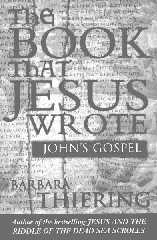
Thus in her latest work, The Book that Jesus Wrote, she argues that John 1:1 -- "In the beginning was the Word, and the Word was with God, and the Word was God" -- really means: "At midnight on 1 March, AD 29, Jesus left the enclosed monastic life and became a village teacher, one who acted also as a priest."
While some of the more reasonably minded among us may wonder how Thiering got her doctorate, this is the sort of stuff the media craves. And the average citizen -- who probably won't read Thiering's book for him or herself -- might very well accept Thiering's ideas in whatever form the media cares to digest them.
So it is with a happy sigh of relief that one greets Hershel Shanks' The Mystery and Meaning of the Dead Sea Scrolls, a breezy, reader-friendly account of the scholarship that has surrounded -- and occasionally suffocated -- the Dead Sea Scrolls since they were first discovered over 50 years ago.
Shanks, as the founding editor of Biblical Archaeology Review, has been in an ideal position to observe the archaeologists, scholars and politicians who have participated in the ongoing Scrolls saga. He is also gifted at making scholarship accessible to the lay reader, in more ways than one.
A few years ago, his magazine played a crucial role in bringing to light those fragments of the scrolls which scholars had so far refused to publish. The Biblical Archaeology Society, which publishes Shanks' magazine, also released a four-volume collection of scroll fragments co-edited by Martin Abegg (who teaches at Trinity Western University).
Shanks explores the many fascinating ways in which the Dead Sea Scrolls have forced Christians and Jews to acknowledge their common roots, and -- best of all -- he peels back the mystique that surrounds scholarship to show, among other things, how scholars sometimes unwittingly let their biases affect their interpretation of the evidence.
Photos and maps are sprinkled liberally throughout the book, which is marred by only a very few serious errors (no doubt Shanks' claim that Romans was one of a handful of New Testament texts written after the destruction of Jerusalem is due to an error in the copy editing).
The Mystery and Meaning of the Dead Sea Scrolls is a delightful, informative primer on an endlessly fascinating subject, and Shanks covers it all with a common-sense approach that, in this field, is not always so common.