
• BC Christian News • NOVEMBER ISSUE 1998 • VOL. 18 #11 • Formerly "Christian Info News" •
Festival over, films live on
- - - - - - - - - - - - - - - - - - - - - - - - - - - - - - - - - - - - - - - - - - - -
By Peter T. Chattaway
THE FILM festival has come and gone, but it will live on a little while longer in the hearts and minds of local movie buffs -- and on the screens of local theatres, where some of this year's more prestigious films will be returning for regular engagements.
Life is Beautiful
BC Christian News, · Arts
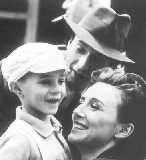 |
Life Is Beautiful (opens November 6) was voted the most popular film at this year's festival, and it's easy to see why. The unlikely premise of the film, a comedy set partly during the Holocaust, is a risky one, to be sure. But Italian writer-director-star Roberto Benigni strikes a rare and amazing balance between humor and tragedy that both affirms life and conveys the horrors that humans visit upon each other.
The first half of the film consists mostly of Guido Orefice (Benigni), a somewhat klutzy but always clever waiter, doing what he can to win the love of a schoolteacher named Dora (Nicoletta Braschi) in the last days before World War II. The film then jumps ahead to 1945, when Guido and Dora have a five year old son (Giorgio Cantarini); because Guido is Jewish they are sent to a concentration camp.
Guido, hoping to protect his son from the horrors of the camp, convinces the boy that everything around them is one big game, and that there's a prize waiting at the end for the boy who follows the rules and does not give in to the taunts of soldiers and other children -- all of whom, of course, are said to want the prize for themselves.
Personally, I could have handled a bit more realism, and I think the question of deceit, even when motivated by love, could have been explored further. But Benigni's portrayal of sacrificial hope amid relentless hopelessness is one of a very few that could be called inspirational.
Last Night
Last Night (now playing) is one of the few recent films about the end of the world in which the world actually ends. There are no nuclear bombs here to save us from spaceborne asteroids.
The film begins in Toronto six hours before the world's demise at midnight (eastern standard time, natch).
Exactly why the world is going to end, and how everyone knows, is wisely left unexplained, nor is there any hint that the planet might be rescued at the last minute. Instead, the question facing the characters in Don McKellar's thoughtful directorial debut is how they will live their last moments, knowing that death is imminent and inevitable. Many options -- including suicide pacts, prayer groups, sex binges, piano recitals and countdown parties -- are considered along the way.
Is there any meaning to these activities? The film does not exactly answer this question, though it does suggest that the will to live, and to love, is something precious in and of itself. It admirably provokes its viewers to consider what they would do at the end of it all and, by extension, what they ought to be doing with their lives here and now. --14A
Elizabeth
Elizabeth (opens November 13), directed by Shekhar Kapur, traces the consolidation of English political and religious power under Queen Elizabeth I (Oscar and Lucinda's Cate Blanchett) and her Machiavellian spymaster, Sir Francis Walsingham (Shine's Geoffrey Rush, displaying far more menace here than he did in Les Miserables).
Images of martyrdom begin and end the film. The Protestant martyrs being shorn of their hair and burned at the stake at the beginning, executed by Elizabeth's Catholic sister Queen Mary (Kathy Burke), die for their faith.
But Elizabeth's martyrdom is more symbolic; she herself is shorn as she transforms herself into the Virgin Queen, becoming a secularized substitute for the Virgin Mary and thus bringing stability to her nation.
By some odd coincidence, I happened to see the film just a few hours after reading an article in World magazine on Tony Blair's plans to instate "secular vicars" who would perform functions that used to be the domain of the church.
The film may flirt with movie conventions -- spooky assassin monks, poisons that kill the wrong people, a climax straight out of The Godfather -- but it has a relevance beyond those gimmicks.