
BCCN: Rock Lyrics
BC Christian News, · Arts
• BC Christian News • NOVEMBER ISSUE 1998 • VOL. 18 #11 • Formerly "Christian Info News" •
Christian views on rock lyrics: the good and the ugly
- - - - - - - - - - - - - - - - - - - - - - - - - - - - - - - - - - - - - - - - - - - -
By John Cody
• Bob Smithouser and Bob Waliszewski: Chart Watch, Tyndale/ Focus on the Family, 1998.
• Steve Peters and Mark Littleton: Truth About Rock, Bethany House, 1998.
Chart Watch, published by Focus on the Family, examines secular artists from a conservative Christian viewpoint. Employing sensible criteria (songs are judged solely on lyric content) the editors manage to avoid getting into a number of contentious areas.
In other words, there are no allegations of backward masking, secret satanic messages or demonic rhythms.
Over 400 current CD titles are covered, including rap, metal, country, hard-core and pop. Each act gets a brief biographical sketch, while individual titles list pro-social and/or objectionable content and a summary/advisory.
On occasion, anecdotal evidence is used to back up claims, and lyrics are misquoted. The Doors' 'The End' was an oedipal epic. Here the author says the protagonist wants to "kill, kill, kill, kill, kill, kill" his mother. Sorry, but Jim Morrison never sang those lines.
Van Morrison's Too Long in Exile, which documents his search to know God, is written off for containing a remake of his '60s chestnut 'Gloria': "Exile this disc; teens can do much better." Personally, I'd be thrilled to know teens were listening to artists of Morrison's calibre.
Nirvana, arguably the most influential band of the last decade, is curtly written off as "noxious noise with no redeeming value." UB40 is cited for a "pessimistic view of life" and a lyric is deemed offensive because it "coldly refuses to accept a mere apology from non-blacks for slavery in England, demanding retribution and 400 years back pay."
As for musical taste, the editors heap praise on acts like Kenny G and Celine Dion. They laud Michael Bolton for his "passionate" vocals; one of his albums is described as an "uplifting effort from start to finish." Consistent with that mindset, they slam two of the brightest, most refreshing acts currently recording, Beck ("worthless") and Radiohead.
The authors warn of the dangers of a legalistic mindset. Keeping children cut off from all popular music can turn it into a tantalizing forbidden fruit, they say. Conversely, an overly permissive attitude, wherein one takes no interest in what's being listened to leaves the child open to far more than he or she may be able to handle. The key, they correctly point out, is common sense, discernment and critical thinking.
Despite the reservations mentioned above, Chart Watch is for the most part well thought out, and overall the best book of its kind.
• • •
On the other hand, Truth About Rock, subtitled 'Shattering the Myth of Harmless Music,' lacks credibility. In the first few pages there are so many factual errors, chronological mistakes and myths repeated as fact that it's hard to take anything seriously. References are confusing, and too often the author cites his own earlier book.
Research is shoddy. Quotes are taken out of context, turning ideas on their head. There are scads of examples, but a for brevity's sake, a few will have to suffice.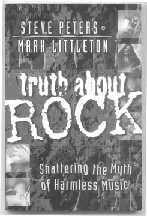
1. This depiction of a typical concert: audiences "shooting up heroin . . . urinating in public, performing open sex, starting fights and carrying weapons." After three decades in the music industry, behind the scenes, in front and as a spectator, I have yet to witness audience members shooting heroin or openly engaging in sex. I've never been involved in a fight, or threatened by a weapon. Someone threw up on my leg in 1974, but that was at a jazz concert.
2. John Lennon did not spend his last few years "so ravaged by his habitual drug use that he hid like a scared mouse, holed-up in his Dakotas apartment in New York."
At the time of his death he had returned to music after taking a five year sabbatical to raise his son. He had just released Double Fantasy, a strong return to form that celebrated domesticity and the joys of family life. Lennon's killer had been a member of a Christian youth group.
3. Buddy Holly did not write tunes with "suggestive overtones, which were muted enough for airplay but not misunderstood by fawning fans."
I mentioned this to a longtime Buddy Holly fan, who couldn't figure out what these suggestive overtones might be. He was, however, offended by the author's assertions.
4. And the real agenda behind so many rock bands? -- "to make you 'twice the son of hell' that they are."
Enough. This book is an embarrassment.