
BCCN: Reconciliation in Rwanda
• BC Christian News • DECEMBER ISSUE 1998 • VOL. 18 #12 • Formerly "Christian Info News" •
Reconciliation in Rwanda
- - - - - - - - - - - - - - - - - - - - - - - - - - - - - - - - - - - - - - - - - - - -
Stuart Spani is a video producer from North Vancouver who has just returned from his second visit to Rwanda. He has been documenting the country's slow recovery from the disastrous 1994 conflict, and offers this eyewitness account:
WHO CAN FORGET the horror as genocide swept Rwanda? Time's headline said it all: "There are no more demons in Hell; they are all in Rwanda!"
We still hear of periodic outbreaks of violence. Since April 1994, it is estimated that up to two million Rwandans have died as a result of war, starvation, disease and revenge killings. Many have asked whether reconciliation is possible. Much of the media reinforces a sense of helplessness, feeding the public flashbacks of the genocide, instead of communicating the many stories of hope and forgiveness now playing out in Rwanda.
Seeking forgiveness
 |
On my first visit to Rwanda in November, 1997, many things surprised me. The beauty of the landscape, the idyllic weather, the intensive agriculture -- but most of all the warm and friendly people, who seemed almost unanimous in seeking the one hope for Rwanda: forgiveness.
The night I arrived in Kigali, the lead story on the news showed 30,000 Hutus and Tutsis, together on their knees praying for reconciliation. Their prayers were an-swered: within weeks, 150,000 had left the rebel forces and returned to their homes, determined to live in peace.
The story which prompted this first visit was of a Tutsi preacher. Pastor Leonard had lost every member of his extended family during the genocide. He was left for dead himself, but miraculously survived, escaped and returned. He has forgiven those who killed his family and his entire congregation.
With the support of the Vancouver-based International Child Care Fund, he is now feeding, clothing and educating 150 orphans, mostly Hutus.
Having only heard stories of racial hatred in our media, I thought this story was unique; but it was not. I have since heard many more stories of people who risked or lost their lives saving those from the other tribes, and extraordinary stories of healing restoration.
One example is a Tutsi soldier who lost his parents during the genocide. In revenge he butchered a young Hutu man in front of the victim's mother. During a reconciliation crusade, he felt convicted. He found this mother, threw himself at her feet and begged for forgiveness. Not only did she offer forgiveness, but has adopted him as her son.
As I heard good news stories like these, I determined to return to the country and document some of them on video.
Healing workshops
This second visit to Kigali was a very pleasant surprise. A year ago I saw signs of hope, but against a very tense background. Everywhere, there were groups of heavily armed soldiers carefully monitoring all activity. This year, the difference was dramatic. Any soldiers I saw were alone, and smiled at me, as did almost everyone I met. Last year, people told me they wanted justice first, then reconciliation; this year the cry is forgiveness and reconciliation -- a profound difference.
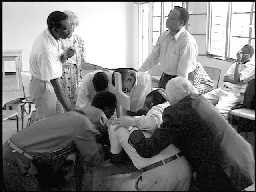
I had the opportunity to videotape a healing and reconciliation workshop at the Rouner Centre for Reconciliation, then to discuss similar programs being conducted by World Vision, African Enterprise, MAP International, the Restoration Church and the Church of Uganda. In addition to healing conferences, these groups have provided much-needed trauma counselling.
One concern haunting many believers is the role played by the church in the 1994 catastrophe. Before the genocide, almost 90 percent of the population professed to be Christian. How could a Christian nation slaughter a quarter of its population? The answer is far from simple, and lies mainly in social and political forces.
Formula for disaster
The minority Tutsis once dominated the Hutus, and treated them as serfs. The Belgian colonial regime favored the Tutsis, and passed a law forbidding Hutus from receiving higher education and holding management positions.
This was a formula for disaster. When Rwanda was granted independence in the late '50s, the Hutu majority turned on the Tutsis; many were killed, and most of those remaining fled the country.
The roles within Rwanda were reversed, with Tutsi education and employment opportunities being severely curtailed. Over the years, there were numerous periods of strife as each side sought revenge for past wrongs.
In 1991, Tutsi armies based in surrounding countries attacked. This short but intense war ended with a moderate Hutu government being installed. Tutsis were allowed to return from exile, and given more rights. These developments angered and frightened many Hutus, especially those whose families had claimed Tutsi land and businesses.
The seeds that would grow into genocide had been planted, and the resulting unrest was carefully watered by Hutus seeking revenge, or fearful of losing land.
On April 6, 1994, the president's plane was shot down. Radical Hutus seized the media outlets; building on the latent anger and fear already felt by many Hutus, they whipped the populace into a murderous frenzy. Within three months, an estimated 800,000 Tutsis and moderate Hutus were slaughtered. Tutsi armies then invaded, forcing much of the population to flee into neighboring countries. Many died in revenge killings, or succumbed to dis-ease and starvation.
Missing Christians
How could people who call themselves Christians either passively stand by, or actively participate in such atrocities? I asked many people, and an African Enterprise leader in Rwanda gave me the best answer.
Antoine Rutayisire compared Rwandan Christians to the 12 disciples. One disciple betrayed Jesus, one denied him, one stayed with him, and the remaining nine simply abandoned him.
Rutayisire said Rwanda's Christians behaved in much the same way: a few actively took part and encouraged the genocide; others denied knowing any Tutsis and refused to offer sanctuary to their Tutsi neighbors; and most fled, hoping to save themselves. Others, however, the dedicated heroes, did offer sanctuary at the risk of their own lives; and many Hutu Christians died.
Yearning for reconciliation
Only God knows if Rwandans can now live at peace with each other. The overwhelming mood I sensed was a yearning for reconciliation; however, there are many forces that could provoke another wave of killings. The war in bordering Congo could spill over into Rwanda; the complex issue of land and business ownership claims continues to be a major irritant. In addition, well over 100,000 prisoners, accused of killings, still languish in overcrowded prisons; sooner or later they must be released, and no one can predict the results.
The reconciliation workshops are pointing the way the country must go. Organizers give people an opportunity to share their pain with others; they are then invited to take all of their hurts to the cross, and to contemplate the fact that Jesus asked God to forgive those who were nailing him to the cross -- even at the height of his agony, even as they were in the act of taking his life. As the enormity of Christ's forgiveness sinks in, the need and the ability to forgive is manifested. This is the only hope for peace in Rwanda: the grace of God and the example of Jesus.
Revival is not a new thing in Rwanda; there have been several. While I was there, I learned of a prophecy that a worldwide revival will spring out of Rwanda. I visited two churches one Sunday morning; between them, these churches would have seven Sunday services, with a combined attendance of over 15,000.
As I shared in the worship, the fulfilment of this prophecy of extraordinary revival seemed imminent.