
BCCN: Robeson's eloquent struggle for dignity
BC Christian News, · Arts
• BC Christian News • FEBRUARY ISSUE 1999 • VOL. 19 #2 • Formerly "Christian Info News" •
Robeson's eloquent struggle for dignity
- - - - - - - - - - - - - - - - - - - - - - - - - - - - - - - - - - - - - - - - - - - -
By Flyn Ritchie
Paul Robeson: Speak of Me as I Am
Vision TV, February 22, 9 pm.
PAUL ROBESON was larger than life. Although he is best known as a singer, he also excelled as an athlete, linguist, scholar and actor. Vision TV will feature Robeson February 22; Denzel Washington narrates Paul Robeson: Speak of Me as I Am, which also features Sidney Poitier and Harry Belafonte.
Robeson's father was a runaway slave who went on to graduate from university. Born in 1898, Robeson won a scholarship to Rutgers University where, despite violence and racism from teammates, he won 15 varsity letters in baseball, basketball and track, and was twice named to the All-American Football Team. He graduated as valedictorian.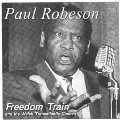
Robeson took a job with a a law firm after graduating from Columbia Law School, but left when a white secretary refused to take dictation from him. From that time on he made his mark in theatre and music promoting African and African-American culture and, increasingly, issues of world peace and justice.
He won international recognition for his role in Showboat, in which he sang 'Ol' Man River' (changing the meek line, 'I'm tired of living' and 'feared of dying' to 'I must keep fightin' until I'm dying'). But his career in dramatic and musical roles foundered in the McCarthy-era 1950s because of his desire for American cooperation with the Russian and Chinese governments.
Peace Arch Concerts
In 1950, the U.S. government revoked Robeson's passport; it took him eight years to get it back again. Highlights of that period were two concerts at Peace Arch Park just south of Vancouver, in 1952 and 1953, which have just been released on CD as Paul Robeson: The Peace Arch Concerts (Folk Era, 1998).
These concerts were major events in this area, but also received worldwide attention and were important to Robeson as he sought to overcome his government's determination to silence him.
The Manchester Guardian noted that 40,000 people had flocked to the border, mainly from the Vancouver side, for the first concert, to see the man "whose very presence seems to arouse a hysterical fear in those who oppose his political views."
Robeson was not cowed by the government persecution. The Peace Arch Concerts were a unique blend of negro spirituals, melodies in Chinese and Russian, and stirring political rhetoric.
The refrain of one song is "Didn't my Lord deliver Daniel, and why not every man?" Others are 'Every Time I Hear the Spirit' and 'Go Down Moses' (let my people go). The spirituals are accompanied by political songs such as 'Joe Hill' -- which he performed in each concert -- and 'Chin Chin (Chinese Marching Song).'
At one point he pointed out that both his father and brother were ministers with the African Methodist Episcopal Zion Church, and that his brother's church in New York had been home to leaders in the abolitionist struggle, including Harriet Tubman and Sojourner Truth.
Robeson wound up the second concert with a moving speech which demonstrates his idealism and powerful oratory -- and explains why the anticommunist leadership in the U.S. so disliked him.
He said, "Other Americans can choose their Francos if they want to, other Americans can choose the refuse of Nazi fascism . . . I choose to stretch out my hands to brave peoples of many lands, across the border to Latin America . . . to the brave people of Cuba and Mexico, across the ocean to the lands of Asia, and I stretch out my hands to the people of the new China as they build a new life for 500 million people." The audience applauded loudly.
"I speak as one whose roots are in the soil of my land," he carried on. "I speak as one whose fathers and whose mothers toiled in cotton, toiled in tobacco, toiled in indigo, toiled to help create the basic wealth on which the great land of the United States was built. The great primary wealth came from the blood and from the suffering of my forefathers, and I say that I have a right to speak out on their blood, on what they have contributed to the land . . ."
Folk Era has also just released Freedom Train, which begins with Robeson's stirring reading of the Langston Hughes poem 'Freedom Train,' and concludes with a 1957 concert given by telephone for miners in Wales, shortly before he regained his right to travel overseas. Again, songs such as 'This Little Light of Mine' are central to the concert. Robeson felt particularly close ties to Wales, a land where labor and revivalist traditions are equally strong.