
BCCN: God in the secular school
• BC Christian News • APRIL ISSUE 1999 • VOL. 19 #4 • Formerly "Christian Info News" •
God in the secular school
- - - - - - - - - - - - - - - - - - - - - - - - - - - - - - - - - - - - - - - - - - - -
By Peter T. Chattaway
IS THERE a place for God in public schools? The question has become a pressing one in recent months, ever since Justice Mary Saunders ruled that religious considerations have no place in the public school system, and it will be addressed this month at a teachers' conference sponsored by Regent College, Trinity Western University and the Teachers' Christian Fellowship.
John Stackhouse, a professor of theology at Regent College and the keynote speaker at the conference, says the question is rooted in the broader question of multiculturalism and public institutions in general.
 |
"In a culture that is as diverse as ours has become, not everyone is going to be happy with the decisions we make together," he says. "There are some positions which are mutually exclusive, so some people are simply not going to get their way."
This is not a new situation, he says, citing jails and mental institutions as places where people with radically different worldviews have tended to end up. But the question is more acute now because, he says, "as a culture, we are no longer committed to a particular religious condition, and we don't have, in my view, a comprehensive and clear public philosophy to take its place."
As a result, the public school system, being the place where many children develop their social skills and come into contact with people from different cultural and religious backgrounds for the first time, is the public institution in which this "cultural confusion" may be most evident.
Some Christians have opted out of the public school system altogether, preferring to send their children to private schools or to educate them at home. But there are also many Christian teachers and administrators who insist that the public school system is not a lost cause and that, in fact, there is room for them to be salt and light in that world.
"School is never a religion-free place," says Steve Bailey, vice principal at Burnaby South Secondary School and an ordained deacon at St. John's Anglican Church in Vancouver. "Everybody operates out of a worldview, and that worldview is, by definition, religious, because it involves systems of values and beliefs."
He adds that worldviews are not limited to beliefs and ideas; they are put into practice within communities, and they have an impact on how students interact within the scholastic community: "As we place more value on community, we have to place more value on the role of people's belief systems in their total operation within a context."
That context can be quite complex; Bailey estimates that there are over 75 different language groups represented at his school alone, and there have been some tensions between Serbian and Bosnian-Muslim students due to the recent NATO air attacks on Yugoslavia. But the complexity can express itself in more positive ways, too.
"We have two Christian [student] clubs here at Burnaby South," says Bailey. "One is sponsored by a Christian teacher, and the other is sponsored by a Buddhist teacher, which is very interesting!"
Thanks to the current emphasis on community and dialogue, teachers and administrators have begun to acknowledge the role of spirituality in, for instance, programs designed to help First Nations students. Christians working in the public school system are hopeful that a similar openness will be extended to Christianity, now that it no longer has the place of privilege.
"I think, in our society, we're in a stage where we're still trying to work out what pluralism really means," says Margaret Cooper, a retired teacher and the provincial coordinator for the Teachers' Christian Fellowship. "In the early stages of that, those who had put up with the dominance of Christianity tried to suppress it. But now we know that that's not what pluralism really means."
She adds, "Maybe it's just a hunch, but I'm hoping that the pendulum is swinging to be inclusive, so that Christians are not the only voice any more, but we definitely are a voice."
Some Christian teachers are taking a more active role within such organizations as the B.C. Teachers Federation. Last month, the BCTF tabled a proposed resolution on religious freedom and diversity at its annual general meeting. The resolution encourages teachers to become more aware of the religious diversity in their classrooms and to "foster respect for the dignity and integrity of students from a variety of religious backgrounds, including non-religious backgrounds."
This is the first time the BCTF has entertained such a policy, says Anita McBride, a science teacher at Frank Hurt Secondary School in Surrey. Some delegates objected that religious tolerance is already covered by the BCTF's code of ethics, but McBride and other delegates argued that it needed to be made more explicit.
"Of course, if it was redundant, we wouldn't have put it in," says Kerry Richardson, who teaches at Laronde Elementary School in Surrey. "But it pushed people out of their comfort zones, and it may take another year or two for people to see the merits of it."
BCTF president Kit Krieger says he supported the basic premise of the resolution, "which is that religious diversity, like all diversities, should be respected in school." However, he adds, "My concern was that we had some members who would interpret respect for religious diversity in such a way that, as a matter of conscience, teachers would be able to exempt themselves from parts of the curriculum."
For example, Krieger says biology teachers should not be exempt from teaching about evolution, and students in general should not be exempt from the Career and Personal Planning program (CAPP) -- a provincially mandated program that covers work-related issues but also more personal matters such as sexuality.
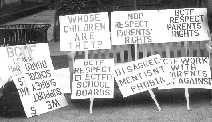
Because CAPP covers such sensitive material, a number of parents, students and religious authorities have objected to the program. Francine Howard is one recent Grade 12 student who never graduated and never qualified for scholarships -- despite being an honors student and a member of her Courtenay High School's student council -- because she refused to participate in those aspects of CAPP which, she felt, compromised her religious principles.
Francine's mother, Cheryl Howard, filed a human rights complaint, only to be told that, because Francine would have been allowed to complete CAPP at home under parental supervision, her religious rights had not been violated.
"They thought they had bent enough by having all these alternatives, and that we weren't flexible enough or reasonable enough as parents. So they weren't looking at it as religious discrimination -- they were looking at it as parents bending to the ministry," says Howard.
After a year attending Bible school in Alberta, Francine is now back at her alma mater, as a worker with Youth for Christ. Her younger sister Courtney is finishing high school and abstaining from the more problematic elements of CAPP, but she has met with little resistance. "They haven't bothered Courtney," says Cheryl. "Francine's the one who paved the way."
Steve Bailey urges caution when dealing with programs such as CAPP. He recalls a church group that began an anti-CAPP campaign at Burnaby North when he taught there a few years ago.
"What they had failed to investigate or find out is that [some of] the teachers who were doing this in the school were Christian teachers who were taking a good, healthy approach, and they hadn't even bothered to find that out. But no, this was CAPP, and they were going to protest," he says.
"We're always open in the public school system to lawsuits and litigation of all kinds, so things are done very carefully," he adds. "So when I read people putting out things about the godless, secular, evolutionary school system, it's just so much words. It's really not like that at all, and I think that's why it's so important for Christian teachers to be a part of it."
Others are more ambivalent. Ron Peters taught at a public high school in Langley until 1990, when the district was unionized; he now teaches at the Mennonite Educational Institute.
"I felt that I couldn't in good conscience join a union that was supporting abortion issues, the homosexual gay-rights agenda and striking against my employers when I was quite happy with the working conditions that I had," he says.
Several colleagues told Peters it would be better to work from within the system, but he was unpersuaded, and the intervening years have only confirmed his decision. "I think that [those teachers] may be called [to work] there, but I don't think that there's been any positive changes towards the values that we uphold and espouse as Christians," he says.
"I had just read a book by Dietrich Bonhoeffer at the time," he adds, "and he relates a story where one of his seminary students had pleaded with him to join the state church and work from within to bring change, and he said you can no more work change from within than you can change a train's direction by running up the aisle the other way."
Still, a number of Christians believe it's worth the effort to be a part of the public school system, not least because it gives them an opportunity to witness to their colleagues.
"I can't think of a greater forum for the exchange of ideas than the [BCTF] AGM," says Richardson. "I shared with more people about the Lord and my belief [at last month's meeting] than I have probably in the whole last year."
But she cautions that such efforts take both energy and humility. "You have to be willing to be embarrassed publicly, and you have to be willing to be misunderstood, and then put in the time, being among people, so that they get to know the real person and to earn some trust."
Richardson recalls feeling nervous before she went forward to speak against the BCTF's resolutions on homophobia and heterosexism at an earlier meeting, but she found that "people who disagreed with me still helped me with wording or timing, when to go up to the microphones, things like that. I don't think I could have stayed in this if there hadn't been some really fair and gracious people who did things like that."
McBride concurs, noting that progress on such issues can't happen unless people on both sides learn to abandon the stereotypes and assumptions that they may have of each other. In doing so, they can focus on points where they do agree.
'Does God Belong at School? How?' will take place at Regent College April 10.
Call (604) 224-3245 or toll free 1-800-663-8664.