
BCCN: Heart recipient takes organ donor message to Ottawa
BC Christian News, · Top Stories
• BC Christian News • APRIL ISSUE 1999 • VOL. 19 #4 • Formerly "Christian Info News" •
Heart recipient takes organ donor message to Ottawa
- - - - - - - - - - - - - - - - - - - - - - - - - - - - - - - - - - - - - - - - - - - -
By David F. Dawes
"MAY GOD bless all donor families and the precious and loving memory of all donors, for they who give the Gift of Life in so doing demonstrate a deep and very profound understanding of another of God's most perfect gifts to humanity: the Gift of Love."
This excerpt from 'A Recipient's Prayer of Thanks' is a clear reflection of the passion which motivates its author. Burnaby resident James McLaren had a heart transplant in April 1996, after 18 years of cardiac problems.
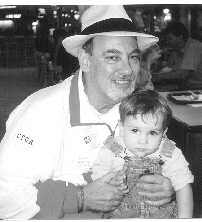 |
Since recovering from his operation, he has dedicated himself to promoting greater awareness of the need for organ donation. His personal campaign recently took him to the nation's capital, where he made a presentation to a government committee.
The issue of organ donation has recently been given a higher profile in British Columbia by the March 23 passing of Bill 50, the Universal Referral and Training Act. An amendment to the Human Tissue Gift Act, the bill requires hospitals to identify all potential organ donors, based on confirmed brain death of patients. The bill also mandates appropriate training for hospital personnel. The Act makes B.C. the only province which has a 're-quired referral' system in place.
McLaren is delighted at the news. "This is a huge positive step forward in the ongoing struggle to find enough suitable organs for the huge number of people waiting for transplants."
McLaren is a spokesperson for the Vancouver Heart Transplant Support Group, and has worked extensively with the B.C. Transplant Society. As a member of the Canadian Transplant Games Association, he was part of Team Canada in the 11th World Transplant Games in Australia, in 1997. He also initiated the 'Newheart Family,' a group of heart recipients who give support to transplant patients in hospitals.
McLaren has read his prayer at donor memorial services, and was master of ceremonies at the B.C. Donor Recognition Medal Presentation at Government House in Victoria. He has written for transplant-related publications, and been interviewed by local and national media. He is a long-time Christian.
In February, McLaren appeared before the House Standing Committee on Health in Ottawa, which has been studying issues related to organ transplants. Prior to his appearance, he submitted a detailed 10-page brief, outlining his concerns about the current state of organ and tissue donation in Canada.
"Canada's donation rate," he wrote, "is one of the lowest in the world, at approximately 14 donors per million population. This has caused a shortage of available organs, resulting in huge increases in numbers on waiting lists. As a result, one in four waiting for extra-renal transplants will tragically die while still waiting."
Further, he contended: "There seems to be an alarming lack of knowledge about organ donation and transplantation in this country. This includes the general public, and the professional health care and medical professions. As a recipient, I have had ample opportunity to see this firsthand."
McLaren pointed out several other problems, including: the small number of eligible organs, due to disease and injury inflicted on potential donors; the failure of hospitals to efficiently and accurately identify possible donors, with the result that an estimated 40 percent of viable donors are being overlooked; and the difficulty of obtaining consent from the traumatized families of potential donors.
He cited B.C.'s year-old Organ Donor Registry as a step in the right direction, and made several suggestions: "Identify, isolate and eliminate all obstacles and objections to organ donation. Develop some kind of national plan to seriously attack the problem and concentrate on educating both the public and the medical profession. A national organ donor registry would unify all data and make it instantly available to all provinces. Advertising and marketing strategies for a national registry would be a good start on education and could be instrumental in attracting more people to sign donor cards."
The need for progress, he insists, is urgent. "Many people believe they are registered because they have a sticker on their driver's license. However, they don't realize that they still have to fill out an organ donor registry card and send it in."
McLaren expresses concern that many people do not realize that organ recipients are able to live fulfilling lives. He endeavors to take a positive approach to the issue.
"Transplant recipients are normal, everyday people who have returned to normal lives as best they can . . . I wear a badge that says, 'Ask me about my transplant.' When people do, it opens the door for talks about organ donation. It's amazing, some of the reactions I get from people: 'Oh, no way, you haven't had a heart transplant; you couldn't have, you look so good.' Well, I ask you, what is a transplant recipient supposed to look like? This is something we must work on. I feel it is my duty to help to get that awareness out there by standing up, being visible and by speaking out."
McLaren's gratitude for his renewed lease on life is expressed by an essay which he included as an appendix with his brief. 'The Best Day of My Life,' written by heart recipient Gregory Lousig-Nont, states in part:
"Today is the day I quit worrying about what I don't have and start being grateful for all the wonderful things God has already given me. I'll remember that to worry is just a waste of time because my faith in God and his divine plan ensures that everything will be just fine. And tonight, before I go to bed, I'll go outside and raise my eyes to the heavens. I will stand in awe at the beauty of the stars and the moon, and I will praise God for these magnificent treasures."
For information on the B.C. Transplant Society call (604) 877-2100.