
BCCN: Hospital chaplain calls it quits
• BC Christian News • APRIL ISSUE 1999 • VOL. 19 #4 • Formerly "Christian Info News" •
Hospital chaplain calls it quits
- - - - - - - - - - - - - - - - - - - - - - - - - - - - - - - - - - - - - - - - - - - -
By John Keery
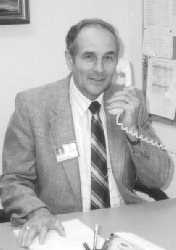
HORST GOLBECK is an energetic, incredibly efficient man who has the air about him that he really knows what he is doing. The Kelowna General Hospital chaplain for the past 13 years has to retire this year because he is 65. Surprisingly, he has no regrets.
 |
"I retire, period," Golbeck said. "I am going to become a gardener and have my own garden for the first time in my life. I told my wife, 'you will eat the produce.'"
Golbeck said he had three serious operations in 1997 which helped him identify with the patients he works with and brought home to him the fact that his life won't last forever. "God gave me an insight into my own mortality," he said.
He said many people get a message from God that they need to slow down and look after themselves, and many don't listen until it is too late.
When Golbeck came to Canada from Germany in 1954, he was a carpenter and spoke little English. God took hold of his life, and by 1958 he was studying for the ministry at Western Pentecostal Bible College, which was then in North Vancouver. He became a pastor and served in German-speaking congregations until the early 1980s, when his wife Lilly became very sick. A pastor's wife was expected to work in the church as a team member and leader alongside her husband, Golbeck said. But Lilly could no longer do that, so Horst resigned from his church and trained to become a chaplain.
A chaplain is part of the healing team in a hospital, helping deal with ethical issues and addressing patients' spiritual concerns in a non-sectarian, often non-religious way.
"A pastor's success is based on how many people head to church because of his leadership," Golbeck said. "My evaluation is: how many people have been helped to heal. It has been very rewarding at Kelowna General Hospital the past 13 1/2 years."
Gordon Fletcher shares chaplaincy duties with Golbeck. Although technically, as director of pastoral care, he has been Golbeck's boss since he came six years ago, Fletcher said he realized early on he was dealing with a master in his art, and did not want to interfere. "I decided I would take the extended care and leave Horst in the acute," he said. "He has a wonderful role with everyone in the hospital."
Golbeck has been particularly good at bringing in people from almost every imaginable faith and tradition into the hospital to minister to patients, Fletcher said. He has developed relationships with Buddhists, practitioners of traditional native Indian religion and other non-Christian groups. He has recited scripture and sung songs in his native tongue to members of the area's large German-speaking population.
Golbeck said he has had a particularly good relationship with local Jehovah's Wit-nesses.
But today many people have no religious affiliation to draw help from, he said.
"A chaplain has to have the ability to be a familiar stranger," Golbeck said. "Usually I have never seen the patient in my life and I deal with him or her for 10 or 15 minutes and may never see them again. You enter into a life's journey and minister to that person."
The fact that he ministers to people on the basis of their beliefs, does not mean for a minute he compromises his own, Golbeck insists.
"For example, it never enters my mind to believe in reincarnation."
Lilly has recovered her health and they plan to travel and help their daughter and son-in-law build a house.
The hospital is looking for a replacement. It won't be easy.