
BCCN: Labyrinth for young spirits
• BC Christian News • APRIL ISSUE 1999 • VOL. 19 #4 • Formerly "Christian Info News" •
Labyrinth
for young
spirits
- - - - - - - - - - - - - - - - - - - - - - - - - - - - - - - - - - - - - - - - - - - -
By Doug Alexander
A grey blanket hangs over Boundary Bay as I begin my journey. A mist strikes my damp face as I circle desolation.
Raindrops cling to the damp grass. A crow looms, perched on a barren tree.
I tread carefully, my feet deliberately staying within lines defined by river rocks.
All is silent.
Water glistens from two piles of stones, smoothed by centuries of rushing water.
I spiral inward.
The river sand beneath my feet crunches softly with each footfall. I spiral, turn, cMy journey ends in silent reverence as I reach the heart of the labyrinth.
Mine was a personal journey -- one of dozens teens have made recently at Ocean Park's Camp Kwomais, as they have explored the enigma of a labyrinth.
Camp Kwomais' labyrinth is the legacy of a group of youths who spent the summer creating this ancient spiritual design on a field overlooking the ocean.
"It's a meditation guide, like a prayer guide," says Ben Daniel, one of the youths who built the labyrinth. "It's a silent experience. There's no talking inside the labyrinth . . . What happens depends on what you want to get out of it."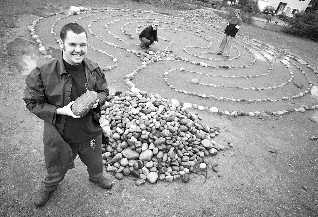
His friend, Evan Robertson, agreed. "It's a spiritual journey, a walk," he says.
Robertson, Daniel and four other youths got the idea of building a labyrinth after attending a workshop last May, which included a visit to the Lower Mainland's only pavement labyrinth, at St. Paul's Cathedral in Vancouver.
Labyrinths aren't mazes, designed to trick the mind. A labyrinth has only one path that leads into the centre and then is followed back to the beginning.
Labyrinths have ancient origins. The form has been used for centuries in several cultures around the world for meditation and prayer. Pavement labyrinths are found in many European churches and cathedrals built during the 12th century. Labyrinths are also found in Native American traditions, eastern religions, and Celtic history.
They have captured renewed interest in the past decade. San Francisco Rev. Dr. Lauren Artress, creator of the Labyrinth Project and Veriditas, called the labyrinth "a spiritual discipline" that soothes the mind and spirit.
"It calms the confused mind and the chaotic, fearful heart. It allows us to release all that is in the way of relating to the divine: our hard-heartedness, our judgments, our impatience."
The youths were so intrigued by the labyrinth concept that they decided to build their own. The first labyrinth was created by drawing lines out of lime on the field.
The youth at Camp Kwomais built a 'Cretan' labyrinth, a well-known design with seven layers of paths that close in on a central point. The latest incarnation, done in September, was made with softball-sized stones embedded in river sand to mark the circular pathway on the ground.
One entrance, facing south, leads into the labyrinth. The path spirals inside the 13-metre circle until it ends in the centre, in a round chamber.
"My first time walking it was amazing. I had just an amazing experience," Heather Dunbar said. "The spot itself has a lot to do with everything . . . We had a specific spot, Sunset Point, because it has got spectacular views."
Dunbar, 19, was skeptical about the 'power' of the labyrinth. Now she's its biggest convert.
Daniel was also moved.
"I got a deep sense of oneness with nature. It sounds really corny, but it's the great view of the ocean; there's trees, mountains in the background. It's a nice nature feeling, a feeling that there's something out there."
Reprinted from The NOW Community.