
BCCN: Refugee seeks sanctuary from changing immigration policies
BC Christian News, · Top Stories
• BC Christian News • APRIL ISSUE 1999 • VOL. 19 #4 • Formerly "Christian Info News" •
Refugee seeks sanctuary from changing immigration policies
- - - - - - - - - - - - - - - - - - - - - - - - - - - - - - - - - - - - - - - - - - - -
By David F. Dawes
AS CANADIAN immigration policy comes under criticism by advocates for refugees, Christians in British Columbia are directly intervening on behalf of a family rejected by Immigration Canada.
A recently released government white paper, 'Building on a Strong Foundation for the 21st Century,' proposes changes to the Immigration Act.
The Canadian Council for Refugees critiques the paper's new categories of immigrant inadmissibility, stating: "This is going in the wrong direction; they already have too many categories." The CCR believes that some proposed measures are "likely to increase arbitrary detention and lead to intimidation of refugees." Further, "some categories of claimants will be particularly vulnerable, e.g. women fleeing domestic violence or sexual assault, [and] people fleeing persecution based on sexual orientation."
Tom Clark, director of the Toronto-based Inter-Church Committee for Refugees (ICCR), commented on the new government strategy: "There is no fundamental new direction . . . At best, there is minor tinkering within the same old formulas. It reflects Canada's rather spotty 'humanitarian tradition,' with its 'none is too many' approach to Jewish asylum seekers in the 1930s, its incarceration of all citizens with links to Japan in the 1940s [and] its visas to block the arrival of Chilean and then Guatemalan asylum seekers in the 1970s and 1980s."
ICCR board member Heather Macdonald, of Coquitlam, contends that if the proposed changes are implemented, "the new Immigration Act is going to make the process faster and harsher, in the name of expediency."
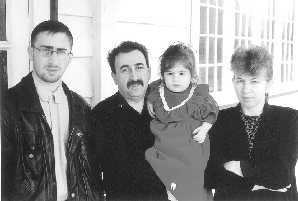 |
In Vancouver, Christians have been galvanized by the government's perceived inflexibility and lack of compassion, in the case of a family originally from Kazakhstan. The time-honored tradition of sanctuary has been extended to Alexander Sapidi by the Ukrainian and Slavic Full Gospel Church, as he awaits the results of efforts on his family's behalf.
Sapidi, his wife Lubov, and his son Alexander Jr. fled Kazakhstan in 1991 when the country broke free from the Soviet Union . Because Alexander is half Jewish, the family felt vulnerable to persecution in their predominantly Muslim homeland; so they emigrated to Israel.
There, however, Lubov's Orthodox Ukrainian background became a problem. Because Israeli custom dictates that children are not considered Jewish if the mother is not Jewish, their son was taunted and Lubov was the object of insults. The family moved on to Germany, but were refused refugee status and deported back to Israel.
In 1994, they came to Canada. Fear of rejection induced them to exaggerate their experiences, and they falsely claimed they had been threatened physically. However, prior to their hearing, they admitted their deception to immigration officials, and the application was tossed out. The reason they confessed their lie was that they had just become born again believers. They wrote a letter to government officials apologizing and asking forgiveness.
They have since made a Humanitarian and Compassionate Application to stay in Canada. Despite the fact that no final decision has been made on the application, Immigration Canada insists that Alexander be deported to Israel. The situation is complicated by the fact that the Sapidis now have a two year old daughter, Daniella, who is technically a Canadian.
Their lawyer, Mir Huculak, says a removals officer bullied Alexander into renewing his Israeli passport in December. Huculak decried what he called "Gestapo tactics," claiming that the officer threatened to arrest Alexander and turn his daughter over to Social Services. When he received an order to leave for Israel without his family February 25, Alexander accepted his church's offer of sanctuary.
He expresses amazement at the actions of immigration officials. "In the Soviet Union, they did not treat me this way. To threaten to take away my child -- in 44 years, I've never run across something like this. I feel there is some kind of resentment toward my family and me -- and I feel it is only because I'm a Jew who has believed in Christ."
As his faith has sustained him, it has also grown. "I now have a fuller understanding of the Bible. Finding myself in the position of being persecuted, I now understand how to love my enemies and pray for them. I would never have understood that if I had not experienced these things. We pray that God will save these officials through his Son -- and when God saves them, our question will be resolved, because Jesus changes hearts."
"We would hate to lose them," says Full Gospel Church pastor Peter Chernenko, who considers the Sapidis "hard-working, honest . . . caring, generous, giving people."
For him, the primary issue is the attempt to separate the family. "We are founded on the word of God. The Bible says, 'Those who God has joined, man shall not separate.' International agreements between countries also have provided laws to protect the family." He cites the Universal Declaration of Human Rights, Article 16 (3): "The family is the natural and fundamental group unit of society and is entitled to protection by society and the state."
Rev. Michael Brandebura, superintendent and bishop of the Western Slavic Conference of the Pentecostal Assemblies of Canada, believes that if the Sapidis are deported back to Israel, they will face "discrimination and persecution" because of Alexander's status as "a born again Messianic Jew."
Valerie Zaitseff, a Full Gospel member and manager of Door of Hope International in Canada, has contacted Christians across North America on the Sapidis' behalf.
She cautions that church sanctuary is not always respected in North America. She cites a recent case in the Seattle area, in which a Russian immigrant was forcibly removed from a church and deported.
At Zaitseff's instigation, MP Libby Davies has written to Immigration Canada, stating: "It appears that the Sapidis are a family that has integrated successfully into Canada and is fully self sufficient. If removed [to Israel] . . . the family would suffer religious persecution for their Christian beliefs."
"What makes Canada great," declares Zaitseff, "is that it has always historically been a refuge for those who are oppressed and persecuted -- particularly for their faith. I don't think we can just be a country of rich, successful people, and still be a great country. In God's word, it says we must reach out to the destitute. God gives us those people so we would learn to show compassion to them."
For more information on the Sapidis' situation, call (604) 430-1747.