
BCCN: Pro-lifers want 'civil' disobedience
• BC Christian News • MAY ISSUE 1999 • VOL. 19 #5 • Formerly "Christian Info News" •
Pro-lifers want 'civil' disobedience
- - - - - - - - - - - - - - - - - - - - - - - - - - - - - - - - - - - - - - - - - - - -
By Jeff Dewsbury
MAY IS a special month in the pro-life movement because of Mother's Day. This year, May will be a particularly full month for pro-lifers.
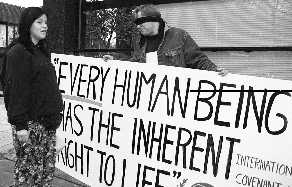 |
On May 4 - 7 the B.C. Supreme Court will hear Jim Demers' second appeal on a conviction of "watching and besetting" in disobedience of the province's 'bubble-zone' law -- legislation that restricts protesting around places that provide abortion.
He was arrested outside Everywoman's Health Centre for holding a sign which read: "Every person has the right to have his life respected. This right shall be protected by law and, in general, from the moment of conception," a quote from the Organization of American States' American Convention on Human Rights.
He will be arguing his complex case based on the premise that unborn children are protected under international law.
On May 10, Norma McCorvey -- best known as 'Roe' in the famous Roe vs Wade trial that was instrumental in legalizing abortion in the U.S. -- will address a fundraising dinner, sponsored by the Pro Life Society of B.C., expected to draw 1,200 people. Both events exemplify different, somewhat polarized, aspects of the movement.
Demers -- a Nelson carpenter who has been a pro-life activist for many years -- is launching a second appeal, after the judge in his first appeal stepped down following three days of hearings. Supreme Court Justice Risa Levine stepped aside during Demers' initial challenge, citing a conflict about presiding over the case.
Lloyd McKenzie, information officer for the B.C. Supreme Court said (Georgia Straight, February 4), "She [Levine] felt she didn't have the necessary detachment that she must have in trying a case."
"It was such an unusual situation for the judge to get that far into the case and then step down," Demers said. "It's reasonable to expect that in a new case, when new evidence is being submitted, but not in an appeal." The first appeal cost Demers over $20,000.
B.C.'s bubble-zone legislation, unique in Canada, has been challenged on and off the streets. John Hof, president of the Campaign Life Coalition, says that police have even monitored the content of prayers being said on the sidewalks outside of Vancouver's two freestanding abortion clinics.
According to Hof, a group participating in a prayer vigil once had their prayers taped by the police. "We questioned them about what they were doing. They said that we could pray as long as we didn't pray about the sanctity of life, the unborn, abortion, anything like that," he says. "Some of them looked very embarrassed."
Michael Markwick, a pro-life advocate who has acted as an advisor on human rights issues for a variety of groups, including the Ontario Human Rights Commission, thinks that scenes like these will raise the public's interest in the abortion debate.
"Right now police monitor prayers, but are powerless to move child pornography from people's homes. The average thinking person must be taking a step back and looking at these issues," he asserts.
B.C. Civil Liberties spokesperson John Westwood expresses his group's support for the legislation because the law creates harassment-free zones around doctors' offices and homes. He adds that the legislation provides "needed privacy and safety for doctors."
Westwood's organization is in favor of banning even the right to peacefully protest in front of the buildings, because people have been harassed in the past as they walked to and from the clinics.
Despite harsh words from both sides of the emotional debate, there is a call to civility from many high profile pro-lifers. Norma McCorvey was once embroiled in the political struggle to make abortion legal in the United States.
Now a Christian, a pro-lifer, and head of the organization Roe No More, McCorvey, once worked at an abortion clinic. She attributes her conversion to a loving little girl who lived next door to the clinic where the woman worked; the girl's parents were part of an Operation Rescue protest that often blocked access to the clinic.
According to the girl's mother, Ronda Mackey, on the Roe No More website, "Emily saw something I couldn't see. She would tell 'Miss Norma' that abortion was wrong, but that she still loved her."
McCorvey wants to change hearts through dialogue. "I'm not out to see Roe vs Wade reversed, as much as I'd like it to be," she says. "The Lord's called me to go speak to women, hoping that if there's just that one sitting in that audience on that particular night, I can change her mind."
It's the battle for public opinion -- the need to win people over through reasoned discourse -- that many feel is the future for the movement.
"A lack in civility decries a lapse in faith," declares Markwick, who was one of the featured speakers at 'Tearing Down the Walls,' the B.C. pro-life conference held in Kamloops April 23 - 24.
"We have to restore discussion to public life. The purpose of a democracy isn't to debate parking by-laws. It's to debate public moral issues," he says. "We need to debate the 'hard stuff' together as citizens who respect each other."
Despite court challenges and street-level clashes, the battle for public opinion is where many pro-lifers are placing their focus.
"We are at a crossroads," says John Hof. "We are having a real awakening to the practical approach. We have an issue that is currently avoided in public debate."
Hof says the average person is unaware that there is full government funding for all abortions in Canada and that a child can be aborted at any stage in its mother's pregnancy. Once the issues are truly debated, "there can be a major turnaround based on practical truth," he states. Hof adds to the equation the lack of medical school students who are training to become abortionists, and he sees a favorable outcome. "Abortion will become unavailable long before it becomes illegal."
According to Markwick and others, true debate has been stifled because of the actions of fringe radicals who have committed violent acts. "The best thing that could have advanced [the pro-choicers'] cause is the shootings," he says. "They want to make us irrelevant, say that we are hate-filled people."
The Achilles heel of the movement, Markwick says, is the way abortion supporters can readily point at incidents of "Christians being unchristian."
The battle to get past caricatures of each other and to delve into the issues starts with the Christian community, he emphasizes. "We have a duty to bring to the debate an authentic Christian witness, a duty to respect life at all stages. Until that is done well, we'll never live up to the task of speaking about the sanctity of human life."
The pro-life movement's battle for responsible debate seems far from over. Pro-choice activist Joyce Arthur recently wrote a response to UBC students who tried to arrange an on campus debate between pro-life debater Scott Klusendorf and a defender of abortion.
In an article on her website called 'Why Pro-Choice Supporters Do Not Debate the Anti-Choice,' she wrote: "Simply having a debate with the anti-choice lends legitimacy and credibility to the so-called pro-life position. And it provides a platform for dangerous anti-choice propaganda. We do not recognize as legitimate a position that is characterized by falsehood, hypocrisy, small-mindedness and intolerance. Why should we give the appearance of legitimacy to the anti-choice position, when we have our hands full just trying to counter anti-choice misinformation, lies, threats and violence? Would a Jew debate a Nazi?"