
BCCN: War-torn 'pariah state' needs help to stand
BC Christian News, · International
• BC Christian News • MAY ISSUE 1999 • VOL. 19 #5 • Formerly "Christian Info News" •
War-torn 'pariah state' needs help to stand
- - - - - - - - - - - - - - - - - - - - - - - - - - - - - - - - - - - - - - - - - - - -
By James Kwantes
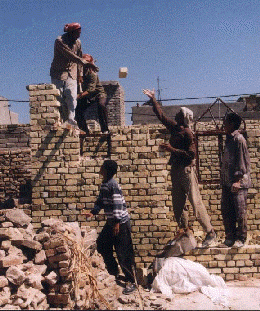 |
BOMBED BUILDINGS dotted the skyline of the capital city, whose residents have grown accustomed to air raid sirens and bombing attacks. A government official informed me which buildings -- potential military targets -- I could not photograph during my recent visit to the pariah state.
Belgrade?
No, Baghdad, the ancient 'city of peace.' I visited Iraq from March 1 to 11 as part of a Mennonite Central Committee peace delegation whose goal was to extend an olive branch to an ostracized people.
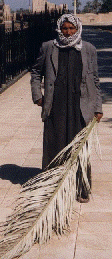 |
Our delegation of four Canadians, three Americans and one New Zealander went to the Middle East bearing gifts: up-to-date medical journals that are largely unavailable there. The difficulty we encountered at a desert border post seemed to illustrate the polarized relationship between the West and Iraq: a border guard who said the journals were a "big problem" relented and allowed us to take them in only after we threatened to leave the books at the border.
We left Iraq feeling blessed by the warm hospitality shown us by the Iraqi people. To our surprise, there was no visible animosity towards delegation members, although we came from countries that have been punishing Iraq -- with weapons during the Gulf War, and sanctions and bombing raids since -- for most of a decade.
 |
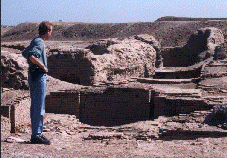
A visitor soon discovers that modern-day geopolitics overshadows the rich historical record in this cradle of Western civilization. To visit the ruins of Ur, Abraham's birthplace, we needed the permission of the area's governor, since the site is located in a heavily militarized southern area that had seen heavy U.S. bombardment in recent weeks. An air raid siren sounded nearby as we waited to meet with the governor -- a tangible reminder that U.S. and British planes continued to pound the country every day of our visit.
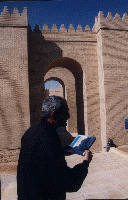
Our Bedouin guide to the ruins of Ur pointed out a clay tablet etched with cuneiform, the precursor to all Western alphabets. At the rebuilt ruins of Babylon, we retraced the steps of the captive Jews, who would have passed through the colorful Ishtar Gate and marvelled at the splendor of the ancient city.
In Basra, a southern city, we worshipped and took communion at a packed Chaldean church dating back to the third century in Iraq. The church's liturgy was conducted in Arabic and Aramaic, the language Jesus spoke. After the service, we met with the church's bishop, who had photos of both Pope John Paul and Iraqi president Saddam Hussein posted on his wall.
 |
Christians -- who make up about five percent of Iraq's population -- are granted more religious freedom than Shi'ite Muslims, who comprise a majority of the population and are seen as a potential threat to Saddam Hussein and his Sunni-dominated regime.
A once-wealthy nation whose principal source of revenue was oil sales, Iraq has been brought to its knees through eight years of extensive economic sanctions. Many of the sewage treatment and water pumping stations damaged during the Gulf War remain in disarray due to restrictive sanctions and the high cost of replacement parts.
As a result, health officials are seeing increases in water-borne diseases, in addition to increased stunting and malnutrition among children who don't get enough protein (rations that have been in place since 1996 do not include meat, which many families can't afford). Iraq's universal health care system, once one of the best in the region, is now ill-equipped to deal with the fallout.
Government officials and hospital directors thanked our delegation for the help MCC provides in the country, but told us again and again: "We appreciate the help, but lift the sanctions and we will help ourselves."
 |
As followers of the Prince of Peace, how should we respond when belligerent leaders in countries such as Iraq and Yugoslavia thumb their noses at the international community?
If an adequate response starts with seeing both Iraqis and Serbians as human beings first and foremost, rather than viewing them in the context of international politics, it should end by attempting to change the underlying structures rather than simply providing aid.
In Kosovo, that means going beyond helping Albanian refugees, as vital as that is, and in Iraq, it means more than giving Iraqis food and medicine and praying that a new leader replaces Saddam.
If the United States and its allies, Canada included, bear a large measure of responsibility for creating the dire conditions that now exist in Iraq -- and by any objective analysis, they do -- then surely Christians in those nations should be at the forefront of demanding changes to the sanctions regime to provide the Iraqis with the tools they need to help themselves.