
BCCN: What will the church of the 21st century look like?
BC Christian News, · Top Stories
• BC Christian News • JUNE ISSUE 1999 • VOL. 19 #6 • Formerly "Christian Info News" •
What will the church of the 21st century look like?
- - - - - - - - - - - - - - - - - - - - - - - - - - - - - - - - - - - - - - - - - - - -
This is the first in a series on architecture and the church.
By Michelle Milligan
 |
THE ANSWER to that question is as varied as the different forms of Christianity. One current trend is a total scale-back of anything that resembles the traditional church. For some Gen-X Christians, the building itself is somewhat irrelevant -- it is merely a place to gather and worship, no frills required. For others, the traditions of art, music, and architecture are very much a part of their history and always will be.
The first Christians met secretly in small groups, in whatever safe places were available to them. Christ himself said, "For where two or three come together in my name, there am I with them." The gathering made the place sacred because of Christ's presence. This is the reason that we meet at a place of worship rather than just pray in the privacy of our own homes, or email our prayers.
Jesus wants us to connect with one another, person-to-person, to love each other and the Lord. The purpose of gathering together is to get to know each other, and Jesus, deeper. As we join as this 'community of love,' we are able to better understand God's love for us.
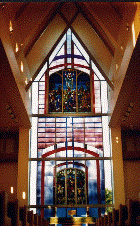
The pre-Reformation church was intensely embellished with beautiful works of art. Tourists still flood to European cathedrals to witness the works of Michelangelo. Many of us still listen joyously to the Palastrina and Monteverdi masses. This style of church is still present, but rarely duplicated. In many of our modern day churches we retain vestiges of the traditional church. We adorn our roofs with steeples and crosses. Stained glass is often used to depict a scene in the life of Jesus. For some Christians, these elements are an integral part of a sacramental tradition.
 |
For other Christians, these same elements are simply a reminder of an oppressive time in history. For them, simplicity and the lack of imagery represents a truer expression of Christian virtue.
The commonality of all Christian denominations is that they have a specific place set apart for the purpose of worship -- it's not just a gathering place like a neighborhood recreation centre or coffee shop. The church has always had the central purpose of worship. Churches of yesterday were built solely with this intention in mind. The Church building was used for Sunday morning worship. The rest of the week, the building was left unused.
Today's church is built with the intention of daily use. We still find the church busiest on Sunday morning, but we also see small groups gathering on week-nights. Some churches host youth activities like basketball in their gyms, and Christian drama productions in their sanctuaries. The church of the future is built with its use in mind. Each congregation will build a church that is reflective of their own identity. The way the church looks should not necessarily be based on a preconceived 'church' look, but on how the church will be used.
The ideal church of the 21st century is a place where you can experience Christ's gospel being lived. It should be a place of warmth, where you feel welcomed and included. The church should feel like a second home where you are part of a larger family, where your gifts a encouraged and put into service. The church is a sacred place, regardless of the style of the building. It is sacred because of what happens within its walls.