
• BC Christian News • JULY ISSUE 1999 • VOL. 19 #7 • Formerly "Christian Info News" •
Testimony: the couple behind 'Footprints'
- - - - - - - - - - - - - - - - - - - - - - - - - - - - - - - - - - - - - - - - - - - -
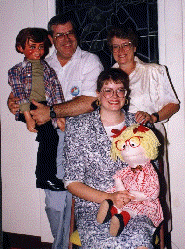
Decades ago, Paul Powers was transformed from a violent criminal to a servant of Christ. A key figure in this process was his future wife, Margaret Fishback. He, in turn, provided the inspiration for one of her poems, popularly known as 'Footprints,' which has since inspired countless people. Together, they operate Little People's Ministry, based in Coquitlam. Paul's story, Too Tough to Cry (HarperCollins), was published last year. The following testimonies were adapted from interviews conducted by broadcaster Bernice Gerard.
Paul Powers:
BC Christian News, · Top Stories
 |
I was raised in the garbage pits in Sarnia, Ontario. I was part of a street gang at age eight, and within four years I was part of a gang of 25; there are four of us still alive today.
At age 12, I robbed a lady at a carnival. I was trying to escape, and I was frightened -- and I shot her. I didn't do it deliberately; I was trying to scare her away, and I just pulled the trigger. I was sent to reform school for murder and armed robbery. I was filled with hatred and bitterness and resentment.
Some people ask me, "What about Sunday school and church?" I never went. My father hated it. I can remember vividly at the Colonial Hotel in Sarnia, watching my father throw a Salvation Army officer out, and rip up his papers and throw them in his face. He had a hatred of the Bible. My brothers and sisters and I grew up without the Gospel.
When I was 21 years old, I went to a Youth for Christ rally in Belleville; it was there I became a believer. After that I went back to the reform school one Sunday afternoon, to share my testimony.
I was involved in London, Ontario, in Youth For Christ. But I was borrowing from the offering plate to go out Saturday nights. I believe the word for that is "theft," isn't it? So I had to face that, and I left. For the next few years I was in a very bad backslidden condition.
In 1964, a pastor that I'd had as a speaker at Youth for Christ, A.W. Tozer, came to a shoestore where I was working. He was surprised to see me and invited me out for lunch and talked with me. And I told him: "I'm finished, I can't be used again. I'm like a broken cup -- you can't use a broken cup again."
He spent time visiting me, and coming by. I started to go to a midweek prayer meeting, and then started going to church. And then just about that time, I met the young girl that I was later to marry.
Marriage was a great thing, because I married a girl who'd been a missionary. In 1966, the year after we were married, we got involved in ministry. The motto of Little People's Ministry, for some 30 years now, has been: "Unless we reach their hearts today, they'll break our hearts tomorrow." And I understand that.
Margaret Powers:
I wrote the 'Footprints' poem on Thanksgiving weekend in 1964, at Echo Lake Youth Camp, near Kingston, Ontario.
When we arrived at the camp, Paul presented me with a ring. And I laughed; I thought it was a bit of a joke. He said, "I'm surprising you. I want you to marry me." I had to really think deeply about it. We took a walk on the beach, and talked about marriage.
I knew a little bit of his background -- and it was quite the opposite from my life. I had been raised in a Christian home, and gone to Sunday school since I was two or three years old.
As we walked back along the beach, we glanced down and I noticed that the footprints were being washed up. And I said to him: "Well, it looks like we don't stand much of a chance. Our footprints are being washed away." And he kind of laughed, and said: "Well, you know, the Lord is there, to carry us."
I said "Yes" to marrying him -- but I wasn't completely convinced. All of a sudden I looked down again, and I said: "Well, I don't know what you have to say about this, but there are no footprints left!"
And he hoisted me up over his shoulder and walked along. I was quite sophisticated, and it was a bit of a shock to me. He kept walking, and I said "Put me down, put me down." I felt suddenly like I didn't know this young man.
And he put me down and he said: "Margie, I really do want to marry you. But I wanted to remind you that when we can't see the footprints, God is still there. When I was carrying you, you couldn't see me, but I was there. Even though we can't see the Lord, he's there -- and he'll carry us."
That night, I couldn't sleep . . . and I started to write down the words of I Had a Dream. And it was a promise that God gave me: that no matter what decision I had to make after that weekend, that He would be with me, to walk and talk with me.
I Had a Dream ('Footprints')
One night a man had a dream. He dreamed he was walking along the beach with the Lord. Across the sky flashed scenes from his life. For each scene, he noticed two sets of footprints in the sand: one belonging to him, and the other to the Lord.
When the last scene of his life flashed before him, he looked back at the footprints in the sand. He noticed that many times along the path of his life there was only one set of footprints. He also noticed that it happened at the very lowest and saddest times in his life.
This really bothered him and he questioned the Lord about it. "Lord, you said that once I decided to follow you, you'd walk with me all the way. But I have noticed that during the most troublesome times in my life, there is only one set of footprints. I don't understand why, when I needed you most, you would leave me."
The Lord replied, "My son, My precious child, I love you and would never leave you. During your times of trial and suffering, when you see only one set of footprints, it was then that I carried you."
Margaret Fishback Powers