
• BC Christian News • AUGUST ISSUE 1999 • VOL. 19 #8 • Formerly "Christian Info News" •
Capitalizing on Y2K fear
- - - - - - - - - - - - - - - - - - - - - - - - - - - - - - - - - - - - - - - - - - - -
By David F. Dawes
"WE ARE only 11 months away from Y2K doom!"
This headline is not from a tabloid newspaper; it appeared in February, in a newsletter issued by an evangelical Christian ministry. It is emblematic of a trend in the Christian community that many observers find disturbing.
The Year 2000 problem, now commonly referred to as 'Y2K,' will occur when the New Year arrives; computers using two-digit dating systems are expected to malfunction when 00 replaces 99. The Christian marketplace has been flooded with books advocating prudent disaster preparations, and offering a wide range of opinions as to the magnitude of the problem.
Some evangelicals are convinced that Y2K worries are vastly exaggerated. In Pentecostal Testimony, William Griffin writes: "The over-dramatized New Year's day has the exact same significance as today, the day you are reading this page. Every day is another gracious opportunity to prepare for Christ's return by reaching sinners and dealing with personal sin."
Margaret Brouillette has attempted to inject a little levity into the discussion with her article, 'Y2K in the Highest,' in which the archangel Michael worries about about the millennium bug's effect: "What if God goes off-line?" Michael is especially concerned about the Lamb's Book of Life, and tells Gabriel: "I hope we still have it in hard copy somewhere."
Grace To You broadcaster and author John MacArthur prefers to write and speak about the return of Christ; his latest book is The Second Coming, and he has recently released a tape series called Jesus Is Coming. He states: "I'm always amazed at how resilient our society is . . . Human ingenuity under God's wonderful, creative, providential control is pretty amazing, and I'm quite confident we'll slide by the Y2K phenomenon rather readily, and it won't have a great impact on any of us, actually."
Many of those who believe Y2K will cause serious problems, such as financial advisor Larry Burkett, are rejecting alarmism. Burkett has stated: "Y2K did not catch God by surprise."
Larry Willard, writing in Pentecostal Testimony, foresees potential problems and advises preparation; but he also maintains a sense of humor, whimsically asking: "Do we need an extra sweater or a bomb shelter?"
In addition to prudent preparation, groups like the Atlanta-based Joseph Project 2000 are emphasizing the importance of helping those in need. Joseph Project materials encourage Christians "to prepare individually, form prayer teams . . . and reach out to their neighbors."
Several British Columbia churches are preparing to offer help to their surrounding communities.
Summerland Pentecostal assistant pastor Jean Miller declares: "As a church, we believe we should be ready to reach out to the community in any disaster, including earthquake, fire, flood -- or Y2K. We would give help in any situation; we're not isolating Y2K as a specific problem."
Abbotsford's Central Heights MB Church is taking a similar approach. The church has formed an Emergency Response Team to deal with various catastrophes. As for Y2K, senior pastor Chris Douglas states: "If nothing happens, great. If something happens, then we will be there with a helping hand." Burnaby's Willingdon Church is also planning to make food available to people living in the neighborhood.
Millennial Fever
Y2K doomsayers offer up a smorgasbord of potential catastrophes: plane crashes, economic collapse, social anarchy, terrorism, nuclear plant meltdowns and accidental missile launches. The potential for panic is exacerbated by speculators who invest Y2K with prophetic significance.
The attention given to the hypothetical biblical ramifications of Y2K comes at a time when many other forms of millennial speculation are coming to the fore. EP News recently reported on a study done in Ohio, involving just over 1,000 people. "The survey found that only 15 percent believe it's 'very likely' or 'somewhat likely' that 'the arrival of the new millennium means that the world will come to an end'; two-thirds of the respondents say they believe looming, global demise is 'very unlikely.' But 72 percent said they generally believe the predictions in the Book of Revelation -- that 'someday the world, as we know it, will be drastically changed by an act of God.'"
Apocalyptic concerns are also getting increasing attention in the secular media.
The July 19 National Post ran an article about the resurgence of Aum Shinrikyo in Japan. The cult, led by Shoko Asahara, has been accused of using deadly sarin gas to usher in its own apocalypse. Seven people were killed in a 1994 attack; 12 were killed and 5,000 injured during an attack on the Tokyo subway at rush hour in 1995. The cult, reduced to about 1,500 members from a high of 10,000, has quietly generated revenue of $74 million from the sale of computers in Tokyo. The Post stated: "[Japan's] Public Safety Agency said in a report that Aum has refocused its energies on one of Mr. Asahara's preachings that Armageddon will come in 1999."
On a more lighthearted note, a recent National Post editorial quoted the 16th century mystic Nostradamus: "In the year 1999 and seven months / From the sky will come a great King of Terror." Rather than dismiss the seer as a fraud, the writer pointed out that Nostradamus used the old Julian calendar, and stated: "His 'seventh month' is our eighth month. Cassini, a NASA probe carrying 72 pounds of plutonium, will swing by earth on its way to Saturn on 18 August . . . Feel free to take alarm."
Meanwhile, the Sun tabloid picks up where Nostradamus left off, predicting that the battle of Armageddon will happen in 2001, and that aliens will land in Washington DC in 2003, announcing that "the creator of all things" will soon return. Judgment day, says the Sun, will be July 4, 2003, when Christ ushers in "a new Golden Age of peace and prosperity." And on January 1, 3003, "every man, woman and child living on earth will be taken up bodily to heaven."
Various secular filmmakers have succumbed to the lure posed by TEOTWAWKI ('the end of the world as we know it.') The Canadian film, Last Night, follows the fortunes of Torontonians as they await the end, scheduled for midnight, December 31, 1999. In The Book of Life, also set on the brink of 2000, a business-suited Jesus is called to use a computer to open the seals of Revelation; this very post-modern Christ instead rejects the wrath of his Father, refuses to open the final seals, and winds up drinking to drown his sorrows.
2000 has been invested with great significance by Christians for reasons other than potential catastrophe. Pope John Paul plans to mark the beginning of the third Christian millennium in the Holy Land in March.
Luis Bush, who coined the missionary concept of 'the 1040 window' said early this year: "I think the year 2000 itself will be potentially the year of greatest spiritual response to the gospel of any year in Christian history."
Others predict that God will give the church power over all world institutions next year. Evangelical notable Kim Clements has stated: "Everything that was stolen from the body of Christ in the last 20 years will be restored . . . [The church will] take the reins for the year 2000."
Next year will also be a very busy -- and potentially tense -- time in the land of Christ's birth. Israeli psychologists expect that 2000 will attract a lot of religious pilgrims afflicted with a malady labelled 'Jerusalem Syndrome'; the term refers to a delusional condition, usually temporary, which causes people to fantasize that they are actually characters from biblical times.
All the while, Christians have been turning out myriads of books and videos with a wide range of apocalyptic themes. Larry Bates' book, The New Economic Disorder, is advertised as "a startling expose of the coming financial wipeout."
Ultra-conservative talk-show host Marlin Maddoux has published Seal of Gaia, a novel set in 2031. The book depicts a global government whose leader plots chemical and germ warfare; he labels Christians 'Offenders,' and worships Gaia, the Mother Earth, "who must be appeased at any cost."
Canadian prophecy buffs, the LaLonde Brothers, are finishing an end-times trilogy of films. In their 1998 release, Apocalypse, a videotape of veteran Bible speculator Jack Van Impe plays a pivotal role in bringing people to Christ during the reign of the Antichrist. Earlier this year, the LaLondes released Revelation, a well-made thriller in which the Antichrist uses virtual reality technology to entice people to worship him. The third film will reportedly be entitled Tribulation, and will deal with the persecution of Christians.
Old faces are surfacing with new ideas. After serving time in prison, and renouncing his former prosperity gospel teachings, Jim Bakker has published Prosperity and the Coming Apocalypse. Bakker believes that recent natural disasters are indicative of 'the Last Days,' and that an impending world economic collapse will spark terrorism; he warns Christians to shun materialism and prepare for Christ's return.
In the meantime, some Christians continue to perpetuate alarmist scenarios that have been accepted uncritically by many evangelicals. The most popular of these is the theory that Scripture predicts an attack on Israel by an alliance of Russian and Muslim forces. Variations on this theme are still being touted by Grant Jeffrey, Jack Van Impe, Morris Cerullo, Hal Lindsey and Jonathan Hanson, among others.
As various Christians have continued to promulgate doomsday scenarios which are at times sensationalistic and irresponsible, the mainstream media have thrown the 'millennium bug' into the already volatile atmosphere of conjecture. And Bible-wielding fortune tellers have jumped on the bandwagon.
As Christianity Today put it: "Secular Y2K speculation has been grafted onto escalating end-times talk in Christian circles." One result is that many evangelicals are becoming convinced that Y2K will be a catastrophe of literally biblical proportions.
In response, Christian Computing magazine declared: "Some actually refuse to believe the good reports because they hold to a conspiracy theory that the government is going to use Y2K to declare martial law and do away with elections."
God's judgment?
Some evangelicals believe Y2K may be a divine wake-up call. Larry Willard wonders: "Could we be the generation who witnesses Y2K and the Rapture as well?" In a 1998 sermon, Jerry Falwell took a more dire view, conjecturing that God "may be preparing to confound our language, to jam our communications, scatter our efforts, and judge us for our sin and rebellion against his lordship."
Author Michael Hyatt has a similar perspective. "If there's one god that has reigned supreme in the modern pantheon of gods, it's the god of science and technology. And let's face it -- as Christians, we've worshipped at that shrine . . . I think that God is shaking the foundations, so that we can see . . . where our true dependencies lie. We're not dependent on this technology to the extent that we're dependent upon God -- and we'd better understand the difference as Christians."
James Dobson of Focus on the Family concurs: "The judgment of God -- I think that is the centrepiece of this issue. Regardless of what the outcome is gonna be, there's one thing I know: and that is that God cares about the morals and behavior of his people."
In his video, Millennium Bug and the Year 2000, Ken Klein declares: "We are running headlong into a technological hurricane." One part of the video refers to Revelation 18:10, which states "O Babylon, city of power! In one hour your doom has come!" Klein speculates: "Will that hour be when the clock strikes midnight, January 1, 2000?"
For various Christians who have repeatedly seized upon current events to bolster their biblical speculations, this potential crisis has proven to be a potent addition to their arsenal of end-times scenarios.
In recent years, Hal Lindsey has marketed books and videos with titles like The Final Battle; The War to End All Wars; The Millennium and the Last Judgment; and Armageddon Scenario. Lindsey's Y2K video, Facing Millennial Midnight, claims that the millennium bug "could do to our civilization what the iceberg did to the Titanic."
His ministry has issued many other dire projections. Countdown magazine asserts: "A Y2K blackout will result in bank runs on a scale unseen since the days following the Crash of 1929." Lindsey's International Intelligence Briefing declares: "The UN plans to play a significant role in supervising global crisis spots in a post-Y2K world. This is a crisis made to order for a global government in waiting, and it's waiting patiently for the chance to prove it is up to the task."
 |
Grant Jeffrey has written a best-selling book on the subject. The back cover of Millennium Meltdown states: "The Year 2000 Crisis will be the most devastating and expensive problem in history." He speculates that Y2K could be the catalyst for the establishment of a worldwide cashless economic system -- setting the stage for people to have a computerized 'mark of the Beast' embedded under their skin.
"It all comes down to the question of whether there is a genuine crisis," Jeffrey asserts. "Personally, I don't know anyone who believes this is a minor thing. My book is like a hurricane warning -- a wake-up call. There is a significant chance this could happen. The likelihood of disruptions, errors and delays is much greater than five to 10 percent."
In response to concerns that his book is alarmist, he states: "I do not apologise for saying that this crisis is real. In light of the risk, I'm suggesting that a few steps of preparation are appropriate, so you don't have to lie awake worrying about it." To that end, he adds, "I try not to use hyperbole or exaggerated language."
While that may be the case, Jeffrey is allowing one of his colleagues to use very hyperbolic language in an advertisement offering a video based on his book. "Don't get caught in the millennium meltdown!" warns a fundraising appeal for evangelist Morris Cerullo's ministry. Cerullo writes: "We are less than a year away from the destruction that will come . . ." The ad refers to Jeffrey's "intensive research efforts to prepare the Body of Christ for the coming disaster!"
Jeffrey's book places a lot of emphasis on hypothetical conspiracies and potentially catastrophic scenarios. He writes: "The increasing power of the United Nations, the International Monetary Fund, the World Trade Organization, and the World Court are rapidly destroying traditional national sovereignty and replacing national political motivations with a global economic agenda . . . Those people dedicated to creating a New World Order realize that the only practical way to achieve their goal is to create an economic, political, or military crisis of such vast proportions that no nation, on its own, could possibly solve it. The Y2K computer crisis provides a unique opportunity to impose a global government solution . . . [It] may be the final crisis that will encourage the nations of the world to surrender. The need to establish global standards of computer communications, a possible worldwide common currency, and a new banking system may eliminate whatever remaining obstacles that stand in the way of the global government the Bible prophesies will rise in the last days."
Despite the tone of much of his book, Jeffrey maintains: "I'm very optimistic. We are going to get through this. I see this as an opportunity to demonstrate the love of Christ." Jeffrey insists that he is only speculating about what he perceives to be the possible scriptural implications of Y2K; he says he is not contending that the phenomenon was predicted in the Bible.
"I don't make predictions. Nobody but God knows what will happen in January. You can't link this event directly to prophecy. I've always said there's no prophecy in the Bible about Y2K. There's also no prophecy about World War Two and the Holocaust. But many would argue that World War Two and the Holocaust (although they're not found in the Bible) were still prophetically significant because they set the stage for the rebirth of Israel -- which is prophesied in the Bible."
Morris Cerullo has frequently linked Y2K with scripture. In a January fundraising letter, Cerullo stated that Y2K "could shut down life as we know it." He has also declared that Y2K "may very well be the trigger that will set off a sequence of worldwide events that could result in the fulfilment of major end-time prophecies leading to the coming of the Lord Jesus Christ
. . . The atmosphere of fear and anarchy that could result from Y2K could be just the circumstances needed for a world ruler to arise."
In a special Y2K issue of his Victory Miracle Living magazine, Cerullo asserts: "This problem could instantly throw the entire world into chaos [and] could bring a darkness such as never seen on the face of the planet until now." Despite these claims, Cerullo has no qualms about advertising, in the very same issue, an event scheduled for Jerusalem just over four weeks into this potentially hazardous time period.
Cerullo's 'New Millennium Israel International Prophecy Conference 2000,' scheduled January 31 - February 9, promises to present teaching by "giants of prophecy" such as Grant Jeffrey. A fundraising letter proclaims: "Expect to receive the most powerful end-time anointing God has ever released!" The ads promise a "journey of destiny . . . a life-changing pilgrimage," and offer round-trip airfare from North America or England; travel insurance; five-star hotel accommodations; full-course meals; and air-conditioned bus tours to historic sites.
Nowhere in the ads, or in Cerullo's letter, is any mention made of precautions being taken to avert any of the Y2K malfunctions he has repeatedly warned about. Nevertheless, prospective attendees are asked to send a $200 non-refundable deposit.
"How can he give absolute assurance of Y2K compliance?" asks Grant Jeffrey, in Cerullo's defence. "Knowing the way his organization operates, I'd assume the conference was probably planned at least two years in advance. The main countries involved -- Israel, the U.S., Canada and Britain -- lead the world in Y2K preparation. He knows this. I asked him if he still wants to go through with this. Mr. Cerullo likely believes the disruptions will be dealt with by late January."
Some Christians have taken scriptural speculation to fantastical extremes. Notorious conspiracy buff Texe Marrs speculates that the American government may have deliberately engineered Y2K to usher in a police state. In his new video, A.D. 2000 -- Year of Destiny, he also predicts that the next century will begin with a sinister event inside the Great Pyramid of Egypt.
He writes: "The creme of the Illuminati, the men of the Inner Circle, will be conducting a black mass inside the King's chamber. The grotesque ceremony, these men believe, will culminate in a visit by their glowing Masonic god of light and magic, Lucifer himself, at exactly the stroke of midnight, December 31, 1999 . . . Lucifer will be privately communing with his chief human disciples and energizing their Great Work of establishing his antichrist kingdom on this planet." Marrs also believes "secret 666 rituals" will be conducted next year at the Summer Olympics.
Christian over-reaction to Y2K has not gone unnoticed in the secular world. Esquire magazine published a satirical article about a Y2K conference sponsored by Pat Robertson. Author Tom Junod quipped that Robertson "embodies the larger paradox at the heart of Christianity: its simultaneous status as mainstream religion and apocalyptic cult. It's a mainstream apocalyptic cult, hence the interest in Y2K, a mainstream apocalypse -- a reliable apocalypse."
Douglas Todd was more scornful in a Vancouver Sun column called 'Nothing Christian about Y2K fear-mongering.' Todd stated: "It's bad enough when fanatic Christians look forward to the end of the world because they believe that's when gentle Jesus will return to Earth to brutally separate the unrighteous chaff from the (self-) righteous wheat. It's even more despicable when U. S. televangelists like Jerry Falwell and Jack Van Impe -- and the only slightly less over-the-top Canadian Jeffrey Grant [sic] -- have have so little trouble accepting tonnes of money for videos, CDs, books and seminars that feed people's anxiety about the Y2K bug."
Todd further declared: "Fringe-dwellers like Falwell seize on the Y2K bug to extrapolate that the resulting chaos will be God's judgment on a society grown arrogant, rich and immoral on technology." Citing the fact that most biblical scholars believe Christ was actually born in 4 BC, he added: "This doesn't discourage misguided mystifiers like Falwell and Van Impe from wanting governments to collapse to make their religious prophecies come true."
Many Christians have expressed similar concerns. On the Bible Answer Man broadcast, Christian Research Institute president Hank Hanegraaff recently stated: "I have just completed an exhaustive study on Y2K in which I look at the sophistry of those who are writing books and making all kinds of apocalyptic pronouncements . . . They're torturing scripture to try to fit this situation into some kind of a biblical prophecy." He decries what he calls the "sloppy journalism" of these writers. "It is hype. It is a windfall and a bonanza for publishers . . . I think it's imprudent to hype, and to use bad information to drive people into a panic and a frenzy."
Hanegraaff concluded: "I agree with Bill Gates. If everybody simply calms down and doesn't make this a self-fulfilling prophecy, it won't even warrant being a top 10 news story in the year 2000."
Author Dave Hunt is also attempting to counterract the trend toward prophetic alarmism. The cover of Hunt's book, Y2K: A Reasoned Response to Mass Hysteria, declares: "Some Christian leaders have gone so far as to connect this event with the cataclysmic predictions of biblical prophecy and suggest that Christians need to prepare for the coming tribulation . . . Dave Hunt argues that some so-called experts have overstated the dangers [and] that Y2K has no direct relationship to biblical prophecy."
William Griffin succinctly states: "The Y2K bug is not a creature from the Book of Revelation." He cautions: "The big story may be the really erratic and volatile behavior of impatient and intolerant humans who suffer inconvenience when technology stumbles. Road rage will be insignificant in comparison with millennial madness."
Richard Abanes, in the July issue of Charisma, writes: "Sadly, the church has again become the subject of ridicule thanks to countless doomsday-obsessed believers who have exchanged the true drama of Christian life for little more than a cartoon sketch starring prophecy peddlers . . . Christians seem to care little that today's most prosperous end-time preachers have been repeatedly wrong."
Abanes concludes: "Those of us who know better than to propose timetables for Jesus' second advent will eventually be forced to repair the damage done by these doomsday prophecies . . . Recasting Christianity in a credible light may prove both frustrating and time-consuming."
Capitalizing on fear?
Y2K has provided a wide variety of marketing opportunities, and Christian entrepreneurs have not been reticent about participating.
Craig Smith is CEO of the Arizona-based Swiss America Trading Corporation, a company which deals in rare coins. His company also sponsors Y2K CPR, a 'Critical Preparation Resource' dedicated to Y2K concerns. It features a variety of contributors, generally promoting variations on negative Y2K scenarios. Smith has appeared several times on Bob Larson's TalkBack program, and offers advice on how investing in gold can help Christians profit from the Y2K problem.
Another Christian company utilizing Y2K fears as a selling point is AlpineAire Foods, based in Washington state. Its Beyond 2000 program offers Gourmet Reserves freeze-dried food. A letter to prospective customers warns of the possible "stark consequences" of the Y2K bug, and urges immediate action: "You will not have to wait four to six months to get your food . . . and it will put you ahead of thousands who will soon be seeing the need, and then they'll have to wait." A free portable burner is offered with every purchase of three or 12 months' worth of food.
William Mikoula, who attends Harvest Christian Centre in Vernon, is selling Y2K preparedness materials. He believes "a recession and depression will be triggered by Y2K," and declares: "It's a question of whether we're prepared, and whether we can help others. Someone may go to hell because we aren't prepared to show we care." His manual includes an invitation to accept Christ, and states: "This is the time for the church to be there to help the world by providing food, clothing, and most of all love." However, the overall emphasis of the manual is on personal survival.
"I'm not trying to scare people," he maintains. "Someone has to carry the torch and wake up churches. Pastors are deathly afraid to speak on Y2K, because the Christian community is a divided camp. On one side, there's almost total denial and apathy. On the other side are the extremists, upsetting the apple cart by predicting doom." He believes the millennium bug has prophetic implications: "I don't think Y2K is going to bring in the biblical Apocalypse, but I do believe it will set the foundation for some things spoken of in Revelation -- such as a cashless society and world government."
Mikoula offers a 'Promote and Prosper Plan,' billed as "a lucrative solution for protecting yourself"; the plan enables interested individuals to "make money every day" as distributors of his materials. He defends the plan, insisting: "I'm not getting rich off this. Making money was never the intent. I've spent a lot more than I've made. Some people don't have the means to prepare for Y2K. So if they can sell these manuals to their friends, it'll help them."
Grant Jeffrey sees nothing wrong with businesses providing stockpiles of food and gold, or offering survival guides. "I don't believe it's exploitation for entrepreneurs to provide goods or services others might wish to buy. I have no reason to think that such people are insincere when they say that they believe Y2K is a genuine crisis."
Shaunti Feldhahn is founder of Joseph Project 2000 and author of The Millennium Bug: A Balanced Christian Response. She counsels discernment. "There are a lot of materials on the market, and unfortunately on the internet, that are somewhat survivalist, that are basically saying 'Grab a dog, grab a shotgun and head for the hills' . . . That has unfortunately caused a lot of people really just to turn their ears off to the whole issue, because they don't want to be a part of that."
Bunker mentality
The bulk of Mikoula's manual was written by Oregon resident Jim Majka, who describes himself as "pro-US Constitution, pro-biblical, traditional and family values." He advocates stockpiling several months worth of food, stating: "Up to a year's supply would not be excessive." He also writes:
"It will be very unlikely that more than a few people will have gold and sliver coins to barter with . . . He who owns the gold makes the rules. Get some. Today. While you still can. And keep quiet about it." Elsewhere, he states: "There are indications that the US government is preparing for martial law."
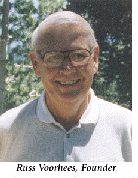 |
Majka recommends Christian websites which cater to survivalism, such as 'Y2K: Bug of the Century'; this website has a link to 'Heritage West 2000,' which advertises a utopian real estate scheme. Featuring photos of founder Russ Voorhees smiling benignly, the Heritage site promises nothing less than a "new Golden Age." Voorhees offers "A living solution to Year 2000 problems." His proposed development features 500 half-acre homesites located northeast of Phoenix, Arizona, with houses designed to use solar and wind power.
The community is billed as "the model rural village for what may be a whole new way of life in the first part of the next century." Voorhees states:
"The pioneers of the next millennium . . . [will] raise healthy, self-reliant, confident and capable children in a rural setting, which fosters a return to the values that made America great . . . Together, we can forge a lifestyle for 'the way things ought to be.' And we can enjoy life in the safe open spaces of the beautiful White Mountains of Arizona."
Voorhees says his village "may prove to be the seed from which the new society is regenerated," and exhorts: "Join me in building this very significant community for ourselves, for God and for humanity." The website urges prospective Golden Age pioneers to send a $1,000 check as a "fully refundable" deposit to reserve one of the homesites.
This survivalist viewpoint is being fueled by the pessimistic claims of prominent figures in the Y2K industry.
Gary North's website calls 2000 "The Year the Earth Stands Still." He foresees a worldwide stock market crash, and predicts that Y2K will cause "a nightmare for every area of life, in every region of the industrialized world."
According to the Christian Research Journal, North is a Reconstructionist, who hopes Christians will establish a theocracy based on Old Testament laws. The Journal states: "North foresees a vast social upheaval that will overthrow present governmental powers, so Christians can take over the country and gradually Christianize the world by the power of the Holy Spirit."
Michael Hyatt has been one of the more high-profile speakers on the subject. He has written The Millennium Bug: How to Survive the Coming Chaos, and co-authored a work of fiction called Y2K: The Day the World Shut Down. The latter book, described in PR materials as "a chilling novel," posits a disaster in which "markets crash, banks fold, and the world is thrown into panic."
On a Focus on the Family broadcast, Hyatt presented several negative scenarios. At the very least, he asserted, Y2K will cause problems for two weeks; he also said a societal "meltdown" could possibly happen, lasting more than 10 years. Citing "decades of Social Darwinism and moral relativism," he stated: "I think we've just gone under the cloud of divine judgment. We could see it coming, and I think we're there."
Many believers apparently agree. The Seattle Times reported that Robert Andrews, a pastor who has moved his congregation to a town in northwest Washington State, is evidently expecting America to collapse into a cluster of independent rural states. Andrews stated: "If God misses 2000 to judge, he will have missed a great opportunity."
"More than 90 percent of my customers come from the Christian population of the country," says Greg Wiatt. "They're all concerned about how the government is handling Y2K. As a whole, they don't trust the government." Wiatt is the organizer of the Concerned Christians for Christ Preparedness Group, and operates a food distributorship in a small Arizona community.
The 'Bug of the Century' website quotes him: "Already you run across people in the cities who'll kill you for a hamburger. Can you imagine what will happen when these people stop getting their government checks?" He is also predicting that Tucson, Arizona will be invaded by "10 million Mexicans pouring in after Y2K." According to the Christian Research Journal, Wiatt has stated: "Gold, guns, groceries and God are the four Gs of Y2K."
Some of the more mainstream figures promoting disaster preparedness distance themselves from such extremes. Gold speculator Craig Smith insists that he doesn't wish to cater to paranoia: "To sell everything that you have -- and buy dehydrated banana chips, machine guns and krugerrands and dig into a bunker mentality and wait for the end to come -- that would be stupid." Mikoula states: "I don't agree with Gary North's doom and gloom scenarios. I don't believe Y2K is going to be cataclysmic." Grant Jeffrey agrees, asserting: "North's perspective is an extreme apocalyptic view."
KARI Radio, based in Washington, frequently features ads urging people to buy dried foods and gold to prepare for an end-times financial wipeout. However, a KARI promo cautions prudence in relation to the millennium bug, stating: "Don't allow yourself to become more concerned about the coming of Y2K that you are about the coming of Christ."
Some Y2K activists also stress the importance of faith. Jim Majka writes: "It is a fact that you could spend over $10,000 and be fortified and stocked up to the rafters with gold and silver, cash, solar panels, gasoline, water, generators, survival food, on and on and on . . . and neglect that one person who will see you through it all. Jesus will give you peace, he will walk with you through storms that are coming."
Grace Wiebe expresses similar sentiments. She works with various missionaries, and believes Y2K could be quite serious. But she also stresses the big picture, writing: "We can take comfort and courage from the fact that our all-powerful God is our Deliverer, Savior, Refuge, our Immanuel who never leaves or forsakes us . . . He has never promised to spare us from difficulty, but He has promised to be with us through it and to fulfil His purposes for us as we trust in him."
But the 'bunker mentality' has crept into mainstream Christian circles. A Washington Post story says that, in a video called A Christian's Guide to the Millennium Bug, Jerry Falwell says he intends to stockpile "food, sugar, gasoline and ammunition." He also reportedly states: "Because I'm blessed with a little food and my family is inside the house with me, I've got to be sure I can persuade others not to mess with us."
Mikoula finds such comments distressing. "I don't think I own anything that's worth taking someone's life over. It's a sad state when we have people of Mr. Falwell's calibre doing this, leading by example. Whatever happened to turning the other cheek?"
The survivalist approach has been decried by many other believers, including Grant Jeffrey, who states: "A bunker mentality is disobedient to the word of God. I'd rather meet my neighbor with a loaf of bread than with a gun." Joel Belz, of World Magazine, laments: "The very thought of Christians by the thousands deliberately choosing to flee from the culture we are here to affect should depress us." Larry Willard insists: "It would be unconscionable for able-bodied Christians to vacate the cities and head for the hills, leaving behind the old, the poor and the handicapped to defend themselves."
Christianity Today admonishes: "Christians are hoarding for a hypothetical disaster while many Third World Christians not only have no electricity or running water but are in danger of being tortured, enslaved or murdered."
Plain Truth editor Greg Albrecht says simply: "We are called to give of ourselves rather than to survive at all costs."
Our finest hour?
Many Y2K preparedness advocates are convinced the event will serve as a catalyst to bring countless people to Christ. Michael Hyatt declares: "I'm looking forward to what God is going to do, because God is very much at work, I believe . . . This could be the church's finest hour. I think this could be an opportunity for evangelism and ministry that we haven't seen in a hundred years." William Mikoula is even more enthused, stating: "This is the greatest opportunity Christians have had in 2,000 years."
"What's wrong with today?" responds Gretchen Passantino of Answers In Action. "Why aren't we witnessing today? Just tell the Christians that suffered and starved to death under Stalin in Soviet Georgia, that Y2K is going to give us a great opportunity to share the gospel that we've never had before . . . We should preach the gospel today, because Christ has already died and saved us from our sins. That's what we need to be going out and proclaiming to people -- not some coming, impending economic or social disaster."
Her annoyance is shared by Bob George, author of Classic Christianity. On a recent People to People broadcast, he stated: "I think that [Y2K] has probably been overstated more than anything that I've ever heard of in my life -- and the majority of the people doing the overstating are unfortunately Christians, who should be walking by faith and living a day at a time, which is what the Lord said . . . Those people are making a lot of money on their tapes as they are able to scare the daylights out of people -- but Y2K has nothing to do with the Bible at all . . .
"We're just becoming idiotic in preoccupation with that sort of thing . . .
When you stop to think of how people have survived in Russia and other parts of the world . . . and God never let them down. We're not scared to death of not having something to eat; we're scared to death that our fortunes are going to be dealt with a little . . . We've become very spoiled brats . . . If we have a little glitch, so what? Where is our faith in the Lord Jesus Christ . . . if our faith is not big enough to realize that the grace of God is going to take care of that?"
George concludes: "The only thing that can cause a tragedy in this country is people listening to a bunch of these Christians that are on the air creating fear, and then . . . selling all their stock, pulling their money out of the bank and causing a financial crisis."
Larry Willard, despite misgivings about Y2K, declares: "What a fitting and sobering reminder of the fallibility of mankind and the reason we are celebrating the year 2000 anyway. God still loves helpless sinners, and Jesus has already supplied the solution for a problem that far exceeds the potential Y2K chaos. Let's not allow this problem to steal our chance to announce the real meaning of AD 2000 to the world."
Harry Maier, a Lutheran minister and Vancouver School of Theology professor, asserts: "I'm a bit distressed at how the church has been responding. The view that Christians should stock food or hoard fresh water flies in the face of the teaching of Jesus. In Matthew 6, he says "Do not worry.' The people of God are not the people who are anxious about tomorrow. Non-religious people are already fearful of the world. When Christians say the Y2K bug will herald the Great Tribulation, they're making the world a more fearful place. This is almost a counter-witness. What are we to be in the world? We are to be a sign of hope."
Stanley Grenz echoes this view. A professor affiliated with Regent and Carey colleges in Vancouver, he has written about the coming of the biblical Millennium -- the thousand years of peace on earth under the rule of Jesus. Grenz advocates "concern but not hysteria" regarding Y2K, declaring: "The evangelistic side of me would say this is an opportunity for the proclamation of the gospel in a sane and hopeful manner. Rather than saying this will signal Jesus' return, or that it is a sign of God's judgment, we can show our hope in the promises of God, seen in Revelation 21 and 22, as the answer to the anxiety of the world."
Central Heights pastor Chris Douglas concurs. "No matter how dark the situation, we know that in the end Jesus wins. We can tell people that Jesus is going to be triumphant. We can help them here and now, and we can get them prepared for the hereafter."
Or, as broadcaster and Plain Truth columnist Steve Brown sagely concludes: "After January 1, 2000, God will still be sitting on his throne. And I suspect there won't be any perspiration on his upper lip."