
BCCN: Frank Peretti's creative talent comes of age in Visitation
• BC Christian News • AUGUST ISSUE 1999 • VOL. 19 #8 • Formerly "Christian Info News" •
Frank Peretti's creative talent comes of age in Visitation
- - - - - - - - - - - - - - - - - - - - - - - - - - - - - - - - - - - - - - - - - - - -
By Ron Reed
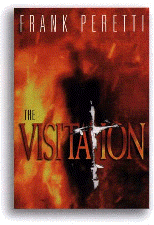 |
• Frank Peretti: The Visitation, Word, 1999.
FRANK PERETTI sells heaps of books. Depending on your point of view, his supernatural thrillers are either badly written exercises in paranoia or a spiritually perceptive impetus to intercessory prayer.
In Peretti's earlier work, such as the well-known This Present Darkness, mundane day-to-day human experience is mostly just a distraction from the real story of supernatural warfare between the forces of Darkness and Light. In his latest book, however, it looks like the author may have become tired of cranking out spiritual pot-boilers. Maybe he figures it's time to deal a little less with the supernatural, a little more with the spirit.
Travis Jordan is a former Pentecostal pastor who lives on his own and no longer attends church. Ostracized by the local ministerial and estranged from the enthusiastic young minister who has come to take over his ministry, he is an outsider. When he hears news of unusual, perhaps miraculous events, he is mostly just glad that he no longer has to deal with such things.
Then he has a strangely stirring encounter with a young man cutting his neighbor's lawn. This soft-spoken outsider is willing to stir up feelings Jordan would rather leave buried, but he also extends a compassion and understanding that sets the embittered pastor on a journey toward reconciliation and healing.
As the signs and wonders continue, Jordan is increasingly confronted with the possibility that Christ's second coming may be imminent -- in fact, that Antioch, in Washington State, might be the new Bethlehem or Nazareth. Who is this enigmatic young stranger?
Peretti does a marvellous job of placing the reader in the same uncertain position as the central character. Is this an unexpected but legitimate Second Coming, a sort of 'What if God Was One of Us' incarnation? Or is it some sort of deception? And because those questions aren't resolved too quickly or neatly, the very human characters in the book must struggle with real questions about the nature of discipleship and the cross, and how those realities are interwoven with the undeniably supernatural elements of our faith.
Travis Jordan's spiritual journey leads him to consider many episodes in his life; growing up through the '60s in a small Pentecostal church in Seattle, experiencing the charismatic renewal as a high school student in the early '70s in Puget Sound, seeking to follow the Lord's leading through intense romances and high-wattage calls to the ministry, a brush with one of the Southern California mega-churches, the founding of a pioneering ministry in a Washington wheat town, the struggles and small crucifixions that can come in ministry and marriage.
Not only does this back story flesh out the very human character at the centre of the novel, it also serves as a fictionalized but personal account of some important events in the life of the church over these past few decades. I recognized episodes in my own life, and was deeply touched to see them rendered so faithfully and perceptively in fiction. There are lots of novels about coming of age sexually: here is one about coming of age spiritually.
For me, this element of the book is its great strength, and its great surprise. With all respect to those who found This Present Darkness an exhilarating read, perhaps a stimulus to prayer, I found it embarrassingly inept. Cardboard characters, pot-boiler plot . . .
It was a theological thriller, but the thrills were cheap -- 'Angels and demons duke it out in this best-seller!' -- and so was the theology. It smacked of paranoia and conspiracy theories. It seemed calculated to instil fearfulness and suspicion, with a strong element of self-righteousness. The world was (quite literally) going to hell in a humanist handbasket, and anyone who didn't recognize that was either 'of the Devil' or being duped by the Devil.
Peretti's first novel was A Warning: don't tolerate anything you don't understand or agree with, because you might be serving The Enemy. Characters in This Present Darkness divided far too easily into Good Guys and Very Bad Guys, and the author seemed to imply that people in the real world could be similarly divided.
The Visitation is so much more substantial and accomplished that it's hard to believe this is the same writer. The fear-fueled human tendency to exaggerate 'us and them' differences is shown to be part of what has damaged the preacher and his ministry: a colleague who writes off the local liberal pastor is reminded of the woman's evident compassion, while a visiting evangelist is recognized as peddling a fairly toxic brand of Old Time Religion: "'Hey Travis, come to the meetings. It'll be good for what ails you' -- I could hear the message coming between the lines: You need to come back to square one and do it all over again, just do it harder."
Peretti, it seems, has lived through spiritual burn-out, has wrestled with his own demons and emerged a more compassionate and human Christian -- or, at least, a more gracious and nuanced writer.
There comes a point in the novel where the supernatural forces which have been seething under the surface -- both Dark and Light -- come very much to the fore. This is familiar Peretti territory, and the fact that this passage doesn't work particularly well is testimony to his success in establishing a very effective realism throughout the rest of the book.
I enjoyed The Visitation. There is humor in this book as well as insight. And there is grace, even for many of the 'bad guys': Peretti is no longer willing to write characters off, and so the work seems that much closer to the spirit of Christ. And for all the increased sophistication of his writing, he hasn't lost the knack of keeping those pages turning.