
BCCN: Stiller hits secular market with a sacred message
BC Christian News, · Arts
• BC Christian News • SEPTEMBER ISSUE 1999 • VOL. 19 #8 • Formerly "Christian Info News" •
Stiller hits secular market with a sacred message
- - - - - - - - - - - - - - - - - - - - - - - - - - - - - - - - - - - - - - - - - - - -
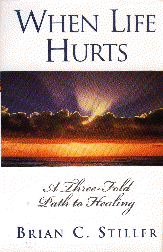 |
• Brian Stiller: When Life Hurts: A Three-Fold Path to Healing (Toronto: Harper Collins, 1999)
By Debra Fieguth
AN ACQUAINTANCE of Brian Stiller told him she encountered a woman who had just picked up his newly-published book, When Life Hurts, not knowing the person she was talking to knew Stiller. The first woman asked her what she thought of the book. "It's a bit religious," she reported, "and I can't put it down."
She's the very type of reader Stiller had hoped to attract when he sat down at his cottage last summer to write his seventh book.
Simply put, the book is "for hurting people of all sorts," Stiller said in an interview with Christian Week. The secular publisher (Harper Collins) didn't put any restrictions on Stiller's Christian perspective. Despite the generic title, the book concludes with a profound and clearly stated gospel message.
"In my heart I'm really an evangelist," explains Stiller, who became president of Tyndale College and Seminary in 1996, after years as head of the Evangelical Fellowship of Canada and, prior to that, Youth for Christ.
Stiller drew on a metaphor used by Lesslie Newbigin in Household of Faith to develop his idea. "My real desire is that people encounter Christ. So if I can invite them into the household of faith they can meet the Lord."
As he saw it, the door to the house was the commonality of suffering in peoples' lives. The question he needed to answer for himself was, "How can I get people up to the door?"
He chose to use stories as the steps that would lead readers to the door and invite them to open it. His stories are drawn from the Bible, from other writers-- Victor Frankl and Philip Yancey among them -- and from personal experience and contacts. Woven throughout is the story of how his brother David and his wife, Evelyn, came to terms with the suicide of their 18 year-old daughter.
When Life Hurts begins by outlining different sources of pain: death, guilt, broken relationships, unrealized dreams. Stiller then introduces the 'three-fold path' to healing: hope, faith, and love. He quotes liberally from The Message, Eugene Peterson's paraphrase of the New Testament and, to follow through with the metaphor, gently draws readers in through the door way to get a clear picture of who Jesus is.
Post-modern readers are much more open to spiritual ideas than people were even just a few years ago, Stiller notes. Evangelicals have moved from rationalism to an appreciation of mysticism, while those without faith "have also come to realize that rationality is not the only lens through which you learn truth.
"The reality of the 20th century for many ends up in barrenness and death," he adds. "Out of the emotional barrenness of the 20th century they're searching for something with great meaning."
Stiller is up-front about the fact that no great meaning, and no real healing from hurt, can take place apart from God. He relates the story of a Cambodian fellow named Reaksa Himm, for example, who survived the horrors of the Khmer Rouge when his family members were clubbed and hacked to death. Reaksa became a Christian at a Thai refugee camp, and later came to Canada.
Reaksa plans to work with Cambodians suffering from the wounds of war. "I want to see Cambodian people start to smile again," he explains. "They have suffered so much, and nothing will make them whole again except the healing message of Jesus' love and forgiveness."
It's that kind of illustration that makes Stiller's book stand as one of hope, faith and love. x