
BCCN: Christians raise their concerns at Seattle WTO protest
BC Christian News, · International
• BC Christian News • JANUARY ISSUE 2000 • VOL. 20 #1 • Formerly "Christian Info News" •
Christians raise their concerns at Seattle WTO protest
- - - - - - - - - - - - - - - - - - - - - - - - - - - - - - - - - - - - - - - - - - - -
 |
By David F. Dawes
IT WAS BILLED as 'The Protest of the Millennium' by some of its organizers. However, while protest was indeed the order of the day for thousands opposed to the World Trade Organization (WTO) meeting in Seattle November 30 - December 3, faith also played a key role.
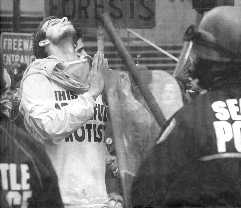
Prayer provided at least one dramatic image for the media; a striking photo showed a protester standing in front of riot police, face uplifted beyond the chaos, seeking some form of divine assurance or intercession.
Prayer was also important to many other opponents of the WTO.
An 'Interfaith Jubilee Service' held at Seattle's First United Methodist Church drew 1,500 participants. The event, which focussed on debt relief for poor countries, was attended by people from a very wide range of Christian denominations, as well as representatives of Jewish, Muslim, Buddhist, Unitarian and Aboriginal faiths.
The service included drama, the music of Sweet Honey in the Rock, and liturgical dance by Denise Nadeau of Vancouver.
In addition to the service, and participation in non-violent protest, Christians were involved in political discussions, some of which were held in church basements.
Proponents of the WTO maintain that the organization's promotion of free trade has invigorated the global economy and benefitted consumers.
 |
Opponents insist that the primary beneficiaries of the WTO are rich CEOs; they express a broad range of concerns, involving everything from labor practices and genetically modified food to the effect of industry on the environment.
Some 3,000 WTO delegates from 135 countries converged on Seattle, to discuss topics such as market access and agricultural trade. Tens of thousands of protesters took over five city intersections, resulting in massive traffic problems. Most protesters confined their activities to chanting, dancing, singing or forming human chains. However, a minority were involved in such things as vandalizing buses, verbally abusing WTO delegates, burning money, setting fires in dumpsters and shattering the windows of stores and banks. Their actions were condemned by protest organizers, who had carefully prepared their contingents with training in peaceful protest methods.
The protests succeeded in stopping the opening ceremonies of the WTO meeting; as a result, a curfew was imposed, and a state of emergency declared. Over a period of several days, more than 12,350 police and state troopers were involved to varying degrees. Implements of crowd control included tear gas; riot police; mounted officers; and armored vehicles dubbed Peace Keepers. Many protesters were dragged to buses; some were injured by rubber bullets. The excesses of some of the police were widely denounced.
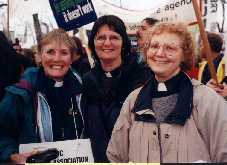
One B.C. member of the Eco-Justice Committee of the Anglican Church of Canada was present at the interfaith service and some of the protests. Margaret Marquardt, the priest of St. Margaret's Anglican Church in Vancouver, expressed grave misgivings about the WTO.
"Many of us were there to raise issues about how economic decicisions are made, and about who gets involved in making these major decisions. I'm very concerned about the environmental codes, labor codes, health care regimes and human rights codes of individual countries. Right now, sovereign nations make decisions about these things; if the WTO keeps heading in the direction it's going, these decisions will be made by multinational corporations, and all these things will be up for grabs."
The actions of the WTO, she said, raised serious questions for Christians.
"How are God's people involved in the decisions that affect our common life? And how do we hold the governing structures of our world accountable to God?"
Marquardt concluded: "As a Christian, my understanding of the gospel includes a focus on Matthew 25, which says that whatever we do for 'the least of these,' we do for Christ. Matthew 25 also applies to the larger world community. Our gospel calls us to be present in our world, to minister to its needs."