
• BC Christian News • JANUARY ISSUE 2000 • VOL. 20 #1 • Formerly "Christian Info News" •
Dead Sea Bible a bestseller
- - - - - - - - - - - - - - - - - - - - - - - - - - - - - - - - - - - - - - - - - - - -
 |
By David F. Dawes
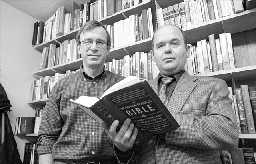
TWO B.C. SCHOLARS are basking in a rare experience: producing a bestseller. In collaboration with an American colleague, they have released The Dead Sea Scrolls Bible, the first English translation of the legendary Qumran biblical manuscripts. The book sold so quickly at its B.C. debut that its Canadian supplier ran out of copies.
The translation, released by HarperCollins Publishers, was produced by three of the most respected scholars in Dead Sea Scrolls (DSS) studies: Trinity Western University (TWU) professors Martin Abegg and Peter Flint, and professor Eugene Ulrich of the University of Notre Dame.
All three have written extensively on the Scrolls. Abegg and Flint are co-directors of the TWU-based Dead Sea Scrolls Institute, which conducts symposiums featuring world-class scholars.
According to the book's editors, the DSS Bible "allows us to read the same Hebrew Bible that Jesus used." Further, the book "shows how closely the old Dead Sea scrolls . . . agree with the Bibles that Christians have been using for centuries." Most significantly, "there are some surprises and differences that were discovered through the translation."
The surprises include previously unknown details about biblical figures; fascinating 'lost' Psalms; and verses missing from almost all other Hebrew manuscripts.
Abegg and Flint were present for the book's official launch, December 1 in Boston. By the second week of December, the first print-run of 20,000 copies had sold out.
When the Canadian launch was held December 8 at the TWU library, the 50 copies on hand sold quickly, and back orders were taken for 150 more. The two scholars were unprepared for the public reaction.
"This is far beyond our imagined hopes. For us, it's rather astounding," says Abegg. Colleague Flint is equally surprised: "We are bowled over by the response. It is stunning."
The book has drawn enthusiastic endorsements from across the theological spectrum, and from other Scrolls scholars.
"This is a book many have been awaiting since the Dead Sea Scrolls were first discovered," says noted evangelical author and scholar N.T. Wright. Harvard professor Frank Moore Cross writes: "Now laymen can judge for themselves whether the biblical manuscripts which predate Christian times differ radically from the received text found, for example in the King James version -- as some scholars claim -- or whether the Qumran texts support the accuracy and conservative character of the received [Masoretic] manuscripts upon which we have always depended." Others endorsing the book include noted Scrolls experts such as Lawrence Schiffman, J.H. Charlesworth, Hershel Shanks and James VanderKam.
Discovery and suppression
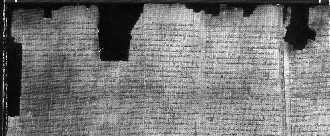
It is no exaggeration to call the Dead Sea Scrolls the archeological discovery of the century. The first texts came to light in 1947, when they were unearthed by a young Bedouin shepherd in clay urns in a cave in the Qumran region of Palestine, not far from the Dead Sea.
Since then, almost 900 manuscripts have been found in 10 other caves, as well as other sites near the Dead Sea, such as the ruins of the fortress at Masada. The majority of the documents survive only in portions; many consist of fragments, which have required painstaking efforts to piece together.
The Scrolls have been the subject of much controversy and irresponsible conjecture. This was largely because access to most of the manuscripts was restricted to a small coterie of scholars, several of whom were Roman Catholic; this gave rise to speculations involving Vatican conspiracies to suppress documents. The truth was far more banal, involving academic jealousy and ambition.
In 1991, Martin Abegg acquired a secret concordance of the Scrolls; he diligently assembled and transcribed the text of various manuscripts, and after a complex series of manoeuvres among various other scholars, all the unpublished texts were released to the public. Since then, the non-biblical scrolls have been translated, and well over two dozen books have been written on the subject.
Essenes
The Scrolls are attributed to the Essenes, an ascetic sect which was as significant to pre-Christian Judaism as the Pharisees and Sadducees. They had a particularly apocalyptic focus, and separated themselves from the Temple in Jerusalem, forming a settlement they called simply 'The Community,' several kilometres from the city.
As Flint stated in a Province interview: "Here were people believing that they were God's community out in the desert, waiting for the end of the world. And when God came with his angels, there'd be a tremendous war. . . They would be the good guys, and God and them would triumph over the wicked Gentiles, and also over the Jews who'd gone astray."
The Essenes' apocalypse came in 68 AD, when The Community was wiped out as part of Rome's campaign to put down the Jewish revolt which began in 66 AD. Some of the Essenes likely fled to Masada, taking several scrolls with them; they may have been among the defenders of the fortress, who died in a suicide pact in 73 AD, three years after the fall of Jerusalem.
Original Jewish Bible?
The standard Old Testament in virtually all modern Bibles is known as the 'Masoretic text,' and is based on scriptures preserved and copied by rabbis from the 1st century AD onward. The most notable repository of the Masoretic text is the Leningrad Codex, which was copied from Hebrew sources in 1008. The Dead Sea Scrolls Bible is based on manuscripts 900 to 1,300 years older than the Leningrad Codex.
The Dead Sea Scrolls, says Abegg, contain "the very earliest manuscripts of the Bible available from anywhere, to anyone." Flint asserts: "The Dead Sea Scrolls Bible is what Jews understood to be the Bible at the time of Jesus."
The only biblical book not included in the DSS Bible is Esther; it was not found at Qumran, indicating that it may not have been considered scripture by The Community.
Apocrypha
On the other hand, the DSS Bible contains Sirach and Tobit; they were evidently regarded as holy scripture by the Essenes. Designated as Apocrypha by Protestants, Tobit and Sirach are considered canonical by the Roman Catholic and Eastern Orthodox churches. They were also included in the Septuagint, the Greek translation of the Hebrew Bible used by the early Christians; but by the 2nd century AD, they had been rejected by rabbinical authorities.
The DSS Bible also features two books rejected as noncanonical by all but one established Christian denomination: 1 Enoch, which is quoted in the Bible's Book of Jude; and Jubilees, which depicts an angel's revelation to Moses. Both feature expanded versions of Genesis material. Enoch also explores God's final judgment of humanity; and it features a messianic 'son of man' figure, prompting speculation that early Christians influenced the writing of 1 Enoch.
New Psalms
Among the previously unknown Psalms and related materials, the DSS Bible features 'Apostrophe to Judah'; 'Hymn to the Creator'; 'Plea for Deliverance'; 'Apostrophe to Zion'; an 'Eschatological Hymn'; and three 'Exorcism Psalms.' The scroll of Jeremiah is 13 percent shorter than the Masoretic version; the Qumran version coincides with the Septuagint.
The new translation features intriguing details, including a description of a demon with horns, and the fact that Goliath was two metres high. More significantly, there are hundreds of 'variant readings': portions of scripture distinctly different from the standard translations. Among the Scrolls are versions of Joshua, Jeremiah and Samuel which feature readings found in the Septuagint, but not in the Masoretic text.
"Variants occur for several reasons," says Abegg. "Often, there are mistakes in copying, which are corrected later. Sometimes, a scribe might accidentally skip a line. It's unlikely they made any deliberate changes."
Jesus foretold?
For Christians, the most significant thing in the DSS Bible is Psalm 22, portions of which are considered prophetic descriptions of Jesus' death. Especially significant is verse 16. The Masoretic text, which was almost certainly composed some time after Jesus' death, reads: "Like a lion are my hands and feet." The DSS version reads: "They have pierced my hands and my feet." This is virtually identical to the wording in the Greek Septuagint, which was produced two centuries before Christ's birth.
Abegg declares: "That Greek text is now backed up by a Hebrew manuscript. What is the better reading -- early Hebrew, or the later Rabbinic version?"
He speculates on why the Jewish scholars did not use the 'pierced' translation. "This may be one example of rabbinic authorities in the 2nd to 4th centuries altering a text for theological purposes -- to take away an argument that Christians were using to verify Calvary."
But there could be a more mundane explanation, he stresses. "It could be a copyist's error. In antiquity, the ways certain Hebrew letters were written could be confusing. The Hebrew words for 'like a lion' and 'they pierced' are almost identical."
Tampering with scripture?
The recovered DSS material has already had some effect on the text of the canonical Bible. A lost verse extolling God has been restored to Psalm 145, and is now in most contemporary Bibles. Also, a few missing verses of 1 Samuel 11, found at Qumran, are now part of the New Revised Standard Bible (NRSV); the 'new' material simply clarifies some details about the reason for the anger of Nahash, the Ammonite king. The NRSV now has 75 variant readings which were discovered in the DSS, and the New International Version has 25. This causes some to ask whether scholars are tampering with the word of God.
Flint responds: "The interesting question is: What is the Bible? Do we just accept Luther's version? The Scrolls are showing us that the Bible grew gradually. The Bible is indeed God's word. But what is becoming clear is that God used the community of faith in the process of determining the canon."
"The Scrolls readings," says Abegg, "are in some cases better than the standard readings; but none of those readings are of the nature that they are going to change anybody's faith or doctrine."
"We don't have to open the canon again," Flint asserts. "What the Scrolls tell us is that we should redefine the Apocrypha to include any scriptures accepted by any legitimate Christian communion." He points out that the books of Enoch and Jubilees are still considered canonical by the Ethiopian Orthodox Church. "I think Enoch and Jubilees should be called Apocrypha, because an ancient Christian communion considers them authoritative."
"In some ways," Abegg concludes, "the canonical process is still going on. In a sense, we're still determining what is truly the word of God; indeed, we have rescued bits and pieces of God's word."
Abegg and Flint will do two more book signings in Vancouver: January 17 at Regent College, and Chapters Bookstore March 16. Their next project will be a scholars' edition of the Isaiah Scroll.