
BCCN: Welcome reminders of swing's glory days
BC Christian News, · Arts
• BC Christian News • JANUARY ISSUE 2000 • VOL. 20 #1 • Formerly "Christian Info News" •
Welcome reminders of swing's glory days
- - - - - - - - - - - - - - - - - - - - - - - - - - - - - - - - - - - - - - - - - - - -
By John Cody
• Benny Goodman: Live at Carnegie Hall, Sony, 1999.
• From Spirituals to Swing, Vanguard, 1999.
• Duke Ellington: Ellington at Newport 1956 (Complete), Columbia/Legacy, 1999.
AS THE swing revival heads into its third year, somewhat abated but still selling, the original acts are enjoying an unprecedented push in the reissue department. Three landmark releases, each previously available on vinyl and compact disc in abbreviated form, have been reformatted with bonus tracks, improved sound and extensive liner notes. Collectively the three make for a crash course in swing music.
Benny Goodman's Live at Carnegie Hall and From Spirituals to Swing were both released long after the original performances (Goodman in 1950, Spirituals in 1959), but the passage of time has done little to diminish the import of either.
Goodman's appearance at Carnegie Hall in January, 1938 was a monumental event. The concert, which marked the first time jazz had been played inside the esteemed hall, cemented swing music's popularity, and Goodman's own reputation as top of the heap.
The new double-disc set includes two previously unissued tracks, a full length (16 minute) version of a jam session featuring Count Basie, and transitions between numbers; in other words, for the first time, the entire concert in real time, plus introductions Goodman recorded in 1950 for the album's original release.
 |
The producers have gone back to the original lacquer masters and, in a controversial move, have refrained from using noise reduction techniques. As a result, pops and clicks are present throughout. But there are also more highs, and the room itself is now part of the mix, resulting in a truer sound than on previous releases. Gene Krupa's drums, in particular, are crystal clear.
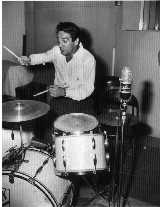
Labelled 'America's Number One Drummer Boy,' Krupa's sterling technique and movie star looks ensured popularity on stage, screen and record. He enjoyed 21 top 30 hits of his own between spring '38 and January '43, when he was arrested in San Francisco on a trumped-up charge of marijuana possession.
Krupa was at the peak of his fame, and the bust was a setup by an overeager DA. In fact, it was Krupa's valet who had the grass, which had been a gift for his boss. Krupa, who rarely partook, instructed the valet, at 17 years old still considered a minor, to get rid of it. Pleading not guilty to a charge of contributing to the delinquency of a minor, he was sentenced to serve one - six years in San Quentin Prison. His band broke up within days of the bust, and Krupa, devastated, feared his performing days were over.
Years later he commented on the incident: "The ridiculous thing was that I was such a boozer I never thought about grass. I'd take grass, and it would put me to sleep. I was an out-and-out lush. Oh, sure, I was mad. But how long can you stay mad? So long you break out in rashes? Besides, the shock of the whole thing probably helped me. I might have gone to much worse things. It brought me back to religion."
Early on in his life he had planned on entering the priesthood, and while that never panned out, he kept close ties to the church, and was actively involved in the later part of his life.
In June 1944 the appellate court of San Francisco reversed the conviction, and he was back, quickly assembling the biggest band he would ever front. Down Beat readers voted him drummer of the year. Soon after, however, the big band era came to an end. Vocalists ruled the charts, and swing was considered old hat, supplanted by bebop.
From Spirituals to Swing was originally a double LP made up of highlights from two Carnegie Hall concerts and a studio session. Twenty-three previously unreleased tracks have been added for this three-CD reissue.
Originally produced by John Hammond, a legendary talent scout credited with discovering Bessie Smith, Billie Holiday, Bob Dylan and a host of others, the first concert was held in December 1938, and was successful enough to warrant a second performance on Christmas Eve the following year. The shows marked a rare occasion when music was performed before an integrated audience.
Hammond was a fierce supporter of civil rights, and had a loose concept of tracing the evolution of African-American music up until that point, with representatives from gospel, blues and jazz. Turned down by a number of sponsors, including the NAACP, Hammond finally found an underwriter in the New Masses, the Communist Party's journal of culture.
There's plenty of gospel, including Sister Rosetta Sharpe, the Golden Gate Quartet, and Mitchell's Christian Singers. Other notable acts include Big Joe Turner, Sonny Terry, and pianists Pete Johnson, Meade Lux Lewis and Albert Ammons. Both shows culminated with a performance by Count Basie and his Orchestra.
Benny Goodman appeared on the '39 show, by which time a number of key players had left the fold, but the replacements, including Charlie Christian on electric guitar and Fletcher Henderson on piano, were every bit as impressive. Goodman had broken the racial barrier long before these shows, adding Lionel Hampton and Teddy Wilson to his band as featured players. In Goodman's case it wasn't so much fighting for civil rights as wanting the best players.
It would take the advent of the Second World War to curb swing's popularity. As musicians were sent overseas, the quality of some acts diminished. After the war, bebop would capture the imagination of the jazz world, and with the exception of a handful of younger bands, the majority of swing acts would trade on old hits, waiting in vain for the swing revival, which would come half a century later than anticipated.
Duke Ellington was in the audience at Carnegie Hall in 1938 to hear Goodman's version of his tune 'Blue Reverie.' Already a major act, Ellington's recording career stretched from the late 1920s until his death in 1973.
Ellington at Newport was the best-selling title from a formidable body of work. Recorded at the Newport Jazz Festival in the summer of '56, almost two decades after the Spirituals and Goodman shows, it captures the sound of swing fully matured. Originally released in '57, the original album contained a handful of live performances. This new edition offers 10 previously unreleased live tracks from the festival.