
BCCN: The witness of the Shroud of Turin
• BC Christian News • JANUARY ISSUE 2000 • VOL. 20 #1 • Formerly "Christian Info News" •
The witness of the Shroud of Turin
- - - - - - - - - - - - - - - - - - - - - - - - - - - - - - - - - - - - - - - - - - - -
By Phillip Wiebe
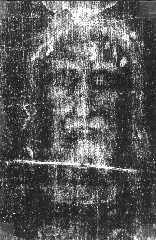
THE SHROUD of Turin still manages to capture the popular imagination, in spite of the fact that carbon dating tests a decade ago convinced many people that it is no older than the 13th century. Public interest in the Shroud noticeably dropped off after the 1988 announcement, which asserted that scientists were '95 percent certain' that the Shroud originated sometime between the years 1260 and 1390.
However, several developments in the last 10 years or so have renewed interest in the possibility that the Shroud was the burial cloth of Jesus Christ. Some of these were presented and discussed at a conference last June, held at the Mary Mother of the Church Abbey in Richmond, Virginia.
In a presentation about the 'Oviedo Cloth,' Mark Guscin offered evidence for the claim that the Shroud dates back to antiquity, rather than medieval times. The Oviedo Cloth exhibits blood spatters in a pattern similar to those found on the head of the man on the Shroud. The history of the Cloth has been documented since the 7th century, and is said to have come to Spain from Jerusalem via North Africa.
The Shroud continues to fascinate, partly because evidences that would establish its origins quite decisively are often tinged with uncertainty. For example, the coins said to be over the eyes of the man on the Shroud are reported to bear the insignia of Pontius Pilate. If proven, this would be impressive grounds for claiming that the Shroud might bear the image of Jesus. However, some Shroud researchers regard what others see as coins as nothing more than a quirk in the weave of the cloth.
The question of how the Shroud of Turin might have been formed still baffles scientists who have examined it. Among its puzzling characteristics are the exceedingly small discolorations that form the image (resembling pointillism in art); the strange reversal of light and dark shades so that the image is best seen by looking at its negative when photographed; its three dimensional character; and the manner in which the bones in the man's hands seem to be visible.
Physicist John Jackson, long associated with Shroud research, has advanced an extraordinary conjecture about its origin. He says that the Shroud seems to have "fallen through" the man that once lay within it. Thaddeus Trenn, physicist and historian of science at the University of Toronto, has developed Jackson's idea in several recent papers -- and also attempts to account for its apparent medieval date.
The Jackson-Trenn hypothesis, as I shall call it, conjectures that the atoms of the body of the man in the Shroud 'broke apart' at the subatomic level. Because the structure of the body disappeared, the Shroud fell through this subatomic material; each particle of the material left its imprint in the form of dots of discoloration (pointillism). The three dimensional effect was produced by the fact that some parts of the body have more mass (for example, areas of dense bone) than others. So when we look at the hands, we seem to see the bones in the man's hands.
The Jackson-Trenn hypothesis suggests a unique event, for nothing similar is thought to have taken place in human history. Although this fact would be sufficient to cause some to set it aside as unscientific, it is testable -- and consequently scientific. Trenn remarks that covering the entire Shroud with film capable of detecting subatomic particles for 24 hours (all encased in lead) would be sufficient.
Whatever the results of research into the Shroud, it has served a unique purpose. The Shroud has kept researchers in numerous fields busy for the last century, especially the last 30 years. Even if it does not bear the image of the Christ, he has used it to keep himself in public view.
-- Phillip Wiebe is director of the Religion, Culture and Ethics program at Trinity Western University.