
BCCN: Chinese diplomat gave Jews 'Visas for Life'
• BC Christian News • FEBRUARY ISSUE 2000 • VOL. 20 #2 • Formerly "Christian Info News" •
Chinese diplomat gave Jews 'Visas for Life'
- - - - - - - - - - - - - - - - - - - - - - - - - - - - - - - - - - - - - - - - - - - -
 |
By David F. Dawes
AN UNSUNG HERO is getting his due in an exhibition at the Chinese Cultural Centre in Vancouver.
'Visas for Life,' running until February 27, tells the dramatic story of Feng Shan Ho, a Chinese diplomat whose Christian principles were a motivating factor in his one-man effort to rescue Austrian Jews from the Nazis.
Ho was born into poverty in 1901, in Yiyang, China. His family received assistance from Norwegian Lutheran missionaries, and Ho was educated in their schools; their example did much to shape his compassionate character. Ho was also greatly influenced by the ethical precepts of Confucianism.
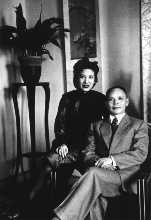 |
After earning a PhD at the University of Munich, he entered the Chinese Foreign Service; in 1937, he was posted to the Chinese Consulate in Vienna. Fluent in German, the new consul general was in demand as a speaker on Chinese culture; he was active in academic and artistic circles, and counted many cultured Jews among his friends.
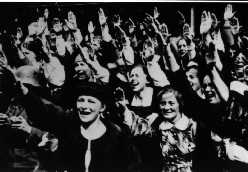
On March 14, 1938, Adolf Hitler paraded through Vienna, celebrating the Anschluss, or annexation, of Austria. Ho was appalled by the reactions of the crowds. "They were shouting and extending their arms in the Nazi salute at mass rallies, with banners waving. The women were especially zealous."
Ho met der Fuhrer soon after, and was less than impressed: "He was a short little man. He had a ridiculous moustache. He was an unspeakable martinet."
The Anschluss provided a catalyst for a vicious explosion of Austrian anti-Semitism, which had been gaining strength in recent years. "At this time," said Ho, "the anti-Jewish campaign intensified. Many Jewish-owned shops were ransacked by Nazis, and their owners deported to concentration camps."
Desperate Jews flooded foreign consulates, but most countries refused assistance. Ho, on the other hand, instituted a 'liberal' visa policy; anyone who applied was given a visa to Shanghai. The Chinese consulate was soon swamped with Jews seeking a way out of Austria.
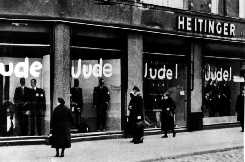 |
Ho's activities put him in some danger, despite his diplomatic immunity. One particularly memorable encounter occurred November 10, 1938, during Kristallnacht, the infamous Night of Broken Glass, when thousands of Jews were arrested, and their stores, workplaces and synagogues vandalized. Ho had provided some Jewish friends with visas to Shanghai, and had come to their home to escort them to the train station. Gestapo agents arrived to search the house and arrest the occupants. One of the Gestapo pulled a gun on Ho; the consul general faced down the threat, and his friends were able to leave safely.
Despite the fact that he was jeopardizing his career, Ho kept issuing visas. When his superiors became aware of his actions, they ordered him to desist; he ignored them, and continued giving visas to Jews. However, just before war broke out in 1939, measures were taken to restrict Jewish entrance into Shanghai. Ho left Vienna in mid-1940, after rescuing thousands of Jews.
After decades of diplomatic service for the Nationalist Chinese government in Taiwan, Ho retired. In later years, he became a founding member of the Chinese Lutheran Church in San Francisco -- a nice irony, considering the Lutheran church's German roots. He published his memoirs, Forty Years of My Diplomatic Life, in 1990; he died in 1997.
Asked to explain his reasons for helping the Jews, Ho once replied: "I thought it only natural to feel compassion and to want to help. From the standpoint of humanity, that is the way it should be."
Visas for Life is part of 'The Righteous Diplomats,' a UNESCO project honoring several dozen diplomats who enabled Jews to escape the Holocaust -- including Christians such as Japan's Chiune Sugihara, and Archbishop Angelo Roncalli (later known as Pope John XXIII). The project will be exhibited at the UN in April.