
BCCN: God sent redemptive signs to Motilones
BC Christian News, · International
• BC Christian News • MARCH ISSUE 2000 • VOL. 20 #3 • Formerly "Christian Info News" •
God sent redemptive signs to Motilones
- - - - - - - - - - - - - - - - - - - - - - - - - - - - - - - - - - - - - - - - - - - -
 |
Veteran missionary Bruce Olsson, author of Bruchko, was one of the featured speakers at Missions Fest 2000, held in Vancouver January 28 - 30. He has spent over 30 years among the Motilone people of Colombia. The following is adapted from an interview with Bernice Gerard.
AS I LIVED with the Motilones in the pristine jungles, I didn't see North American sins apparent among them. According to books about the old-time missionaries who had gone to Africa, they stood up as a bulwark against sin -- and preaching against sin brought conviction.
So I intended to preach to the Motilones against sin -- but they didn't have the Western sins. There was no violence among them, aside from when they fought to protect their environment; if anything, I admired their way of life, and thought: "Here God has a marvellous group of people enveloped in the jungles. Why has he sent a missionary here?"
Years later, I was traveling one day through the jungles with the warriors, after their chief had died. I heard excruciating shouts echoing through the trees, and we deviated off the trail, and found a warrior named Okdubidaina. He had dug a hole six feet deep into the ground, and he was shouting into the hole: "God, come out of the hole and reveal yourself to us! Our chieftain is dead."
Another Indian had climbed the tree. He was praying to God: "Reveal yourself to us. Our chieftain died -- his 'ah' (which means language, and life) has left his body." He was eating the tree's unfolding leaves. He was identifying himself with the life of the new leaf, and the horizon -- the abode of God.
Now I was seeing something different, after living with the Motilones for five years. Jesus commissioned us to go into the whole world to bring the gospel of his resurrection -- of his reunion with the Father. Now I could understand why it was that God's spirit had brought a missionary to the Motilones.
How would I introduce them to Jesus? I had to use the language of the people.
God's trail
There's a legend of a Motilone warrior who was transformed into an ant. And as an ant, he taught the other ants how to build anthills exactly identical to the Motilone community home -- but all in miniature. I took their phrase, meaning 'a warrior incarnate into an ant,' and I wrote the word 'incarnate' into my linguistic data.
Now I faced a challenge. A Motilone was shouting into the hole for God to reveal himself to the community. And so I took this word "incarnate," and I said: "There are many trails that go to the jungles -- the trail of the hunt, the trail of the fish. But there's one trail that goes beyond the horizon, to the abode of God. God is incarnate in human flesh, to walk this trail of life's experiences. We must walk in his footsteps."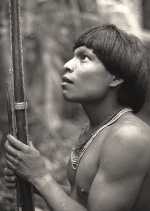
And so Okdubidaina approached me, took my hand, and said: "Do you know God incarnate in human flesh?" I said "I do." And Okdubidaina pulled me towards the jungle, and said: "Take me to his trail, so I can walk in his footsteps."
I had a problem. How do you take a person -- physically in the 20th century, in the jungles of Colombia -- to walk in the trail of God? And I shook off his hand, and I said: "I can't. You killed Jesus Christ." When I said that, they thought Jesus Christ must have been an oil company employee whom they had shot, in their warring years.
Another time, when I was hunting with the Motilone warriors, they killed a deer. A medicine man got a knife, and took the hide off the deer. Then he pulled this hide over his head and down his back, and said: "I have become a deer. You no longer see me." That's a blood sacrifice!
Sin as deception
The Motilone concept of sin is deception. We knew God, but were deceived to leave the horizon -- the abode of God -- generations ago. The spirit that took us away from God deceived us, and disappeared and died -- just like any other warrior. And so I said: "Jesus has pulled his blood over our deception -- our sin. Just as the medicine man pulls the hide of the deer over his head and down his back, and has become a deer, Christ has become sin for us -- and Christ is resurrected from the dead." That last part was hard for them to understand. They had seen no one come back alive after death.
The Motilones have a tonal language. When you hear the winds whispering through the banana patches, there are certain tones -- and the combination of these tones, to the Motilones, brings prophecy. And they have a prophecy involving a banana stalk, through which God would reveal something of his character. Mind-blowing! God had been preparing the Motilones in their own culture, with redemptive signs, for a message that will come. What was this redemptive message?
This was the moment I'd been waiting for. Okdubidaina went into the banana plantation, and cut out a portion of the banana stalk. He brought it into the community home, and cut that banana stalk open lengthwise -- and the severed leaves inside fell out, like pages from a book.
I wanted them to hear that the leaves of the banana stalk were saying: "Jesus is resurrected from the dead." I took my New Testament, and flipped through its 'leaves' and said: "Here, it says Jesus was resurrected from the dead."
Orphans rescued
I didn't see North American sins or hang-ups among the Motilones. So what's the virtue of the gospel experience within the community?
Well, first of all, it's a reconciliation with God the Father. But then I started seeing social changes. I found that orphans were abandoned by the community, because they believed the evil spirits that brought the death of the parents would be visited on an adopting family. So orphans were left to the prey of the jungle. You can imagine the orphan children who have lost their parents, angry against society and community, angry at confronting death in the jungles, or the wild tiger, the dangers that exist, and the hunger.
After the Motilones had received Christ into their community, there was an orphan whose name was Odo. Boborishora, whom we lovingly called Bobby, said: "Since Jesus adopts us into the family of God, this we have learned from the New Testament: 'Whereas we were orphans, Christ adopted us into the family of God,' now we must adopt our orphans back into the community."
So Boborishora adopted Odo into his family. And Odo just melted with love for his new father. So beautiful! And Boborishora, who was the first Christian among the Motilones, became an influential tribal leader because of his compassion, and Odo was his adopted son.
Enemies no more
The Motilones and Yupas were enemies. God spoke to Elrabadoika that he should be a witness of the gospel of Jesus Christ to the Yupas. I was fluent in the Motilone language, and I had a balanced mind, and I was an academic, and so I was going to reason with Elrabadoika: "You can't go to the Yupas, because they are enemies, and they will kill you. We couldn't survive the death of Elrabadoika."
He didn't listen to the missionary, fortunately. He was a leader himself, and he had a revelation from God. He left his bow and arrows on the jungle floor -- and with several warriors, walked up into the higher echelons of the Andes mountains, to the domain of the Yupa.
A year later, Manestowry, the Yupa chieftain, told me this: "Elrabadoika walked into firing distance of our arrows. We had orchestrated an ambush; we would kill the Motilone messenger. He had no bows or arrows with him. He would be our victim." And as Manestowry shouted "Shoot!" the arrows were released from the bows -- but they fell to the earth, dumb. No force. And Elrabadoika then extended his hands, and put them on the shoulders of the chieftain Manestowry, and he said: "We must walk God's trail of life's experience."
Now, among the Yupas, when someone dies, the body is buried in the ground, and one year later the bones are recovered and packed into a bundle. After three days of mourning the death of the loved one, this bundle of bones is tied to the back of the elder daughter. She climbs a mountainside, and walks into a cave where there are thousands of other bundles of bones. And in a ritual, she takes this bundle off her back, and places it inside a cave, and shouts: "God, give life to the dead, dry bones of our deceased relatives!" In other words, they have a prophecy that there will be a resurrection!
So Elrabadoika had his hands on the shoulders of Manestowry, and he said: "The shed blood of Christ will give life to our dead, dry bones. There is a resurrection!"