
BCCN: Mozambique floods can't drown faith and hope
BC Christian News, · International
• BC Christian News • APRIL ISSUE 2000 • VOL. 20 #4 • Formerly "Christian Info News" •
Mozambique floods can't drown faith and hope
- - - - - - - - - - - - - - - - - - - - - - - - - - - - - - - - - - - - - - - - - - - -
 |
By David F. Dawes and Claudia Van Riesen
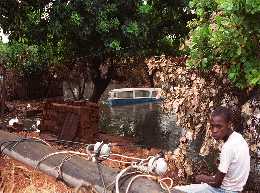
SINCE THE massive flooding in Mozambique last month, Mission Aviation Fellowship (MAF) and World Vision have been on the scene with food, medicine, supplies and workers.
As water levels rose, initial MAF flights plucked people out of the trees, and also provided aerial surveys to determine the extent of the relief effort that would be required.
Canadian pilot Bob Strother of Victoria was one of the first to fly over various devastated towns. "In some places, just the roofs were showing . . . We saw very little dry ground. All land creatures want the dry ground; rats, snakes, lizards and crocodiles were no longer confined to the river. I have images of people waving frantically from the rooftops and patches of dry ground."
"The disaster struck most severely in the Machanga District," said World Vision president Dave Toycen. "First came heavy rains, then floods, followed by Cyclone Eline, and then more rain. The landscape is riddled with fallen trees, destroyed houses and damaged school buildings."
The relief effort is expected to continue for months to come. Bridges, roads and sewage systems have been destroyed. Most flood victims were subsistence farmers who will need relief supplies until new crops can be harvested. The raging waters also relocated thousands of old but still active landmines, posing a formidable threat to the farmers wanting to resettle on their land.
"There are more than a million people homeless," declared Toycen. "The death toll has been estimated at approximately 500 --known deaths, that is. No one knows the exact figures; we expected worse." He cautioned that the devastation may not be over.
"They're talking about the rivers rising again. Also, malaria is endemic; in some areas the infection rate has quadrupled, which especially threatens children. The biggest challenges right now are the food supply, clean water and shelter."
At the hospital in Maputo, Mozambique's capital city, staff had to erect tents to deal with the thousands of cases of malaria, cholera, tuberculosis and other water-borne diseases. There were hundreds of displaced children wondering whether their parents were still alive. It is clear that there will be many orphans needing help long after the floods go away.
MAF workers have seen many dramatic and poignant situations. They encountered one man who had climbed into a tree with his two goats; he refused to be be rescued without them because they represented the total of his worldly possessions. The MAF personnel left him some food and made plans to rescue him later.
A couple fled their home but could not make it through the water to the safety of a tree. They were clinging to life on a termite hill just before one of the rescue boats reached them.
Another man on high ground saw that his neighbours were trapped by rising water. He roped together some logs to make a raft, but the flood swept it away. He built another and, by himself, in one trip after another, he rescued more than 300 people.
Toycen has had his share of memorable encounters. "The flood has made life miserable for the elderly," he asserted. "Altalia Novela is in her seventies and has difficulty walking. She and her disabled husband had been caring for some of their grandchildren, and the family was trapped by rising waters. Altalia wept as she recalled the cries of her husband and the screams of her grandchildren as they were swept away. She can't remember how she managed to grab on to a log; eventually, the log was trapped in a banana tree -- which saved her life. She said: 'I don't understand, but God must have saved me."
Faith has been a crucial factor in sustaining many others affected by the disaster. "People see God in the most challenging situations," said Toycen. "At one camp for displaced people, we encountered a blind man named Isaac Matusse, singing in Portuguese. He had escaped with only his wife and kids, the clothes on his back, and his old, broken-down guitar. He was strumming away, and singing: 'I'll run and go to the Lord Jesus, I'll run and go to the Lord Jesus. Even if I don't have clothes, even if I don't have food, still I will run to the Lord Jesus.' These are not the words of a man who sees faith as a tender sentimentality. They are the words of a man who lost all his family's possessions -- save for the battered guitar --and who finds meaning in the gentle repetition of these words."
Toycen affirmed: "I'm impressed by how many are able to interpret this catastrophe through the eyes of their faith. A number have said it was only by the grace of God that they were saved. I met Dinis Sengulane, the Anglican Bishop of Maputo. He said that a lot of people were so glad that the Lord had spared them -- because there was so much water, they knew God clearly had the power to destroy everyone. He told me: 'Many people would think this has been a hair-raising experience, but in fact, it's been miracle-raising. There have been more expressions of compassion and care for others because of the experience.'
"Even in the midst of misery," Toycen concluded, "there are the rays of hope and the early foundation to build a better future.
Call toll free: Mission Aviation Fellowship at 1-877-351-9344; and World Vision at 1-800-268-5863.