
BCCN: Honouring our spiritual elders: Pastor Bob Birch
BC Christian News, · Top Stories
• BC Christian News • AUGUST ISSUE 2000 • VOL. 20 #8 • Formerly "Christian Info News" •
Honouring our spiritual elders: Pastor Bob Birch
- - - - - - - - - - - - - - - - - - - - - - - - - - - - - - - - - - - - - - - - - - - -
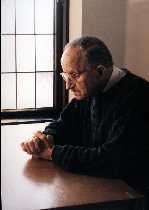 |
Pastor Bob Birch is a spiritual father to many, particularly in charismatic circles. As part of a series of articles honouring our spiritual elders in British Columbia, BCCN spoke to Birch in July. Now 92, Birch's memory is not what it once was. Birch and his wife Margaret have allowed BCCN to use an interview with Paddy Ducklow from November, 1990. For those wishing a more detailed life story, a biography by Beth Carson is scheduled for release later this year.
PD: Tell us about your home and your background, and how it is you became a Christian.
BB: I was the youngest son in the family, born on the prairies . . . The family returned to Ireland, and I was left there with an older sister and finally rejoined the family in North Vancouver. So I always had a sense . . . in my heart, I didn't realize how deep it was, of not feeling that I really belonged anywhere . . .
At 14, I was attending some children's meetings . . . and an old English gentleman was showing some classical paintings of Jesus' life. He showed a picture of Jesus being scourged by the Roman soldiers. I had a sort of a deep physical empathy with him, and I thought that must have really hurt him. The old gentleman said, "He doesn't want your sympathy, he's doing this for you, he wants you to believe him."
I thought, "I never knew that before about God. He took my punishment, I needn't be afraid of him." Something in my boyish heart just responded . . . So I opened my heart, and he came in. Then I went on to high school and to university and got ambitious, and forgot all about that -- and buried it so deep, I didn't even know it was there.
In 1926 I went . . . down to Bellingham to attend a meeting at The Firs. A missionary was speaking on the nobility of a life laid down for him [God]. And I saw the ambitions of my life as vain, and that I had no ambitions for my life other than my selfish ambition, totally built on sand. God again addressed me, and I capitulated to his grace -- total, total grace. And he came in like a flood, air into a vacuum, and I turned around 180 degrees.
PD: Tell us about the event with the car accident . . . and how that was grace to you as well.
BB: I had been a pastor in the Okanagan valley at the Baptist church there . . . It was the time the Lion's Gate bridge was being built. I realized there'd be an influx of population into North Vancouver, and in my ambition . . . I wanted to plant a church. I thought, "we'll get to West Vancouver just as those floods are coming across that new bridge, and we'll plant a church," with lots of ambition and lots of zeal and lots of ignorance -- I think the ignorance was the main quality . . .
And so in Seattle we were driving through with an old model T Ford, and I put my wife and two boys in an autocourt. I went out to get some groceries, and a hit and run driver hit me . . . It took about 12 years to get over that.
God allowed me to go through great devastation of mind and emotion and body, for a number of years. I learned that there's something in me called a spirit, and I determined that I would not turn my spirit away from God, no matter what happened to my body, my emotions, my mind . . . I look back on those years as the most valuable years of my education . . . In the education of my heart, they accomplished a great deal . . . I did try to plant the church for six years, and finally it failed, it went kaput -- and that was God's mercy, too.
PD: Can you tell us a little bit about your early marriage [to his first wife, Dorothy, who died in 1990]?
BB: I'm sure that marriage makes eternal impressions upon us. Romantically we say, but I'm sure that realistically we say, that marriages are made in heaven. And I believe that ours was . . . We were very, very different. We marry our opposites, don't we? My wife was a warm-hearted, good Baptist, with an excellent history of Baptist integrity. I was sort of a wandering Anglican. She knew far more about scripture than I did, and had this great, great integrity. I was sort of this unstable, bib-lical illiterate, but with a hunger in my heart for God.
We got along fine. We got along fine at the very end. But the first 25 years were great. And you think you've got it all made after 25 years. What else can come up after 25 years? But the trouble was the charismatic movement came along after 25 years, and there were fresh manifestations of the Holy Spirit for hungry, unstable people like myself. And so in her excellent, Baptist integrity -- and I think she's hearing this now, and it's in good humour, and I think she'll accept it . . . she found it hard to find out why at St. Margaret's church we were raising our hands and clapping our hands, and doing these silly things that were perfectly childish.
She sought with real integrity, and I sought with integrity. And so we went through the next 15 years with a great struggle, to find out how to relate [to] this whole matter of the Spirit, his dynamics, his effect upon us, our character, our whole church conduct, our concept of power and the kingdom of God. It wasn't easy. I can recall many painful times . . .
One afternoon she was in the hospital, and I was going down . . . to visit her. I've learned to check my day with God to know what he has to say. So I kneeled down at a chair in my office and I simply said "God, if you've got anything to say, I'm listening. If you don't have anything to say special, I'll just go ahead and do what I'm supposed to be doing, going down to the hospital."
He told me to open my Bible, and I didn't know what I was going to read . . . I read this: "Son of man, I'm about to take from you with one blow the delight of your eyes. You're not to mourn, you're not to weep, you can groan silently, but you go on with what I've told you to do." Then I read, "And in the evening, my wife died." . . . I said "Father, is that you?" And that was him. What he was saying in essence was "her work is finished, your work isn't finished, she wants to go, you stay here. Don't waste your time in self-pity. I've got work for you to do, I've a church, I've a bride that I love. I want you to help me love my bride, and present her perfect before me at my coming."
PD: Tell us how you brought St. Margaret's church from a staid and traditional Reformed Episcopal with robes . . . How did you go from there to teenagers with blue jeans and drinking Coke in the aisles?
BB: There are some of those here . . . who will remember those early services at St. Margaret's with the lights turned low in the evening and everybody going to sleep, and the organ groaning away. Me with a clerical collar and a black robe reading a service out of a prayerbook. Well, that's not very charismatic. But my heart was for God . . .
You remember the Jesus Movement, and the Vietnam war, and the whole social revolution going on in universities, and the Jesus people. One day there was a knock on my study door, and I opened the door and there were two girls . . . I was a very square person, they were hippies. They had a sack on their back, and they said "We're going up to Simon Fraser University to witness, and we'd like some church to refer these people to when they come to Christ. Could we refer them to your church?" I don't know why they came to this church. But they came in and took their packs off and got the Bible out, and so I thought "Well, they can't be too far off," so I said yes. I didn't realize what I'd let myself into.
Pretty soon these strange people started to come with long hair and bare feet and all kinds of odours. There got to be a sort of a circuit in those days. It seemed to come from Montreal across Toronto to Vancouver, down to Seattle and back around again. On this circuit, it was known that there was a church in Vancouver you could go to. We turned the hall next door into a hostel, and so they started to come. But when you've got a nice choir, and a liturgical service and you're kind of conducted in an orderly way, the ship starts to rock.
But I had a vision that Jesus was always surrounded by strange people. The religious Pharisees looked down the sides of their noses at this. But I said, "God, just as long as the ship doesn't upset." You can't go very long with a liturgical service and a crowd like that.
I think the climax was one Sunday morning. They had no sense of order, no sense of respect or reverence, they'd sit anywhere in the church, not nicely in the back as I'd hoped they would. They filled the choir seats and everywhere, the place was packed with people. One morning, one guy, I think he had one leg a little shorter than the other, he had a pop bottle in his hand, looked as if he was drunk. He came staggering up to the front, right up the front, right past where I was and sat in the choir seats and I thought "Oh God, how long do I have to put up with this?" And I felt I heard the Spirit say, "You've got to put up with it until it stops bothering you." And so they transformed the whole church . . .
BCCN's Meg Johnstone recently asked Birch if he had anything to add.
MJ: What do you feel God is saying now to the church?
BB: Well, I think those scriptures in Revelation: "Whoever has an ear, let him hear what the Spirit is saying to the church." I think that's basic. The church needs to be sensitive to the Spirit and not become over-involved in its own programs. It's easy to become too involved in our own programs, and then there's no vision. And where there's no vision, the people perish. The church is the body of Jesus Christ, and needs to be sensitive to the head.