
BCCN: Sudanese archbishop brings message of hope
BC Christian News, · International
• BC Christian News • AUGUST ISSUE 2000 • VOL. 20 #8 • Formerly "Christian Info News" •
Sudanese archbishop brings message of hope
- - - - - - - - - - - - - - - - - - - - - - - - - - - - - - - - - - - - - - - - - - - -
 |
By David F. Dawes
FOR SOME Sudanese refugees, the joy of Christ has enabled them to transcend the suffering they have fled.
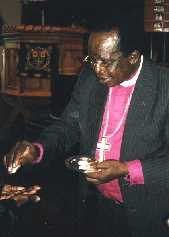
This was made abundantly clear July 9 at Holy Trinity Cathedral in New Westminster, when a Sudanese choir greeted their spiritual leader with several jubilant songs of praise. The occasion was a communion service celebrated by Archbishop Joseph Marona, Primate of the Episcopal (Anglican) Church of Sudan. Marona has been visiting various parts of North America to speak about the current situation in his strife-torn country.
There are an estimated 350 Sudanese expatriates in British Columbia. Marona met with many of them July 8 at St. Barnabas' Church in New Westminster; he also participated in a service at Christ Church Cathedral July 9, and spoke at St. John's Shaughnessy July 11.
At the Holy Trinity service, he spoke words of encouragement. "Your brothers and sisters in Africa live in joy and hope. The name of Jesus Christ is praised forever, every day." He cited 2 Corinthians 4:7-10, stating: "We are troubled, but not in despair; persecuted, but not abandoned; struck down, but not destroyed. We may suffer, but need not be crushed. Let us look to God."
Marona will be returning to a nation which has been ravaged by violence for many years. The current war began in 1983. The National Islamic Front has been in power in Khartoum throughout the conflict.
Human rights activists have accused the government of persecuting both non-Muslims and moderate Muslims; maiming and killing civilians; utilizing chemical weapons; deliberately bombing hospitals, schools and churches; subjecting people to forcible conversions to Islam; and inflicting rape, slavery, prostitution, famine and torture on its opponents. They also claim that the government has displaced millions of people -- and has plundered villages, destroyed harvests, stolen livestock, and poisoned wells. Observers estimate that more than two million Christians and animists have been killed since 1983.
Atrocities
Amnesty International released The Human Price of Oil May 3; the report cites grim examples of what it says are government tactics for clearing out unwanted populations: "Women and children were nailed to trees with iron spikes. Reports . . . claim that soldiers slit the throats of children, and killed male civilians who had been interrogated by hammering nails into their foreheads."
Such claims are affirmed by Cal Bombay of Crossroads, who has been extensively involved in freeing Sudanese slaves. "I have seen the scars of beatings, and looked into the deadened eyes of children ripped from their families' arms . . . It's hard for us to imagine that a seven year old Christian girl would be nailed to a tree with spikes, to die, in the year of our Lord, 2000 . . . I have witnessed the trail of genocide where thousands have been wiped out in the name of Allah -- the compassionate, the merciful!"
Other high-profile Christians have been outspoken in their criticism of Khartoum. Paul Marshall, chair of the Religious Liberty Commission of the Evangelical Fellowship of Canada, contends: "The Sudanese government is engaged in a genocidal war."
Fraser Valley MP Chuck Strahl has also advocated a strong response to the situation, and has stated: "The ethnic cleansing that's going on in the Sudan . . . will go down as one of the biggest atrocities of the second half of the 20th century."
Oil and guns
Many critics of the Khartoum regime say that its extremist interpretation of Islamic sharia law, combined with a hunger for oil revenue, are driving the conflict. One Canadian oil company in particular, Talisman Energy of Calgary, has been the object of increasing scrutiny and scorn in the past several months. Its determination to continue with a major oil project in Sudan has prompted outrage from many quarters -- including some of the company's shareholders.
One of them, Baptist minister Merv Schafer, spoke passionately at Talisman's annual stockholder's meeting May 3: "Mr. chairman, the most relevant thing about this morning's presentation of production and cash flow charts was their colour -- red, blood red . . . How could you blunder into the world's longest-running civil war . . . and strike a deal with one of the world's most unpopular, barbaric, extremist regimes? . . . These are not people to do business with. They should be indicted as war criminals . . . More and more investors and money managers and ordinary citizens are going to find out Talisman shares are stained with blood and carry the stench of death."
The company, it appears, intends to soldier on. At a June 5 symposium, Talisman vice president Jacqueline Sheppard stated: "Our preference is to be there to encourage a common objective of peace, in accordance with our commitment to the Canadian Code of Business Ethics."
Critics insist that such responses will only encourage further depredations by the Sudanese government. According to the Amnesty report: "There is a clear connection between the new-found wealth and the government's ability to purchase arms."
Archbishop Marona confirms this. "The Khartoum government," he told BCCN, "is very happy to have this oil revenue. The danger is that this will encourage them to manufacture guns and munitions, to kill more of the Christians."
At present, he sadly affirms, "Nothing is getting better in Sudan." However, he notes that he will be speaking at a major conference in Khartoum, involving the government, Christian officials and Muslim representatives. "We are looking forward to it. If all goes well at the conference, I am hopeful that things will get better."
He also believes his sojourn with his compatriots has bolstered their hopes. "My visit has been very encouraging to the Sudanese community in the Vancouver area. I've encouraged them to live in peace among themselves -- and to respect themselves, their elders and this country. I've also encouraged them to go to school, to learn and to plan projects well and share ideas."
He concludes: "I want to help them to live with purpose -- so that when they return to Sudan, they will go back with something to help their people."