
BCCN: Playwright praises Pacific Theatre's 'sophisticated staging'
BC Christian News, · Arts
• BC Christian News • NOVEMBER ISSUE 2000 • VOL. 20 #11 • Formerly "Christian Info News" •
Playwright praises Pacific Theatre's 'sophisticated staging'
- - - - - - - - - - - - - - - - - - - - - - - - - - - - - - - - - - - - - - - - - - - -
 |
Sister Calling My Name
Pacific Theatre
By Meg Johnstone
FOR 18 years, Michael has cut himself off from his mentally disabled sister. Recently, Lindsey has begun to paint -- paintings believed to be inspired by God. Now she wants Michael back in her life. But Michael wants nothing to do with his 'broken' sister or her work, which is attracting critical accolades and large sums of money. Lindsey's guardian, Sister Anne, is determined to see this family reconciled.
Pacific Theatre presents the Canadian premiere of New Jersey playwright Buzz McLaughlin's Sister Calling My Name, featuring a stellar cast including Miriam Brown, Katherine Venour and managing artistic director Ron Reed.
McLaughlin conveys gentle insights into the human experience in plays such as Leaving Jane, Traverse des Sioux, Spirit on the Plains, Absent Without Leave and Limits and Wings (a musical adaptation of Aristophanes' The Birds).
McLaughlin's work has won numerous national competitions, including the 1996 National Play Award for Sister Calling My Name. He is the recipient of a Playwriting Fellowship from the New Jersey State Council of the Arts. He is founding director and former artistic director of Playwrights Theatre of New Jersey, a professional theatre dedicated to the development of new plays, and a professor of theatre arts at Drew University, where he teaches playwriting.
BCCN's Meg Johnstone spoke with McLaughlin at the production's opening October 20.
MJ: You came from New Jersey for this Canadian premiere of Sister Calling My Name. Why was it important to you to come?
BM: It's always interesting to see a director's approach to my work. They have their own sense, their own artistry and craft -- they work with the words I write. A director is a sculptor, and takes the words and adds other ingredients of design and makes it his own. I always learn when I see a director's artistic interpretation. That's why I like to catch as many productions as I can.
MJ: Was there a striking difference in how Pacific Theatre handled the material from other companies that have produced Sister?
BM: Pacific Theatre's production was much more fluid with the shifts in time. The director chose to let the shift between the past and present be much fuzzier. There were moments of suspension where the audience is not sure of the shift. Time has actually melted into the past . . .
This production gives credit to the audience that they can figure it out. It requires them to stay with it. It was a very sophisticated staging of the play . . . I think a moment of not really knowing where they were [past or present] is not necessarily a bad thing.
MJ: Was this the first time Sister was produced by a Christian theatre?
BM: Yes. There is a production opening in Orlando by a Christian company next month, however. This play has been produced six times by secular theatres in the States. It had its League of Residence Theaters (LORT) premiere at the Charlotte Repertory Theater which has a 500-seat house. It was a big deal.
Seeing the work Pacific Theatre has done with it here -- there was no difference in the quality of work, the way they attack the work, the discussions about it. They're professional theatre people.
The stigma is that if a production is Christian, for some reason it will be inferior in quality. This is so frustrating, and it's simply not true. Pacific Theatre is a really good example of a professional company, who are a Christian company, but take that for granted; it's just who they are as human beings. They are serious, talented people. The works they choose to produce in one way or another play into their worldview -- but what theatre company doesn't do that?
The danger is when proselytizing enters the picture. That's where the bad reputation comes from . . . There's been some concern that the play will be trashed because of its religious content. Even though it deals with strong elements of Christianity, it's a story well-told first, not proselytizing or preaching.
MJ: Was there a particular portrayal of a character that struck you?
BM: It was pretty even, they were all very good. Katharine [Venour's] portrayal of Lindsey was exceptionally strong. She does careful, controlled, professional work. She captures her humanity and her disability well, without the disability overtaking her humanity. You fall in love with her character.
Ron [Reed] captured Michael's cynicism: the surface, dry, cynical thing hiding his woundedness, covered over with tough-nail denial. He has come the closest to capturing the sense I had in my head when I wrote it. He's very controlled -- but when the emotion cracks through and the dam breaks, he's able to deliver. It's his journey, his play -- Michael's journey and metamorphosis.
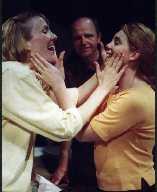
I loved the moment where Lindsey puts her hand on Michael's face and says "God love Michael," and there's this long pause. Everything else is complete for her and she's able to deliver the real gift. People in the audience are wiping their eyes, and I could hear breaths being clutched up all around me. That's a great moment for a writer.
It was a great moment for me to be there in the audience. Nobody knew who I was. I had to apologize to Deb Sears afterwards because when she introduced me, I didn't stand. I was so enjoying my anonymity that I couldn't get myself to get up and accept the accolades.
My applause is when the actors get three long curtain calls. The applause just didn't stop. That's the thrill of being a playwright. You can sit in a darkened theatre with an audience and be invisible. That's especially potent, and one of the reasons I like to see my work. I look around at the audience's faces. That's one of the ways I learn how moments are working. I get better as a playwright when I see my work performed well. Having a feel for what it can be informs my work so much.
MJ: Has the writing of Sister changed as you've watched productions of it?
BM: It has changed . . . After a workshop production at the Playwright's Theater of New Jersey in '95, it was pretty much set. But Morris Ertman has suggested some shifts in some lines. I thought his suggestions were well-presented and I have actually made those shifts and cuts . . . They will be permanent.
Morris is an amazing director. He's really strong and really bright, and knows how to get inside a play and understand its motor, and translate that with actors into actual production. I'm extremely impressed. He makes his living doing it and I can see why. That's not an easy thing to do.
Sister Calling My Name runs until November 18, Wednesdays to Saturdays at 8 pm with 2 pm matinees on Saturdays. Call the Pacific Theatre box office, (604) 731-5518.