
BCCN: Peacemakers 'Getting in the Way' in the Middle East
BC Christian News, · International
• BC Christian News • JANUARY ISSUE 2001 • VOL. 21 #1 • Formerly "Christian Info News" •
Peacemakers 'Getting in the Way' in the Middle East
- - - - - - - - - - - - - - - - - - - - - - - - - - - - - - - - - - - - - - - - - - - -
By David F. Dawes
IN A SAD irony, the 2,000th birthday of Jesus was denied a joyful celebration in the town of his birth. Because of the renewed conflict between Palestinian and Israeli factions, the municipality of Bethlehem -- in the Israeli-occupied West Bank -- cancelled all major Christmas events.
The cancelled events included 'Choirs of the World,' which was to have showcased American, Russian and Ukrainian choirs; a Thirteen Holy Nights program; Christmas eve fireworks; a dove releasing ceremony; and a Christmas Festival which, according to the Jerusalem diocese of the Catholic Church, would have restored "the dignity the town had lost during 30 years of [Israeli] occupation."
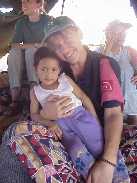
According to the Chicago-based Christian Peacemaker Teams (CPT), the Israeli military have subjected Bethlehem and neighbouring villages to "relentless attacks" and heavy bombardment in recent weeks. In response, CPT sent some of its members to live in Beit Jala, one of the villages under attack. The purpose, according to group member Anita Fast, was to persuade the Israelis to cease their military action in the area.
 |
Fast, who spoke in Vancouver December 6, said such tactics are part of CPT's approach to preventing conflict. The group's motto is 'Getting in the Way,' which refers to both direct non-violent intervention and, as Canadian coordinator Doug Pritchard has said, following "Jesus' way of loving enemies and praying for those who persecute you."
CPT was formed in 1986, and has been involved in many trouble spots, such as Chechnya, Haiti, Bosnia and Chiapas, Mexico. Recently, CPT members intervened in the Native fishing dispute in New Brunswick. The teams are ecumenical, and include Mennonites, Quakers, Catholics and members of Church of the Brethren.
Fast is a Vancouver resident, who attends Point Grey Inter-Mennonite Fellowship. She spends most of her time as a full-time volunteer in the West Bank; there are several other Canadian CPT members currently in the Middle East.
CPT does its work through various means. In some situations, members have literally stood between soldiers and demonstrators. In other cases, as in the Bethlehem area, members put themselves at risk of more drastic violence.
"We sleep in neighbourhoods that are being bombed," said Fast, "and let the military know where we'll be . . . with the hope that Israel will be less likely to bomb a neighbourhood where North Americans are sleeping."
Speaking to the Vancouver Sun , Fast said that the idea for this kind of action was inspired by her stay with a Palestinian family.
"I could hear the breathy push of the missiles as they went through the air," she recalled. "It gave me a first-hand sense of being shelled, especially for children."
Fast spoke just before she and a Jewish activist left for the Middle East. Her colleague, Maxine Kaufman-Lacusta, attends Or Shalom Synagogue in Vancouver; the synagogue's head, David Mivasair, is affiliated with a group called Rabbis for Human Rights, and is currently working with Palestinian peace activists.
"We are determined to reduce violence," Kaufman-Lacusta told the Sun . "We seek a just peace . . . The people in Vancouver synagogues are divided on this. Some think what we're doing is naive. But you know the Jewish saying: 'Two Jews, three opinions.'"
Asked about the obvious danger CPT members are courting, Fast told BCCN : "We don't just see a gun and go stand in front of it. We're not on a suicide mission, and we're not there to be stupid. But if we think it will reduce the potential for violence, then we will stand between those with the guns and unarmed civilians.
"We believe that Christians who accept that the cross is an alternative to the sword must be willing to take similar risks to what soldiers take for war -- but to take them non-violently, on behalf of a just peace. To be a disciple of Jesus is to address injustice and oppression as Jesus did -- and to take seriously his commandment to love our enemies and return good for evil."
CPT members are trained in non-violent direct action techniques, modelled on the traditions of Mahatma Gandhi and Martin Luther King. "Some of it is as simple as learning to use body language to communicate non-violence -- and to de-escalate the tension and fear that often lead to violence."
The group applies this discipline to their everyday lives, she asserted. "We're in a constant process of training ourselves to live a non-violent lifestyle. We live communally, which helps us to learn how to care for one another and to solve conflicts within the team.We begin every morning with worship. We have Bible studies, and we sing together. We live very grounded in our Christian faith and commitment."
Fast said her group works closely with Palestinian Christians, as well as Jewish Israeli peace activists. CPT members, she stressed, have put themselves at risk for both Jews and Palestinians.
"Two years ago, there was a series of bus bombings in Israel. One Jerusalem bus route was targeted every Sunday for two weeks. We decided to publicise the fact that our team would be riding that bus route on the third Sunday; and it was not bombed."
She was candid about CPT's sympathies in the current conflict. "We are not neutral. We don't claim to be neutral. Where there is a situation of oppression and injustice and a misuse of power, we stand with those who have the least amount of power. We are in Hebron to address the violence against the Palestinian people -- mostly in the form of the military occupation. We believe that by doing so, violence against Israelis will also decrease, because the vast majority of the violence that Palestinians partake in is an uprising against the injustices of the military occupation."
Asked about the use of terrorism by some Palestinian groups, she declared: "No one is innocent. No side has a surplus of purity; but we must look at the power imbalance that exists. It's important not to condone the violence of revolt. But in order to stop it, one must address the reason behind it -- which is the depth of loss and suffering that have faced the Palestinian people because of the occupation. Why do we sanction military violence, and then call non-military violence terrorism? They're both a form of terrorism. Indiscriminate bombing of civilian neighbourhoods terrorises an entire population. We cannot then call it worse, or more tragic, when a car is bombed, than when an entire neighbourhood is bombed -- simply because the neighbourhood was bombed by the military, and the car was bombed by an unofficial organization."
The majority of the current violence, Fast contended, "is against Palestinians, in the West Bank and the Gaza Strip -- carried out by the Israeli military and fully-armed Israeli settlers." She expressed skepticism about the Oslo peace process that was begun in 1993. "It wasn't leading into a just peace, but into a system of apartheid similar to South Africa. Essentially, the recent uprising is the Palestinian people saying no to this future."
Regarding the very active support given to Israel by some evangelicals, Fast asserted: "Christians have many reasons -- theological and otherwise -- why they feel sympathy for Israel. However, it is important to distinguish between the Israel of scripture and the modern political state of Israel. Christians need to realise that when they uncritically support the state of Israel, they are supporting great injustice, violence and oppression against Christian and Muslim Palestinians."
She added: "Many Christian Palestinians wonder why many Western Christians are blaming the victims -- and buying tanks for Israel, while ignoring the suffering of their fellow Christians."
One of the key problems, she contended, is the militancy of some of the Jewish settlers. "There are about 300 of the most extreme settlers in Hebron -- which is why part of the city is under full occupation. Often, settlers will start hurling insults or throwing vegetables at Palestinians, and the Palestinians will respond in kind. Then the soldiers step in. Their mandate is to protect the Jewish settlers, even though they know the settlers are the provocateurs. So they'll start shoving the Palestinians."
Fast has a lot of first-hand experience of such confrontations. "One day, we heard a commotion in the market and went to check it out. A group of soldiers were pushing a Palestinian man, who stumbled backwards and fell on the street near to where I was standing. The soldiers continued to come towards him, and I was afraid they would start kicking him. So myself and another team member spontaneously stepped in front of the Palestinian; we each held out one hand toward him and one hand toward the approaching soldiers. We looked the soldiers in the eyes, and said very calmly: 'It's okay, we'll take care of it.' They immediately backed away; they were quite surprised by our presence there, and not sure how to respond.
She said she has been in half a dozen similar situations; so far, she has not been physically injured.
"I have been yelled at, spit at, shoved, and threatened with arrest -- but that's the extent of it. Some CPT people have been beaten up by soldiers; some have been hit by bottles or stones thrown by settlers; one woman was pushed over and dragged down the street by a settler. But no one has sustained any permanent injuries or come close to losing their life."
She concluded: "You can see the importance of having our lives grounded in prayer."
For more information about Christian Peacemaker Teams, contact (312) 455-1199 or www.prairienet.org/cpt