
BCCN: From the steppes of Mongolia to Cambodia's killing fields
BC Christian News, · Mission Fields
• BC Christian News • JANUARY ISSUE 2001 • VOL. 21 #1 • Formerly "Christian Info News" •
From the steppes of Mongolia to Cambodia's killing fields
- - - - - - - - - - - - - - - - - - - - - - - - - - - - - - - - - - - - - - - - - - - -
• Hugh P. Kemp: Steppe By Step, OMF/ Monarch, 2000.
• Don Cormack: Killing Fields, Living Fields, OMF/MARC, 1997.
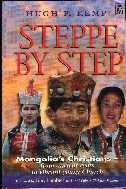
ANYONE WHO thinks books about missionaries are dull should read Steppe By Step and Living Fields, Killing Fields. They are filled with dramatic personal stories and historical insights -- and they're well-written too. Missionary literature has tended to be weakly written and not very self-critical. These books recognize the heroism implicit in the tales they tell, but aren't afraid to point out a few warts either.
Mongolia and Cambodia both provide abundant raw material for these excellent books.
In Steppe By Step, Hugh Kemp points out that Kublai Khan's mother was a Christian, and that Mongolia had several Christian queens. He recounts amazing stories of Nestorian (Orthodox), Catholic and Protestant missionaries who have introduced the gospel to Mongolia with varying degrees of success.
Mongolians look back with pride on Chinggis (Genghis) Khan and his empire; new Christians have been surprised -- and enthused -- to learn that culture of the father of their nation had strong Christian elements.
The book continues to hold one's interest -- in large part because it alternates between historical passages and the author's own experiences with the young church. Kemp describes the dramatic changes which have occurred between the time he first set foot in Mongolia in 1992 and the present. The church has literally been reborn.
From a mere handful of believers, there are now estimated to be between 2,000 and 10,000 Christians in Mongolia. Kemp writes: "While 1990 - 1993 saw expatriates doing the evangelizing, the organizing and the church planting . . . by 1995 the church was taking on a Mongolian face and fewer foreigners were to be seen 'up front.'"
He sees three major challenges facing the Mongolian church:
First, to understand the Mongol Christian church's place in history, right back to the history of the Nestorian Church in the 7th to 11th centuries. Christianity predates the dominant religion, Tibetan Buddhism. Learning how to express their faith in a culturally appropriate way is a key issue.
Second, to play a strategic role in nation-building. Mongolia has been "opening the book" on communism over the past few years. Christians have an opportunity to lead their fellow Mongolians in acts of reconciliation -- following 70 years of atrocities, missing persons and purges.
Third, Tibetan Buddhism has experienced a renaissance alongside Christianity. There will be a spiritual struggle for the soul of the Mongolian people.
It is a shame the book has no index, but the four appendices are very useful. Particularly fascinating is the one describing the various missions which have worked in Mongolia over the centuries, including the Franciscans, who were instrumental in carrying out correspondence between the Pope and the Khans in the 13th century.
Also described are a wide selection of Protestants, from the Moravians, who worked with the Kalmuck Mongols on the Volga River in the 18th century through to the China Inland Mission and later arrivals such as the Brethren, Pentecostals and several Swedish groups. Their work is described in detail throughout the book. The bibliography is excellent as well.
Cambodia's experience of communism was even more devastating than that of Mongolia. The Khmer Rouge massacred as many as two million of their own countrymen, adding the phrase 'the killing fields' to the English language.
Killing Fields, Living Fields tells the story of the church's harrowing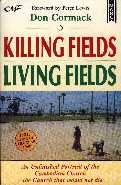 experiences throughout that period, but it also does much more. Cormack starts at the beginning, but unlike Mongolia, there are no mystical links to an earlier Christian community. Cambodia is also Buddhist, although of the Theravada branch, from Sri Lanka.
The country was introduced to Catholicism when the French annexed it in the mid-19th century (the church had attempted to establish itself in the 16th century with little result). Protestant missions began in the 1920s. Cormack traces the slow but steady growth of the church by describing the lives of key individuals.
By 1970 there were still only a few hundred Christians in the whole nation, although they were a committed remnant who had persevered through government suppression and virtual isolation from any outside support. Then came the Khmer Rouge's reign of terror, from 1975 - 1979. The church survived that, as well as civil war until 1991 and continued instability, but it is uncertain how many are now involved.
The real strength of Cormack's impressionistic portrait is his insight into daily life. He spent many years in Cambodia himself, and his writing follows certain individuals and families over a period of decades. We are allowed a glimpse of their daily lives, the reality of their existence under the Khmer Rouge and the terror of overland flights to the Thai border.
With the Khmer Rouge massed around its perimeter, the last days of Phnom Penh must have been both exhilarating and terrifying for Christians. People were flocking to the faith. "Gone now were the platitudes, the social niceties, the easy banter of earlier days. Talk of eternal things was straightforward and undiluted." On the last Sunday before the the city fell (in April 1975), almost 4,000 people squeezed into city churches; all over Cambodia, many thousands were turning to Christ.
Cormack is an evocative writer. To take but one example, he writes of the "pitiful columns of captives" dumped by "Khmer Rouge drovers . . . like great heaps of stinking refuse on Thailand's doorstep . . .
"Very occasionally, one would catch a glimpse of some poignant indication of the human spirit, a reminder that all these filthy ragged bundles were in fact human beings after all. I recall a distraught middle-aged Chinese woman stumbling towards me cradling in her arms the long emaciated body of her totally wasted teenage son. He must have been taller than she was, but he was now very light, just skin and bones. The lad was all that remained of her family. She must have been dragging him around from place to place like this for days . . . The next day he was gone."
There is plenty more in that vein, but the message of the book is one of a realistic hope rather than despair.
Steppe By Step and Killing Fields, Living Fields are actually part of a trilogy of books from OMF. The third is China's Christian Millions (1999), which documents the dramatic growth of the Christian church under China's communist regime. Author Tony Lambert is a former British diplomat to Beijing and Tokyo, now director of Chinese research for OMF International.
He alerts us to what may be the largest revival in world history. Jonathan Lamb, chair of the Keswick Convention, describes the book as "an amazing eye-opener . . . who would have believed that the Chinese Church is shortly destined to become the largest evangelical community in the world." (See here for related stories.)