
BCCN: Women's rights pioneers were rooted in faith
BC Christian News, · Top Stories
• BC Christian News • JANUARY ISSUE 2001 • VOL. 21 #1 • Formerly "Christian Info News" •
Women's rights pioneers were rooted in faith
- - - - - - - - - - - - - - - - - - - - - - - - - - - - - - - - - - - - - - - - - - - -
By David F. Dawes
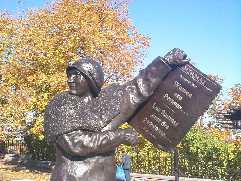 |
'WOMEN are Persons!' proclaims a monument which was recently unveiled on Parliament Hill. It is a set of bronze statues, representing the 'Famous Five,' a group of prominent women's rights activists.
The women, all from Alberta, had roots in various denominations: Henrietta Muir Edwards was a Baptist; Irene Parlby and Emily Murphy were both Anglican; and Nellie McClung and Louise McKinney were United Church members, and were actively involved in the Women's Christian Temperance Union. Their faith was acknowledged at an interfaith service held on the evening before the unveiling ceremony.
Aside from its symbolic significance, the ceremony emphasized the very real progress women have made in Canada. In addition to Prime Minister Jean Chretien, the event was attended by Governor General Adrienne Clarkson; Chief Justice Beverly McLachlin; Canadian Heritage Minister Sheila Copps; MP Hedy Fry; and Senators Joan Cook and Lois Wilson.
The ceremony was held October 18, which is also known as 'Persons Day.'
On that date 71 years before, the Judicial Committee of the British Privy Council made a key ruling regarding Section 24 of the British North America Act. The council declared that the term "qualified persons" included women, and that they were now eligible to become members of the Canadian Senate.
The decision in the 'Person's Case' was the result of a campaign begun in August, 1927, when Murphy persuaded the others to sign a petition requesting an interpretation of Section 24. The petition got to the Supreme Court the following April; the court ruled that the term 'persons' did not apply to women. They appealed to the Privy Council, which was the British Empire's highest court; the Council ruled in the women's favour October 18, 1929.
The ruling, McClung com-mented dryly, "came as a surprise to many women in Canada . . . who had not known that they were not persons until they heard it stated that they were."
The monument, set in the midst of statues of prime ministers and Fathers of Confederation, is the first one on Parliament Hill featuring a depiction of women.
"All Canadians have benefited from the actions of these five women," Copps declared at the ceremony. She referred to the Five as "nation builders," who provided "the catalyst for change which led to the right of every citizen to participate in the formal decision-making bodies of our country."
The monument, she said, "will serve to recognize the contribution of all women to the development of Canada as a great nation."
The installation of the monument was protested by a conservative activist group, REAL Women of Canada. Speaking to ChristianWeek, spokesperson Diane Watts dismissed the significance of the Persons Case as "highly exaggerated," and declared: "Women were recognized as persons before 1929; they held the federal vote, could own and manage property, and enter professions."
She also challenged the heroic status of the Five. Murphy, she said, "wrote material which was racist"; Watts also maintained that four of the women "favoured eugenic sterilization for the mentally and physically unfit."