
BCCN: Messianic Jews test the boundaries of Judaism
BC Christian News, · International
• BC Christian News • FEBRUARY ISSUE 2001 • VOL. 21 #2 • Formerly "Christian Info News" •
Messianic Jews test the boundaries of Judaism
- - - - - - - - - - - - - - - - - - - - - - - - - - - - - - - - - - - - - - - - - - - -
By Flyn Ritchie
• Carol Harris-Shapiro: Messianic Judaism, Beacon, 1999.
• Dan Cohn-Sherbok: Messianic Judaism: Cassell, 2000.
• Ruth A. Tucker: Not Ashamed: The Story of Jews for Jesus, Multnomah, 1999.
• Yaakov Ariel: Evangelizing the Chosen People, North Carolina, 2000.
• Tikva Frymer-Kensky et al, editors: Christianity in Jewish Terms, Westview, 2000.
• Stephen M. Wylen: Settings of Silver: An Introduction to Judaism, Paulist, 2000.
• Jacob Neusner & Alan J. Avery-Peck: The Blackwell Companion to Judaism, Blackwell, 2000.
RABBI Carol Harris-Shapiro opens Messianic Judaism with a traditional joke about a Jewish peddler walking through the wild, dark woods of Russia to his next destination:
"He feared that in such an isolated spot he might meet with bandits or, God forbid, wild beasts! His worst fears were realized when, out of the corner of his eye, he caught a glimpse of a large, dark shape. Whirling around, he saw it -- a bear! He dropped his pack and prepared to run, but then he noticed a funny thing. The bear was wearing a yarmulke! The bear was wearing ritual fringes! And, strangest of all, the bear held a Hebrew book in his paw and appeared to be praying!
"The peddler drew closer to this amazing sight -- a Jewish bear! Could anything be more wonderful? He drew a big sigh of relief, feeling safe. And then he heard what the bear was praying -- the blessing before a meal."
When Harris-Shapiro felt herself drawn to investigate Messianic Judaism, she had to overcome a widely shared fear and disdain for both 'fundamentalist' Christianity and for those from the Jewish community who have chosen to follow Jesus. Messianic Jews, in the eyes of most of the Jewish community, are dressed up, like the bear, to appear Jewish, when in fact they are really evangelical Christians in disguise.
Messianic Judaism is, according to Harris-Shapiro, "a largely American Jewish/Christian movement whose origins can be traced . . . to Hebrew Christian missions to the Jews in the 19th and 20th centuries, the Jesus people of the late 1960s and 1970s, and the resurgence of American Jewish ethnicity during the same decades." She adds that Messianic Jewish congregations are composed "both of those born Jewish who accept Jesus as their saviour and their Gentile supporters who adopt a 'Jewish lifestyle.'"
The radical conclusion of both Messianic Judaism books (Harris-Shapiro's and Dan Cohn-Sherbok's) is that the time has come, scary and distasteful though it might be for some, to accept the movement into the Jewish fold. This process will not be easy.
Harris-Shapiro describes what she felt as she approached her first Messianic synagogue: "I had heard heard so much about this congregation as I was growing up in the Jewish community -- how they brainwashed people, how they conned small children into their facility to be coerced into their religion, how they were deceptive and dangerous . . . despite my intellectual conviction that these stories were ridiculous, I still felt as though I was visiting the bogeyman."
She says the group, "known popularly (but misleadingly) as 'Jews for Jesus,'" have confused modern Jews by combining Christian and Jewish beliefs and cultures. "The one surety for even the most inactive Jew," says Harris Shapiro, "is that 'Jews are not Christians.'" She adds that "the Jewish community has struggled to maintain a distinctive identity under constant threat of assimilation. Although a Jew can be liberal, secular, even Buddhist, these choices do not necessarily lead to losing one's Jewish identity."
She quotes Stuart Charme on why accepting Jesus is different: "To embrace the radioactive core of goyishness -- Jesus -- violates the final taboo of Jewishness and brings immediate condemnation. Belief in Jesus as messiah is not simply a heretical belief, as it may have been in the first century; it has become the equivalent to an act of ethnocultural suicide."
Cohn-Sherbok echoes Harris-Shapiro's portrait of a Jewish community. He points out that Orthodox Jews consider Messianic Jews heretical, as they would any who do not subscribe to their views. But other Jews are no more welcoming. "Even though the adherents of [very disparate] branches of the tradition differ over the most fundamental features of the Jewish religion, even including belief in God, they have joined together in excluding Messianic Judaism from the range of legitimate interpretations of the Jewish heritage."
Harris-Shapiro and Cohn-Sherbok are in agreement that Messianic Jews should be accepted into the Jewish fold. Harris-Shapiro is bemused: "As the American Jewish community looks at Messianic Judaism, we see ourselves as in a carnival funhouse mirror . . . Some of our usual feature have disappeared, others are exaggerated almost beyond recognition. This is not us. And then, just as suddenly, we get an eerie prickle of acknowledgement; yes, this is us, after all . . . The enemy is us."
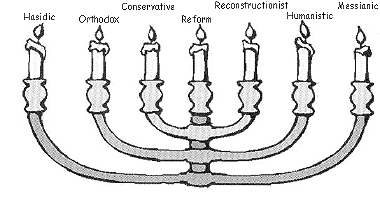
Cohn-Sherbok, a professor of Judaism at the University of Wales, suggests "a new conception of modern Jewish life [which] can best be represented by the image of a seven-branched menorah," with branches for Hasidic, Orthodox,Conservative, Reform, Reconstructionist, Humanistic and Messianic Judaism.
 |
But their blessing is a mixed one. Both demonstrate pluralistic, liberal worldviews. They may represent a new openness to Messianic believers, but they certainly do not yet represent the mainstream of the Jewish community. And the prerequisite for the admittance of Messianic Jews, it seems, has been the remarkable watering down, uncertainty and division of the Jewish community. If Messianic Jews are to be considered full-fledged members of the community, so are groups which do not even accept the existence of God.
Ruth Tucker tells the other side of the story. In Not Ashamed, she has written about Jews for Jesus -- the best known of the new wave of groups devoted to introducing the Jewish people to Jesus Christ.
Tucker, author of an excellent biographical history of Christian missions (From Jerusalem to Irian Jaya, Zondervan, 1983) and several other books, writes about the group's first 25 years, and about its founder, Moishe Rosen.
She describes her first meeting with Rosen as "downright unpleasant." A dominant, if not domineering, individual, he had the chutzpah and strength of will to form Jews for Jesus into an organization which the rest of the Jewish world has been forced to deal with.
Rosen's personality has been stamped on the organization he founded. Jews for Jesus is known for its "somewhat aggressive and forthright style of distributing broadsides," and this style has paid off. Many Jews have been won to Christ; but they have also faced serious attacks, being accused of destroying Jewish culture, using deceptive practices and even of anti-Semitism.
Tucker reports that "The Jews for Jesus staff respond to accusations, psychoanalysis and opposition in general without rancour. They figure, probably rightly so, that the only reason they face organized opposition is the fact that they are making a difference."
J.I. Packer, in one of his patented insightful forewords, succinctly states the purpose of Jews for Jesus. The mission is based on two principles, he says:
"First, Jews who receive Jesus Christ as their Lord and Saviour and who are 'completed' and 'fulfilled' thereby do not need to leave behind their Jewish identity or break with Jewish ways. As Judaizing was not a theological requirement for the first Gentile Christians, so Gentilizing is not a cultural requirement for todays's Jewish believers . . .
"Second, up-front, in-your-face challenge, with as much humour, chutzpah and good will as possible,is the way to approach Jews evangelistically.
"Principle one has to be maintained against official Judaism, which (let us be clear) is a post- and anti-Christian mutation of the Jewish religion that Christ knew. Official Judaism routinely denies that a Jew who becomes a Christian is still a Jew.
"Principle two means moving beyond the cool, low-key evangelistic style that often sets Western Christians apart from, for instance, their more exuberant African and Latin American counterparts."
In Evangelizing the Chosen People, Yaakov Ariel offers the first comprehensive history of Protestant missions to Jews in America, from 1880 to 2000. Basing his work on missionary archives as well as Jewish writings, Ariel analyzes the theology and activities of both the missions and the converts and describes the reactions of the Jewish community, which in turn helped to shape the evangelistic activity directed towards it.
He delineates three successive waves of evangelism. The first was directed toward poor Jewish immigrants, the second toward American-born Jews trying to assimilate and the third toward Jewish baby boomers influenced by the counterculture of the Vietnam War era. He points out that after the World War II, the movement became almost exclusively the realm of evangelicals, as the more liberal wing of the church took the path of interfaith dialogue.
Ariel also wrote On Behalf of Israel: American Fundamentalist Attitude towards Jews, Judaism and Zionism, 1865 - 1945.
Christianity in Jewish Terms does just what the title implies. The editors state: "We believe it is time for Jews to learn about Christianity in Jewish terms: to rediscover the basic categories of rabbinic Judaism and to hear what the basic categories of Christian belief sound like when they are taught in terms of this rabbinic Judaism."
They point out that Jews have traditionally been taught about Christian belief in non-Jewish terms. In Europe, they learned about it "only through the untranslated terms of a Christianity that separated itself from its Jewish roots." Even more recently, they note, "secular European thought often treated Christianity as a universal religion, as opposed to the particularity or 'tribalism' of Judaism."
The book is concerned to "encourage Jews to rediscover the revered place of Judaism among the great religions of the world," and thus is not much interested in considering the claims of Messianic Jews or other Christians who state that Jews must in some way be completed through Jesus Christ to be saved.
Contributor Christopher M. Leighton comments favourably on several mainline denominations such as the Lutheran World Federation, the United Methodist Church and the Presbyterian Church USA which "decry the evils of anti-Semitism and call their churches to a new and constructive engagement with the Jewish people."
But he is also concerned about the Southern Baptist Convention's call to evangelize the Jewish people in the fall of 1999, which he says "signals the enduring grip of Christian triumphalism among many evangelical Protestants."
Christianity in Jewish Terms looks forward to further dialogue, but it is hard to know what they would make of the two Messianic Judaism books, let alone of groups like Jews for Jesus. They may be hoping that it will peter out, however unlikely that seems.
Settings of Silver and The Blackwell Companion to Judaism are good new resources for anyone wanting to learn more about the Jewish faith. It is interesting, however, that they virtually ignore Messianic Jews.
In this second edition of Settings of Silver, Stephen Wylen doesn't mention Jews for Jesus, Chosen People or any of the other Messianic Jewish groups directly. But he does obliquely, noting: "In recent decades some Christian missionary organizations have aggressively targeted Jews without religion, encouraging them to maintain their vestigial Jewish cultural identity while adopting Christianity as their religion. The organized Jewish community feels greatly threatened by this missionary activity because it refuses to acknowledge the integrity of Judaism, and also because it is very difficult to articulate to Christians of good will why Jews feel threatened and oppressed by offers of religious merger."
Wylen also states that "A Jew can respond to the person Jesus of Nazareth, but the doctrine of the Christ was and will remain alien to Jewish religious thought. In response to calls for Jews to find a place for the doctrine of the Christ in their religion, Jews have asked for mutual respect for those differences that are basic to the two religions."
He adds that in much of the world, Jews are "more in danger of being loved to death through assimilation than hated to death through persecution."
It is interesting to note that Settings of Silver is published by Paulist Press, a Catholic publisher. One cannot help but wonder whether Wylen will not have to grapple more fully with the Messianic Jewish movement in the third edition of his work.
in the Companion to Judaism, contributor David R. Carr says "Judaism in the medieval West seems a tree clinging to a cliff . . . Although exiled, reviled, massacred and converted, medieval Jews managed to sustain and create thriving communities and cultures."