
• BC Christian News • MARCH ISSUE 2001 • VOL. 21 #3 • Formerly "Christian Info News" •
Artist engages culture through surreal landscapes
Writer Len Hjalmarson recently interviewed interior artist John Revill for BCCN. The following is a portion of that interview. According to Hjarlmarson, Revill is an artist who defies easy categorization. "The influences on his work are myriad: from ancient Chinese culture to mystical Hindu and contemporary First Nations -- and the creative streams flow together, but are filtered through his own life and faith."
 |
Len Hjalmarson: Where do you get your ideas?
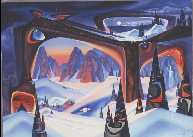
John Revill: Many of my ideas have come to me in dreams. For example, I saw [my] white elephants in a dream and I saw these portals [see photo] in a dream, with worlds within worlds.
LH: Your paintings are very complex, yet at the same time very beautiful and inviting. That strikes me as a quality of truth, and also as a contrast to what we sometimes experience in our Christian sub-culture. Some people dwell in the emotive end of the spectrum and stay superficial, and others in the spiritual heights. Yet both can be in error, a kind of gnosticism that denies the incarnation.
JR: I want to engage culture and I do this primarily through landscape, because there is depth and resonance and texture in the natural world. I see in the reflection of the three dimensional world something higher that can be a place of nourishment. And yet it is free of the cultural baggage we face. It's also a part of the work of Christ and can be a window on hope. In some ways I'm an escapist [laughs].
LH: Earlier we talked about technique, and now we are talking about inspiration. How do you bring discipline and passion together?
JR: That was a struggle. When I started out, I was only interested in the vision and in the exploration. I wanted to say something new about the everyday world. But as I started doing that, I found I didn't have the 'language.' I couldn't communicate what I wanted to say, and came face to face with my lack of a sufficient narrative -- both artistically, with line, colour, form, shape, texture, harmony -- but also in my personal life. Then came a long period of exploring design, where I began to understand the visual language -- and I found I was expressing something mystical and personal in the process. And I realized that God was the author of my own process, and in fact he would often throw a monkey wrench into my preconceptions. I was continually moved into new areas and stretched beyond my expectations.
LH: So somewhere the personal and the transcendent come together and engage culture. You referred to self, church, and world. Are there three circles?
JR: I think of God as a master of double entendre. Wheels within wheels. The fire and white elephants falling in the desert speaks of the Gulf War. As a result of a false narrative or belief all these men fought the West and ended up in a dilemma. In military history the elephant was the tank, and in the Gulf War the tanks were very vulnerable. They had no air cover. We can be the same way. If we aren't covered by God, or if we lose our moorings in faith, things go wrong.
On the personal level, the painting became a diary of my own journey. I was dealing with pride and with my own false narrative. The elephant was an icon and an idol in religious history. On another level was the church. Israel was swallowed up in the desert. But God wasn't after the people, he wanted to purge the idols. In one dream I saw men standing in the fire, and God was the fire. As we got close to the fire it was no longer threatening, because we were no longer attached to our idols.
So my paintings are very didactic. Yet I think they are speaking in a new way, and so [are] more easily heard. I also think they stand on their own as works of art, even when the message is not heard.
LH: How long have you been working on the white elephant painting?
JR: Eight years . . . a little at a time. It has to be a good painting, and it's finished when I have the time. It has to be true to the vision, and that reveals itself over time.
LH: Let's talk about the portal painting. What's happening in this work?
JR: I hadn't painted in a while, and I felt a need to do something imaginative. I asked God to give me something like my current landscape style -- but that also had a sense of an exploration and the supernatural. I saw this painting in a dream in a room with some others. At the time I was spending some time walking in the snow and praying. My desire was to know Christ directly -- not from a book, not from people praying for me, not secondhand.
I was also coming out of some darkness and trying to find the mystery and beauty of the night and the stars and creation. And as I was painting, I noticed what seemed to be the faint image of a head tilted to the side, and I saw a crucifixion there. The waterfall represents finding refreshment and grace and rest. I was very thirsty at this time in my life. The red around the doorway is like the blood over the door-post; it also functions artistically.
The different worlds represent what I wanted to say about Canada and its relationship to God. How does a Christian paint in our time, when most people just want an escape in a landscape? But I'm saying that Christ effaces himself. He gives it all, but doesn't hit us over the head with his presence. He invites us in.