
• BC Christian News • APRIL ISSUE 2001 • VOL. 21 #4 • Formerly "Christian Info News" •
Blind Boys of Alabama still vital and adventurous
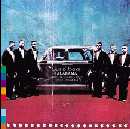
• Blind Boys of Alabama: Spirit of the Century, Real World, 2001.
ORIGINATING at the Talledega Institute for the Blind in 1937, the Blind Boys of Alabama are now in their eighth decade of performing.
They were initially known as the Happy Land Jubilee Singers, but a shared bill in 1948 with another blind group -- the Jackson Harmonies from Mississippi -- brought about the name change. The show's promoter had advertised the performance as a contest between the 'blind boys of Alabama' and the 'blind boys of Mississippi,' and both groups promptly adopted the new monickers. To add to the confusion, the Alabama group have also recorded as 'The Five Blind Boys of Alabama' and 'The Original Five Blind Boys.'
Over the years, the group's membership has fluctuated; but, considering the time span, it has been remarkably consistent, with two founding members -- lead vocalist Clarence Fountain and tenor George Scott -- still on board. Jimmy Carter, a long-time member of the Five Blind Boys of Mississippi, has been with the group for more than a decade.
The group has a reputation for innovation. In the late 1980s, they performed on Broadway -- in the musical The Gospel at Colonus, which reinterpreted classic Greek tragedy in a modern-day Pentecostal setting. The production brought the group before a whole new audience. Fountain comments: "It did a lot for us. We ventured into playing for white audiences; we were trying to reach as many people as we could, and make them understand the gospel."
That sense of inventiveness permeates Spirit of the Century. Producer John Chelew has assembled an exceptional backup band, including: guitarist David Lindley; blues men John Hammond and Charlie Musselwhite; and Richard Thompson's current rhythm section, acoustic bass legend Danny Thompson and drummer Michael Jerome.
The Blind Boys sound entirely at home in such esteemed company, singing in their classic gospel quartet style. Recorded at Capitol Records' Studio B -- where Nat King Cole, Frank Sinatra and others produced some of their finest work during the middle part of the last century -- the sound is sparse. It has a relaxed groove, not entirely in keeping with traditional gospel -- but it works well.
As always, the emphasis is on the gospel. A handful of songs from contemporary writers -- including Tom Waits and Ben Harper -- sit comfortably alongside more traditional fare like 'Amazing Grace' and 'Motherless Children.'
Motherhood, specifically loss of the matriarch, is a recurring theme for the group. Their first hit was 'I Can See Everybody's Mother but I Can't See Mine,' and they've recorded similar titles ever since, including 'Living on Mother's Prayer,' 'Death has Taken Mother Home,' 'Since Mother's Been Gone,' 'Alone and Motherless,' 'Goodbye Mother' and 'When I Lost My Mother.'
Sixty-four years on, the group is making music as vital as any in its lengthy history. It was recorded between recording contracts; once completed, Peter Gabriel's Real World label picked it up. With both parties' reputation for adventurous music, it's a perfect fit.
The Blind Boys of Alabama will be performing at the Vogue Theatre in Vancouver May 11 and in Victoria May 12 at the Royal Theatre and May 13 at the Fort Theatre. Alpha Diallo will open the show.
• Great Men of Gospel, EMI Gospel, 2000.
• Absolutely the Best of Gospel Vols. 1 & 2, Fuel/Varese Sarabande, 2000.
• Praise the Lord -- The Best of Gospel, Fuel/Varese Sarabande, 2000.
Ten acts are featured on Great Men of Gospel. Basically a sampler for EMI's Gospel division, the tracks span 1988 to 1999, with Al Green, BeBe Winans, Rance Allan, Commission and six others. The disc is a bit skimpy, time-wise, with only 10 songs, and hampered by having to draw from recent material -- of which most is on the slick side.
The three Fuel releases are better values. They're as short as the EMI release -- each title offers a dozen tunes -- but the music itself is far more enjoyable, with classic acts like The Staples Singers, Swan Silvertones, Otis Clay, and Aretha Franklin. Packaging is minimal -- Praise the Lord doesn't include liner notes, and none of the titles indicate when or where the material was recorded. But at a budget price, these are worth picking up.
• Happy In the Service of the Lord, Vols. 1 & 2, HMG/Hightone, 2000.
Recorded in 1982-83, volume one in this series was released at that time; but volume two consists of previously unreleased material.
The CDs are part of the Memphis Gospel Quartet Heritage Series, and feature acts which are quite obscure -- especially in this part of the world -- but well worth checking out.
Mostly a capella, the tracks emphasize traditional styles and songs learned through oral tradition, with the newest compositions dating back to the 1920s and '30s. Both discs clock in at close to an hour, and feature excellent packaging, with informative bios and backgrounds.
• Sister Elizabeth Eustis: Walk With Me, Delmark/Festival, 2000.
Sister Elizabeth Eustis was a longtime missionary evangelist. She refused to sing blues material, commenting: "Somebody's always trying to get me to sing blues, because I have the voice for it; but no, indeed -- the blues have no hope. Singing gospel, you have hope, a vision in view that you want to reach other people." Commenting on gospel music's popularity with the general public, she claimed: "It's a good thing, because people who don't go to church will hear a true message."
Her recording career began in 1947, with releases on a number of obscure labels. She worked with many New Orleans jazz musicians, including Dr. John, but always stuck with gospel material. Walk With Me was recorded in 1962 at the Second Mount Olive Baptist Church, backed by piano, organ and bass; only four tracks were released at the time. Nine additional performances are included on this set.
• Horace Clarence Boyer: The Golden Age of Gospel, Illinois, 2000.
An excellent introduction to black gospel music, The Golden Age of Gospel touches on all the important players, and clarifies regional and denominational differences. First published in 1995 as How Sweet the Sound, this paperback edition offers no significant changes; but then again, there was nothing amiss with the original version