
• BC Christian News • APRIL ISSUE 2001 • VOL. 21 #4 • Formerly "Christian Info News" •
| Image not preserved |
Christians make spiritual pilgrimages to India
In the past several months, several Christians from British Columbia have been drawn to India for very different reasons. Following are their personal accounts.
Andhra Pradesh State
Ron Bryson, president of White Rock-based Christ for India:
Every few months, I take a team of west coast pastors, singers and 'senders' (see Romans 10:15) to India, to join up with our full-time 'plant a church a day' indigenous teams.
We arrived deep in Hindu territory -- in the city of Warengel, Andhra Pradesh State -- March 2, for a two-week stay. Every day, we joined the local evangelism team on visits to totally unreached villages. (There are 480,000 of them in India). Our approach is simple: We pull in with our gospel jeep equipped with sound, generator and preachers of the gospel. The preachers start singing, drawing a crowd, and then one of the team starts preaching; many of the listeners accept Christ.
I was very impressed with our team's work in one village. In addition to preaching and having many people accept Christ, they also found someone to open their home for a weekly Bible study. Two members of the team now go back to teach and make disciples every week.
Every night, we conducted an evening crusade in villages where our team had recently established small Bible studies. These villages average 1,200 residents, and we often draw around 1,000 people. The big attraction is that we show a movie afterwards -- the Jesus film, dubbed with Indian dialogue.
In one memorable incident, the very first night, we were holding a meeting where two streets intersect. My daughter Sharon was singing. All of a sudden, the whole left side of the 1,200-person crowd started getting very fidgety, and finally got up to move out of the way -- as a big truck was coming through! Order was never really lost; Sharon actually didn't miss a note. The gospel was preached, and approximately 1,000 accepted Christ.
In this area, as of January 2000, we had only one church. Now we have more than 500 villages evangelized, 200 Bible studies in place and 64 Sunday worship services -- thanks to the diligent work of the teams, and the faithful senders here in Canada.
Indore
Jim Taylor, Okanagan-based author:
I was 10 when [my family] left India . . . Last October, my wife Joan and I went back to the United Church's former mission field, in what was then called Central India. And I received a welcome I didn't deserve.
At the Christian Hospital in Indore, the entire nursing staff, including 60 students, gathered for an assembly for us. They served tea and Indian sweetmeats, and hung garlands around our necks. Because I had been born in that hospital.
At the Indore Christian College, the principal gathered his senior faculty and the chair of the board to meet us, although it was a study week. They walked us around the campus personally. Because my father, Bill Taylor, had taught there . . .
On Sunday morning, we attended [a Hindi worship service] at the church served for years by United Church missionaries, my grandfather among them.
"Welcome back," said Solomon Thorsi as we stood outside after the service, taking my pale hand in both of his. "My grandfather and your grandfather worked together." His grandfather, if I understood him correctly, was my grandfather's gardener and driver. Nevertheless, his grandfather -- and hundreds of others in the Indian church --saw their work as a partnership.
Isaac Khimla, now 84 and one of the few still alive who can remember the missionary era personally, told me about my grandfather. "He always wore a three-piece suit," Khimla recalled, "with a gold watch hung on a gold chain tucked in his waistcoat pocket. When I came in, he would snap his watch open and say, 'Isaac, you're three minutes late.' He taught me punctuality . . ."
To my Western ears, the relationship between missionaries and their Indian co-workers sounds patriarchal. But it was much more than a master-servant relationship. In 1954, Isaac Khimla was in Toronto representing the Church of North India when my grandmother died. Grandpa Taylor invited him to be pallbearer at her funeral. Isaac Khimla still choked up with emotion, almost 50 years later, when he referred to that incident . . .
Many Indian Christians feel that they have been forgotten. Ignored. Abandoned by their former partners. Although I had no official status, they celebrated my return to India, to their homes and churches, as a symbol of renewed connection.
South of Hyderabad
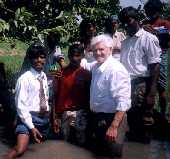 |
Bill Dyck, of Pacific Family Life Counselling in Richmond:
I wanted a fresh vision from God. At 65, I wasn't ready to slow down or retire from being involved in his work. My wife Charlotte and I were praying that God would use us like never before.
That's why I travelled to India with Church Evangelism Partnership, in February. I wanted to see God at work, and I desired to help bring the gospel to a nation of people who would welcome the good news. I've been in ministry for most of my life, but I've never seen anything like I did in India.
For 12 days, with a team of Indian Christians, I spent four days each in three villages south of Hyderabad, going door-to-door with the gospel. The openness was phenomenal, and the results were incredible. Over and over, people responded to a simple gospel presentation -- and most of them prayed a prayer of acceptance.
In one village, while we were sharing the gospel with a group of people, a man on a bicycle joined the crowd and listened intently. Interrupting the scene, the man announced, "If God heals my wife, I'll believe in God."
"God can heal in two ways," I responded through an interpreter. "Directly from prayer, and through medicine. We'll pursue both to try to help your wife."
Content with the display of concern, the man -- a father of eight children, whose wife could barely walk -- finished listening to the gospel presentation. Afterwards, he did not hesitate to pray to receive Christ into his life.
Later, a team member drove the man home to pick up his ailing wife and bring her to the Mennonite Brethren Medical Centre in Jadcherla. The following day, his wife was diagnosed with a calcium deficiency and was promptly given calcium supplements. Undoubtedly, the couple returned home to tell their friends and family what had happened.
As a result of the trip, God has given me a new anointing on my life. I'm excited about how God is moving in India, and I was thrilled to be a part of it. The trip has also strengthened my desire to help Christian couples, both here and in India. My wife and I plan to go to India, to teach marriage and family principles to Bible college students, as well as pastors and their wives, throughout the country.
Kumbh Mela festival
Liane Jagger, an elementary school teacher from Coquitlam, travelled to the Kumbh Mela festival in Allahabad, to participate in intercessory prayer. Held during January and February, the festival attracts an estimated 70 - 80 million people. The key reason the pilgrims come is to participate in a ritual cleansing in the Ganges River, which is believed to provide salvation.
In Allahabad, there was a need to be cautious. Indian secret service personnel had been interviewing people associated with our prayer project. Our team had rented a house from a Christian principal, and he had been arrested and thrown in jail.
The Kumbh Mela was a huge media event, and the police didn't need any international coverage of trouble. The festival has had riots involving sadhus (holy men) and police. Also, pilgrims have been crushed and drowned in the rush to reach the water at the most auspicious time; they do it because they believe they will be free from their accumulated karma if they get into the river when all the planets are aligned.
Another reason for tension was that extremist Hindus had bombed a Muslim temple a few years ago. Not only was the trial going on in Allahabad, but some Hindus were setting up a display of the new temple they intended to build on the site where the Muslim temple had been. We had also been told of 10,000 spies being hired to watch out for tract distribution and evangelism. I was glad that evangelism was not the focus of my involvement.
Altogether, our prayer group consisted of 120 Christians, from 21 countries -- including Indian Christians. We began our prayers by speaking peace to the city. We also prayed for the safety of the pilgrims, and for God's authority over the area.
We prayed for the sadhus -- because we recognized that they were unredeemed pastors, evangelists, apostles, leaders and teachers. We prayed that God would redeem these spiritual warriors through his grace and mercy, and use them for his kingdom and his glory. We prayed that those honestly seeking would find God, because we knew that his faithfulness is for them, too. We prayed that the pilgrims and sadhus would find their true identity in God; we prayed that their pride would be broken, and that they would have a reverence for the living God.
The most memorable occasion was the day before the Hindu pilgrims were to conduct their final key ritual bathing ceremonies. That morning, we had divided into six teams of 10 people each, and walked through the pilgrim sites. Each team brought rose water, representing the fragrance of Christ; oil, for the release of the Holy Spirit; and clean water, for purifying the land for God's use. All the teams used the elements differently. I led a team into the sadhus' camp. We anointed our feet with rose water and oil; it was a reference to Joshua 1 -- signifying that anywhere we walked would be claimed for the Lord. We went to the Varanasi Bridge, which goes to one of the sacred Hindu places; we claimed the bridge as a highway of holiness for God.
In the meantime, our leadership team was out on a sandbar in the middle of the Ganges River, praying for the death of the Saraswati -- the Hindus' supernatural, spiritual river -- and the birth of the River of God. We joined them for a worship service on the sandbar, singing and dancing joyfully. Thankfully, we had no trouble; the sadhus waited respectfully until we finished, and nobody else gave us a bad time.