
• BC Christian News • APRIL ISSUE 2001 • VOL. 21 #4 • Formerly "Christian Info News" •
Vanier helping to create 'places of belonging'
"Whoever wishes to become great among you shall be your servant."
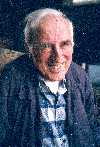 |
No one embodies this line from Mark's gospel more clearly than Jean Vanier, the much-loved advocate for people with disabilities. The philosopher and theologian made several public appearances in British Columbia last month, and also spoke to BC Christian News.
After careers as both a naval officer and academic, Vanier underwent a radical change in 1963, when he discovered the world of people with mental handicaps. He left Canada the following year, establishing his first 'L'Arche' house -- named after Noah's Ark -- in Trosly-Breuil, France. This was the beginning of a worldwide network of interfaith communities -- now comprising 114 locations in 28 countries. Vanier's ministry also includes some 1,300 Faith & Light communities worldwide, which facilitate fellowship between people with disabilities, and their families and friends.
Vanier, a recipient of the Order of Canada, is known for both deep compassion and great eloquence; a good example of both is found in his book, Becoming Human: "I once visited a psychiatric hospital that was a kind of warehouse of human misery. Hundreds of children with severe disabilities were lying, neglected, on their cots. There was a deadly silence. Not one of them was crying. When they realize that nobody cares, that nobody will answer them, children no longer cry. It takes too much energy. We cry out only when there is hope that someone may hear us."
Creating community
Many came to hear March 14, at Vanier's public lecture in Vancouver. The event was co-sponsored by L'Arche, Faith & Light and the Vancouver School of Theology (VST). Speaking to a standing-room-only crowd at St. Andrew's-Wesley, one of the city's largest churches, Vanier expounded on the topic of 'Creating Community in a Divided World.'
He said that, over the years at L'Arche, he has learned that "people with disabilities have incredible gifts." This insight, in turn, has taught him that "each person is precious," and that we are all in the position of "helping to welcome the gift of each person" we encounter.
People, he said, are "all fundamentally the same. [We need] to be seen as precious by someone . . . to feel appreciated and wanted . . . There are so many lonely people -- so many closed up in their own power and their own self-satisfaction."
At L'Arche, he said, "we find people who are normal a rather strange group of people. They're very sad. They don't know how to celebrate." He referred to a visitor's encounter with Jean Claude, one of the happier residents of L'Arche. After Jean Claude left, "Mr. Normal . . . said, 'How sad.' The only thing that was sad was that he was blinded by prejudice. He didn't see his handicap."
He spoke self-effacingly of his earlier careers. "Before I started L'Arche, I was a serious guy. I found it easier to command and teach." People with disabilities, he said, "brought out the child in me," the capacity "to celebrate, to sing, to have fun." After 37 years of living with these people, he said, he learned to understand "my humanity, my brokenness -- but also, about being loved."
Vanier spoke of the emptiness of an overly competitive society riddled with emotional barriers, and stressed "the vital importance of places of belonging . . . where we can rejoice in life together [and] suffer together." How many individuals, he asked, "have to be pushed into depression -- pushed aside -- before we listen to their dreams?"
He asserted that all people have extraordinary potential to counteract destructive forces. "Our treasure is our capacity to give life to people, to give hope."
During a question-and-answer session after the lecture, he referred to the gospel of John, speaking of Christ's first interactions with his followers. "Jesus said to the disciples: 'What are you looking for?' Then, where did he take them? Not to the desert, not to a retreat -- not to VST. He took them to a wedding. We are called to a life of ecstasy. We're called to the wedding feast."
Vulnerability
In a meeting with several reporters from Christian publications, Vanier said he was recently in India, and witnessed the aftermath of the huge earthquake. "I was told that never in the country's history has there been such a spiritual awakening as has happened since the earthquake. The poor are giving their rupees to help the suffering, and recognizing their common humanity. Never before has there been such an awakening to solidarity and unity in India."
This unity, he said, is distinctly lacking in the more affluent areas of the world; rather, fear and prejudice predominate. "We are vulnerable people, living in a difficult world over which we must acknowledge that we have no control. Earthquakes and other disasters suddenly occur to terrify us. We see the great inequality between people, and we feel guilty and hide behind our walls. Then we push ourselves to make our group the best, to comfort ourselves."
Fear and competition, Vanier said, are compounded by relativism. "We don't know what is true and not true." Consequently, he said, "What remains is that I have to win . . . All that is left is to prove that I am the best."
These kind of handicaps, he said, do not afflict people with mental limitations. "I have never seen a person with a mental handicap who does not believe -- and that is because they are people who trust. We, on the other hand, are people of the mind -- who seek power, influence and capacity. When one lives with people who trust, that sort of flows into us; something is born within us that is childlike."
People with handicaps, he continued, "slow us down by taking us away from the mind. You don't talk philosophy and theology to them. In fact, they rarely use the word 'Christ'; they just say 'Jesus.' They talk about Jesus in a simple way. They see him as a friend, and even talk about meeting him when they die. When you talk about the gospel with them, you don't complicate it."
He smiled and recalled an eye-opening moment after a talk, when a mentally disabled young man came up to him and said, "I didn't understand a word you said, but you opened up my spirit!"
Blessing and grace
When asked what had motivated him to accept Christ, Vanier recalled a previous time when a reporter had asked him that question. "I asked him, 'Are you married?' He said 'Yes.' I asked him: 'Why did you accept your wife? Why did you fall in love?' It happens, and you know it's right. It wasn't a calculation. I just knew it was right. It's like when people get married. A moment is there, and they know it's right. The actual event is a blessing and grace which you can't define. It's above reasoning. You know you could say no. But you know this is what you should do now. At one moment I knew -- that I must do it now."
In response to the perception that his work has inspired many people, Vanier was self-deprecating. "I'm not 'doing a good work.' I'm trying to be a Christian. It's people with disabilities who are doing a good work."
He urged other Christians to become more actively involved. "Things would change if our parishes simply became concerned with people in need." He cited an encounter with an atheist -- who had wanted to volunteer at L'Arche, but expressed concern that his lack of faith wouldn't fit into such a Christian endeavour.
"I asked him: 'Do you believe in people with handicaps?' He said 'Yes.' I told him: 'I'd rather have somebody who believes in people with handicaps and who doesn't believe in God, than someone who believes in God and doesn't believe in people with handicaps.'"
For more information about L'Arche Greater Vancouver, contact (604) 435-9544 or
www.larchevancouver.org
With files from The B.C. Catholic.